Within Tunguska
Why Tunguska Left No Crater
The leading explanation is a cosmic body exploding in the air, not a meteorite striking the ground.
On this page
- How an airburst flattens forest
- Why a ground impact did not fit
- Asteroid versus comet explanations
Page outline Jump by section
Introduction
The central mystery of the 1908 Tunguska event is deceptively simple: how could an explosion powerful enough to flatten more than 2,000 square kilometres of Siberian forest leave no obvious crater behind? The answer lies in the leading scientific explanation for the disaster — an atmospheric “airburst”, in which a cosmic body exploded in the sky before reaching the ground. Modern researchers regard Tunguska as the clearest historical example of a large asteroid or comet fragment disintegrating in Earth’s atmosphere and releasing nuclear-scale energy without producing a conventional impact scar. NASA[Encyclopedia Britannica]britannica.comEncyclopedia Britannica Tunguska eventEncyclopedia BritannicaTunguska event | Summary, Cause, & FactsThe Tunguska event was an enormous explosion that occurred at about 7:14 A…
 That missing crater once fuelled speculation about everything from antimatter to alien spacecraft. Yet the absence of a crater is now considered one of the strongest clues to what actually happened. The forest damage pattern, eyewitness accounts, atmospheric effects, and later modelling all point toward a high-altitude explosion rather than a direct ground impact. Tunguska therefore became more than a historical curiosity: it turned into a foundational case for understanding asteroid airbursts and the real-world danger posed by objects too small to trigger civilisation-ending impacts yet large enough to devastate entire regions.[Wikipedia]WikipediaTunguska eventTunguska event[ScienceDirect]sciencedirect.comLow-altitude airbursts and the impact threatby MBE Boslough · 2008 · Cited by 254 — The 1908 Tunguska event in Siberia is th…
How an Airburst Flattens a Forest
An airburst occurs when a meteoroid or small asteroid enters Earth’s atmosphere at enormous speed and experiences catastrophic pressure and heating before reaching the surface. Instead of striking the ground intact, the object fragments and releases most of its kinetic energy in the atmosphere as a blast wave and intense heat pulse.
In the Tunguska case, most estimates place the explosion between roughly 5 and 10 kilometres above the ground.[Encyclopedia Britannica]britannica.comEncyclopedia Britannica Tunguska eventEncyclopedia BritannicaTunguska event | Summary, Cause, & FactsThe Tunguska event was an enormous explosion that occurred at about 7:14 A…[Encyclopedia Britannica]britannica.comEncyclopedia Britannica Tunguska eventEncyclopedia BritannicaTunguska event | Summary, Cause, & FactsThe Tunguska event was an enormous explosion that occurred at about 7:14 A… At those altitudes, the expanding shock wave could still strike the surface with extraordinary force, but the body itself would largely vaporise or fragment into tiny debris.
The mechanics are counterintuitive because people often imagine cosmic impacts as giant craters. Tunguska demonstrated that a sufficiently energetic atmospheric explosion can produce devastation comparable to a major ground impact without excavating a large hole.
Why the Trees Fell in a Radial Pattern
The forest damage became one of the strongest pieces of evidence for an aerial explosion. Investigators found that trees over a huge area had been blown outward from a central zone, forming a radial “butterfly” pattern visible in later aerial surveys.[Wikipedia]WikipediaTunguskaTunguska may refer to: Contents. 1 Places; 2 In arts and entertainment; 3 Other uses; 4 See also. The Tunguska event, a catast…
Even more revealing was the centre of the blast zone. There, many trees remained upright but had been stripped of branches and bark. This odd arrangement puzzled early investigators because a conventional impact might have uprooted or buried everything near ground zero.
The airburst model explains the pattern naturally:
- Directly beneath the explosion, the blast wave travelled downward almost vertically, stripping trees but not necessarily knocking them flat.
- Farther away, the shock wave spread horizontally across the landscape, toppling trees outward from the epicentre.
- The elongated “butterfly” shape suggested the incoming body approached at an angle rather than falling straight down.[Wikipedia]WikipediaTunguska eventTunguska event
Soviet researchers later recreated similar blast geometries using scaled experiments with model forests and explosives. The resulting patterns closely resembled Tunguska’s damage field, strengthening the case for a mid-air detonation.[Wikipedia]WikipediaTunguskaTunguska may refer to: Contents. 1 Places; 2 In arts and entertainment; 3 Other uses; 4 See also. The Tunguska event, a catast…
Why the Explosion Was So Powerful
The destructive force came from velocity more than size. Even a relatively modest asteroid — perhaps 50 to 80 metres across — carries immense kinetic energy when travelling at tens of kilometres per second.[ScienceDirect]sciencedirect.comLow-altitude airbursts and the impact threatby MBE Boslough · 2008 · Cited by 254 — The 1908 Tunguska event in Siberia is th…
As the object plunged deeper into the atmosphere:
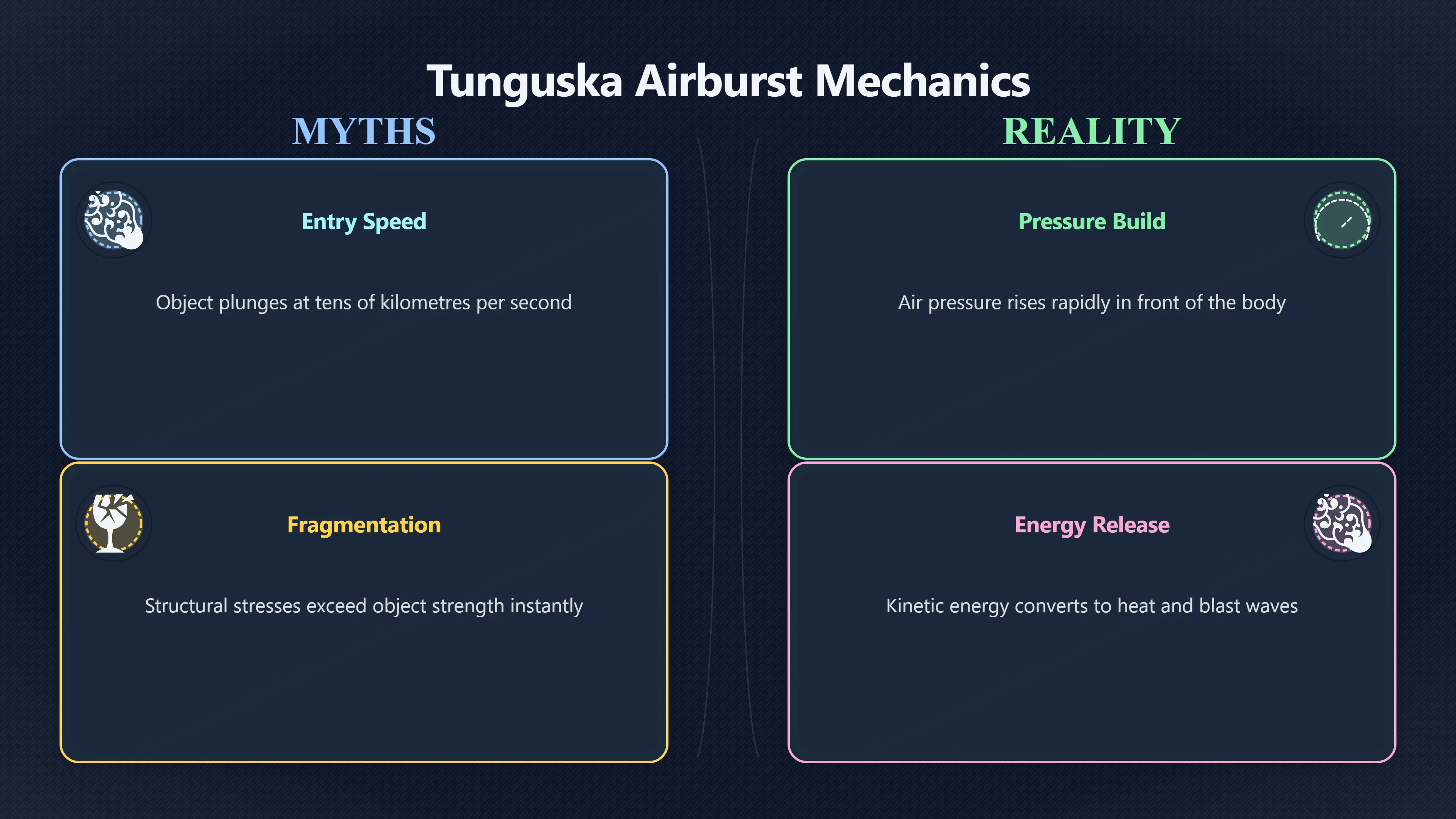
- Air pressure built rapidly in front of it.
- Structural stresses exceeded the object’s strength.
- The body fragmented violently.
- Its kinetic energy converted into heat and shock waves almost instantaneously.
Modern estimates vary, but many studies place the blast in the range of several to perhaps 15 megatons of TNT equivalent, with some higher estimates also proposed.[Wikipedia]WikipediaTunguskaTunguska may refer to: Contents. 1 Places; 2 In arts and entertainment; 3 Other uses; 4 See also. The Tunguska event, a catast…[ScienceDirect]sciencedirect.comProbabilistic assessment of Tunguska-scale asteroid impactsby LF Wheeler · 2019 · Cited by 47 — One can see the optimal burs… Even at the lower end, this was vastly more energetic than the Hiroshima bomb.
Because the explosion happened above the ground, much of the energy spread laterally through the atmosphere instead of excavating deep rock and soil.
Why a Ground Impact Did Not Fit the Evidence
Early investigators expected to find a crater because meteorite impacts were generally understood through examples where large bodies struck the surface directly. Leonid Kulik, who led the first major expeditions in the 1920s, initially searched for exactly that kind of impact scar.[Wikipedia]WikipediaTunguskaTunguska may refer to: Contents. 1 Places; 2 In arts and entertainment; 3 Other uses; 4 See also. The Tunguska event, a catast…
Instead, the landscape contradicted expectations.
The Missing Crater Problem
A conventional impact should have produced several obvious features:
- A substantial crater
- Large meteorite fragments
- Massive ejecta deposits
- Severe excavation of soil and rock
Researchers found none of these in convincing form.[Wikipedia]WikipediaTunguskaTunguska may refer to: Contents. 1 Places; 2 In arts and entertainment; 3 Other uses; 4 See also. The Tunguska event, a catast…
Kulik identified several bogs and depressions that he suspected might be impact craters, but closer inspection undermined those ideas. In one famous case, draining a suspected crater revealed an old tree stump beneath it, proving the hollow predated the 1908 explosion.[Wikipedia]WikipediaTunguskaTunguska may refer to: Contents. 1 Places; 2 In arts and entertainment; 3 Other uses; 4 See also. The Tunguska event, a catast…
This absence gradually shifted scientific opinion away from a classic impact scenario and toward atmospheric detonation.

Why No Large Meteorite Was Recovered
Another long-running puzzle was the lack of substantial meteorite fragments. Yet an airburst again provides the simplest explanation.
If the object fragmented and vaporised high in the atmosphere:
- Most material would disperse as dust and microscopic particles.
- Smaller fragments would decelerate rapidly and scatter widely.
- Any surviving debris might bury itself in swampy taiga or permafrost and remain difficult to identify.
Later expeditions did recover tiny extraterrestrial particles from soil and tree resin, including microscopic silicate and magnetite spheres enriched in nickel, a common meteoritic signature.[Wikipedia]WikipediaTunguskaTunguska may refer to: Contents. 1 Places; 2 In arts and entertainment; 3 Other uses; 4 See also. The Tunguska event, a catast… These findings supported the idea that cosmic material had indeed reached the region, but mostly in dispersed microscopic form rather than as a giant surviving meteorite.
Why the Shock Wave Travelled So Far
The blast was powerful enough to generate atmospheric disturbances detected across Eurasia. Seismic instruments recorded the event, and unusual night skies were reported far from Siberia, possibly due to high-altitude dust and aerosols injected into the atmosphere.[ScienceOpen]scienceopen.comhosted documentImplications for Impact and Airburst Phenomenaby G Kletetschka · 2025 · Cited by 9 — The event released energy equivalent to 1…
This wide reach once encouraged exaggerated theories about impossible energy sources. In reality, a large airburst naturally channels energy efficiently through the atmosphere. Modern comparisons with nuclear blast physics helped scientists understand how such a detonation could flatten forests over enormous distances without carving a giant crater.[Wikipedia]WikipediaTunguskaTunguska may refer to: Contents. 1 Places; 2 In arts and entertainment; 3 Other uses; 4 See also. The Tunguska event, a catast…
Asteroid Versus Comet Explanations
Although the airburst model dominates scientific discussion, debate continues over the nature of the object itself. The main disagreement concerns whether Tunguska was caused by a stony asteroid or a comet-like body rich in ice and volatile material.
The Asteroid Interpretation
Many modern researchers favour a stony asteroid. Several lines of evidence support this view:
- The estimated penetration depth into the atmosphere
- The scale of the blast
- The recovered microscopic mineral particles
- Comparisons with later observed asteroid airbursts such as Chelyabinsk in 2013
NASA and many planetary defence studies now generally describe Tunguska as an asteroid airburst.[NASA]nasa.gov115 years ago the tunguska asteroid impact event115 Years Ago: The Tunguska Asteroid Impact Event13 Feb 2026 — On June 30, 1908, an asteroid plunged into Earth's atmosphere and expl…[ScienceDirect]sciencedirect.comTungusk Meteoritean overviewThe term 'Tunguska Event' refers to a cosmic phenomenon observed on 30 June 1908 in Central Siberia over the Krasnoyarsk Terri…
Asteroids are denser and mechanically stronger than typical comet nuclei, allowing them to survive deeper into the atmosphere before exploding. That fits many reconstructions placing the detonation relatively low above the forest.

The Comet Hypothesis
Other researchers have argued for a comet fragment, especially because so little large debris was recovered. A loosely bound icy body could disintegrate more completely, leaving fewer obvious remnants on the ground.[Encyclopedia Britannica]britannica.comEncyclopedia Britannica Tunguska eventEncyclopedia BritannicaTunguska event | Summary, Cause, & FactsThe Tunguska event was an enormous explosion that occurred at about 7:14 A…[Armagh Observatory and Planetarium]armagh.spacetunguska eventArmagh Observatory and PlanetariumTunguska EventOn the morning of 30 June 1908, a massive explosion shook the sparsely-populated Eastern…
Some proponents also point to unusual atmospheric luminosity reported after the event. Dust and water vapour injected into the upper atmosphere by a cometary object might help explain the bright night skies observed across parts of Europe and Asia in the days following the explosion.
The difficulty is that both asteroid and comet models can reproduce many broad features of the event. The available evidence is incomplete because no large surviving body was recovered.
Fringe Alternatives and Why They Persisted
The missing crater encouraged decades of speculation outside mainstream science. Proposed explanations included:
- Alien spacecraft explosions
- Antimatter annihilation
- Mini black holes
- Secret weapons experiments
- Natural gas eruptions
Most of these theories failed because they could not explain the observed forest pattern, atmospheric trajectory evidence, seismic records, and known behaviour of high-speed cosmic bodies as coherently as the airburst model. The lack of a crater, once seen as anomalous, eventually became evidence in favour of atmospheric detonation rather than against it.[Wikipedia]WikipediaTunguskaTunguska may refer to: Contents. 1 Places; 2 In arts and entertainment; 3 Other uses; 4 See also. The Tunguska event, a catast…
The Lasting Importance of the “No Crater” Mystery
Tunguska changed how scientists think about impact hazards. Before the twentieth century, the public image of cosmic collisions centred on giant craters and extinction-level impacts. Tunguska revealed another category of threat: medium-sized objects capable of exploding in the atmosphere with devastating regional consequences.[ScienceDirect]sciencedirect.comLow-altitude airbursts and the impact threatby MBE Boslough · 2008 · Cited by 254 — The 1908 Tunguska event in Siberia is th…
The 2013 Chelyabinsk meteor over Russia reinforced this lesson on a smaller scale. That object also exploded in the atmosphere, injuring people primarily through shock waves and shattered glass rather than through direct impact. Tunguska represents the same mechanism at much greater energy.[Wikipedia]WikipediaTunguskaTunguska may refer to: Contents. 1 Places; 2 In arts and entertainment; 3 Other uses; 4 See also. The Tunguska event, a catast…
Today, planetary defence planning treats airbursts as a serious hazard precisely because they can occur without warning and without leaving the classic signs people expect from impacts. The “missing crater puzzle” is therefore no longer viewed as a failure to explain Tunguska. It is the key to understanding what the event actually was: a catastrophic atmospheric explosion caused by a cosmic body that largely destroyed itself before ever touching the ground.
Amazon book picks
Further Reading
Books and field guides related to Why Tunguska Left No Crater. Use these as the next step if you want deeper reading beyond the article.
The Tunguska Mystery
Devotes entire sections to analyzing how high-altitude atmospheric disintegration flattens forests without producing an impact crater.
The Skeptics' Guide to the Universe
Explains how the missing crater baseline initially fueled unverified pop theories like antimatter or crashing spaceships.
Impact!
Places the 1908 Siberian devastation into a global perspective of modern planetary defense and metric impact modeling.
Rain Of Iron And Ice
Details why objects under a certain mass threshold predictably collapse into atmospheric airbursts instead of striking the surface.
eBay marketplace picks
Marketplace Samples
Live-tested eBay searches with available results related to this page.




Endnotes
1.
Source: nasa.gov
Title: 115 years ago the tunguska asteroid impact event
Link:https://www.nasa.gov/history/115-years-ago-the-tunguska-asteroid-impact-event/
Source snippet
115 Years Ago: The Tunguska Asteroid Impact Event13 Feb 2026 — On June 30, 1908, an asteroid plunged into Earth's atmosphere and expl...
Published: June 30, 1908
2.
Source: britannica.com
Title: Encyclopedia Britannica Tunguska event
Link:https://www.britannica.com/event/Tunguska-event
Source snippet
Encyclopedia BritannicaTunguska event | Summary, Cause, & FactsThe Tunguska event was an enormous explosion that occurred at about 7:14 A...
3.
Source: britannica.com
Link:https://www.britannica.com/story/what-is-known-and-not-known-about-the-tunguska-event
Source snippet
Encyclopedia BritannicaWhat Is Known (and Not Known) About the Tunguska EventThe explosion likely happened at an altitude of 5–10 km (15...
4.
Source: Wikipedia
Title: Tunguska event
Link:https://en.wikipedia.org/wiki/Tunguska_event
5.
Source: sciencedirect.com
Link:https://www.sciencedirect.com/science/article/abs/pii/S0734743X08001784
Source snippet
Low-altitude airbursts and the impact threatby MBE Boslough · 2008 · Cited by 254 — The 1908 Tunguska event in Siberia is th...
6.
Source: sciencedirect.com
Link:https://www.sciencedirect.com/science/article/pii/S0019103518304676
Source snippet
Probabilistic assessment of Tunguska-scale asteroid impactsby LF Wheeler · 2019 · Cited by 47 — One can see the optimal burs...
7.
Source: ntrs.nasa.gov
Link:https://ntrs.nasa.gov/api/citations/20190002302/downloads/20190002302.pdf
Source snippet
It has...Read more...
8.
Source: scienceopen.com
Title: hosted document
Link:https://www.scienceopen.com/hosted-document?doi=10.14293%2FACI.2025.0001
Source snippet
Implications for Impact and Airburst Phenomenaby G Kletetschka · 2025 · Cited by 9 — The event released energy equivalent to 1...
9.
Source: armagh.space
Title: tunguska event
Link:https://armagh.space/weather/history/tunguska-event
Source snippet
Armagh Observatory and PlanetariumTunguska EventOn the morning of 30 June 1908, a massive explosion shook the sparsely-populated Eastern...
Published: June 1908
10.
Source: britannica.com
Link:https://www.britannica.com/video/video-overview-Tunguska-event/-234276
Source snippet
Hear about the band of dust and...
11.
Source: britannica.com
Link:https://www.britannica.com/place/Tunguska-River
Source snippet
Tunguska River | Tunguska Valley, Siberia, RussiaBecause the object exploded in the atmosphere high above Earth's surface, it created a f...
12.
Source: britannica.com
Link:https://www.britannica.com/facts/Tunguska-event
Source snippet
Tunguska event FactsThe Tunguska event was an enormous explosion that occurred at about 7:14 AM on June 30, 1908, at an altitude of 5–10...
Published: June 30, 1908
13.
Source: science.nasa.gov
Title: a cosmic explosion over siberia 154488
Link:https://science.nasa.gov/earth/earth-observatory/a-cosmic-explosion-over-siberia-154488/
Source snippet
Cosmic Explosion Over SiberiaJun 30, 2025 — On June 30, 1908, an incoming fireball exploded kilometers above Earth's surface, scorching a...
Published: June 30, 1908
14.
Source: nature.com
Link:https://www.nature.com/articles/s41598-021-97778-3
Source snippet
A Tunguska sized airburst destroyed Tall el-Hammam...by TE Bunch · 2021 · Cited by 73 — No contemporary crater has yet been identified...
15.
Source: scienceopen.com
Title: hosted document
Link:https://www.scienceopen.com/hosted-document?doi=10.14293%2FACI.2025.0006
Source snippet
Misunderstandings about the Tunguska airburst event...by G Kletetschka · 2025 · Cited by 1 — This paper presents multiple lines of physi...
16.
Source: Wikipedia
Link:https://en.wikipedia.org/wiki/Tunguska
Source snippet
TunguskaTunguska may refer to: Contents. 1 Places; 2 In arts and entertainment; 3 Other uses; 4 See also. The Tunguska event, a catast...
17.
Source: grantpiperwriting.medium.com
Title: the tunguska asteroid impact event by the numbers 98060f1d0a16
Link:https://grantpiperwriting.medium.com/the-tunguska-asteroid-impact-event-by-the-numbers-98060f1d0a16
Source snippet
Tunguska Asteroid Impact Event By The NumbersThe asteroid seemingly exploded so hard that it vaporized itself and was far enough above th...
18.
Source: sciencedirect.com
Title: Tungusk Meteorite
Link:https://www.sciencedirect.com/topics/earth-and-planetary-sciences/tungusk-meteorite
Source snippet
an overviewThe term 'Tunguska Event' refers to a cosmic phenomenon observed on 30 June 1908 in Central Siberia over the Krasnoyarsk Terri...
Published: June 1908
19.
Source: rmg.co.uk
Title: tunguska event
Link:https://www.rmg.co.uk/stories/space-astronomy/tunguska-event
Source snippet
The Tunguska event explained6 Apr 2023 — Called the 'Tunguska event', an asteroid flashing through our atmosphere on 30 June 1908 explode...
Published: June 1908
20.
Source: youtube.com
Link:https://www.youtube.com/watch?v=F7PX51IeMbU
21.
Source: slideshare.net
Link:https://www.slideshare.net/slideshow/tunguska-event-78888044/78888044
Source snippet
TUNGUSKA EVENT | DOCXThough no crater was found, evidence points to an asteroid or comet exploding 5-10 kilometers above the surface. The...
Additional References
22.
Source: spacedaily.com
Link:https://spacedaily.com/t-in-1908-something-exploded-in-the-sky-over-siberia-with-hundreds-of-times-the-energy-of-the-hiroshima-bomb-flattening-more-than-2000-square-kilometres-of-forest-when-scientists-finally-reached-the/
Source snippet
In 1908, something exploded in the sky over Siberia with...2 days ago — On the morning of 30 June 1908, an object from space exploded ab...
Published: June 1908
23.
Source: usgs.gov
Title: tunguska comet or great siberian mystery explosion 1908
Link:https://www.usgs.gov/publications/tunguska-comet-or-great-siberian-mystery-explosion-1908
Source snippet
The Tunguska comet or the great Siberian mystery...It is dawn on a June morning in Siberia in 1908. The sky is cloudless, but even in su...
24.
Source: newsweek.com
Title: largest impact event recorded history iron asteroid hit earth 1502364
Link:https://www.newsweek.com/largest-impact-event-recorded-history-iron-asteroid-hit-earth-1502364
Source snippet
Largest Impact Event in Recorded History May Have Been...6 May 2020 — While the Tunguska event was the largest impact event in Earth's r...
Published: May 2020
25.
Source: facebook.com
Link:https://www.facebook.com/I.M.O.History89/posts/following-on-from-my-article-on-the-tunguska-event-which-was-likely-an-airburst-/1041332271460946/
Source snippet
Following on from my article on the Tunguska Event, which...But, even without a crater, scientists still categorized it as an impact event...
26.
Source: reddit.com
Title: 1908de sibiryada gökyüzü patladı krateri olmayan
Link:https://www.reddit.com/r/TarihiSeyler/comments/1ob1w0z/1908de_sibiryada_g%C3%B6ky%C3%BCz%C3%BC_patlad%C4%B1_krateri_olmayan/?tl=en
Source snippet
In 1908, the sky exploded in Siberia: A blast without...The estimated power of the explosion was around 15 megatons of TNT — about 1,000...
27.
Source: shop.minimuseum.com
Title: when the sky split in two the tunguska event
Link:https://shop.minimuseum.com/blogs/specimens/when-the-sky-split-in-two-the-tunguska-event?srsltid=AfmBOor8NSceCsu8MXmHL8Jh2dJ9lGjZNbY3g9m20xVhj1ZDNTqOm0MJ
Source snippet
the Sky Split in Two: The Tunguska EventOn the morning of June 30, 1908, in a remote area of eastern Siberia, a strange sight was witness...
Published: June 30, 1908
28.
Source: facebook.com
Link:https://www.facebook.com/IFLScience/posts/it-most-definitely-will-not-be-a-second-tunguska-event/1128615075596275/
Source snippet
igns of a traditional impact, leading scientists to...Read more...
29.
Source: space.com
Title: tunguska meteor impact explained
Link:https://www.space.com/tunguska-meteor-impact-explained.html
Source snippet
Meteor that blasted millions of trees in Siberia only 'grazed'...May 29, 2020 — A mysterious blast in 1908, thought to have been caused...
Published: May 29, 2020
30.
Source: catalina.lpl.arizona.edu
Title: what tunguska event
Link:https://catalina.lpl.arizona.edu/faq/what-tunguska-event
Source snippet
Catalina Sky SurveyOn June 30, 1908 deep in the remote recesses of central Siberia, Russia, and 50-100 meter (150-330 feet) asteroid expl...
Published: June 30, 1908
31.
Source: mensa.org.uk
Title: the tunguska event
Link:https://mensa.org.uk/the-tunguska-event/
Source snippet
16 May 2025 — The Tunguska event, as this phenomenon later became known, remains the largest recorded impact event on Earth – although mu...
Published: May 2025
Topic Tree