Within Flight 105 UFO
Did Flight 105 See UFOs or Misidentified Objects?
Analyzes conventional misidentification theories versus pro-UFO arguments for the Flight 105 sighting.
On this page
- Misidentification possibilities: aircraft, balloons, birds, illusions
- Pro UFO perspectives emphasizing pilot experience
- Evaluation of evidence strengths and weaknesses
Page outline Jump by section
Introduction
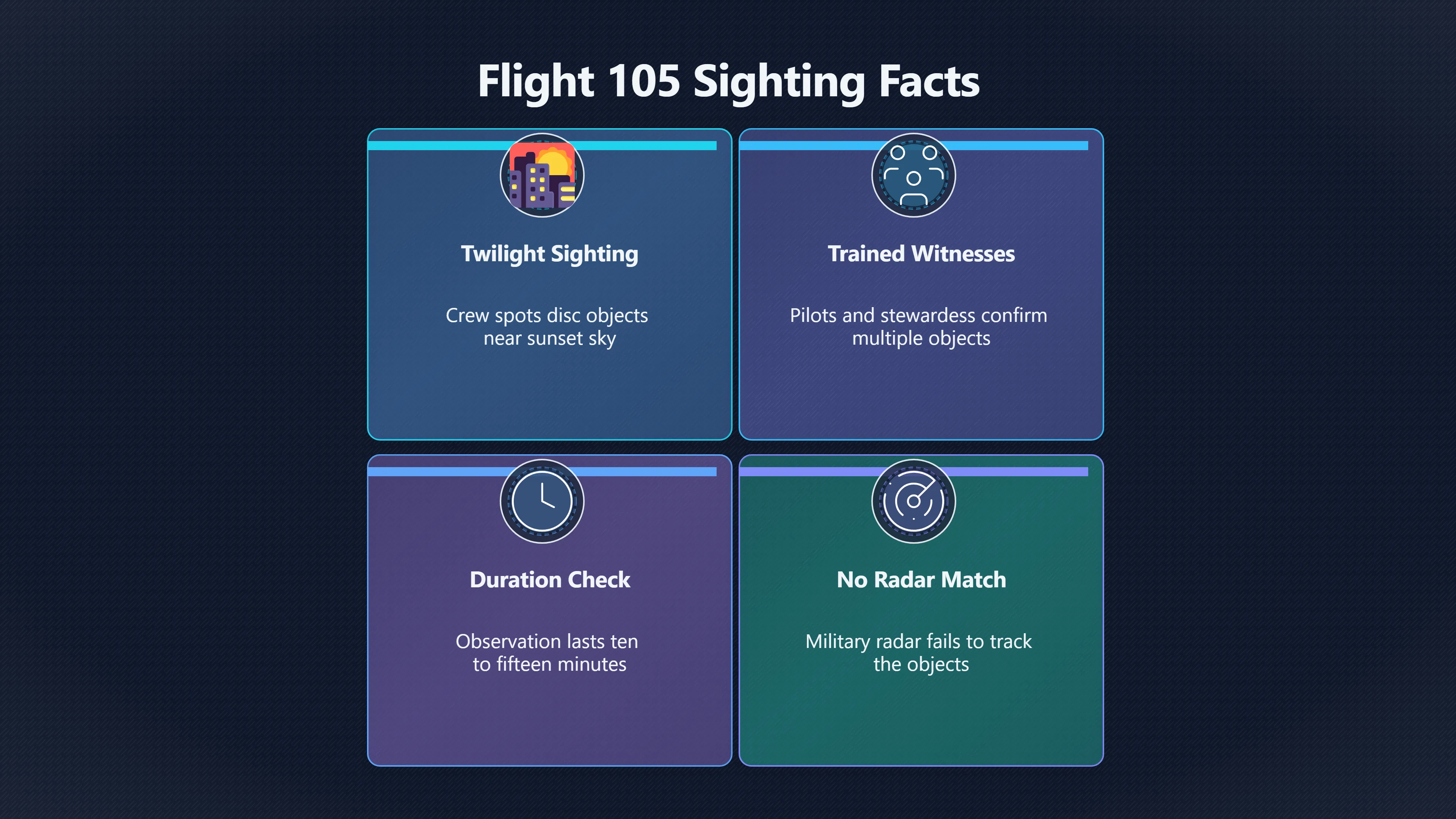
The Flight 105 sighting on 4 July 1947, involving Captain E. J. Smith, First Officer Ralph Stevens and stewardess Marty Morrow aboard a United Airlines DC‑3, is often cited in UFO history because experienced aircrew reported seeing multiple disc‑like objects for several minutes in the twilight sky. While pro‑UFO commentators highlight the professional credentials of the witnesses, official investigations and later sceptical analyses place the incident in a broader context of misidentification, perceptual effects and cultural suggestion. The dispute between extraordinary versus conventional explanations reflects the tensions in early “flying saucer” research: credible observers, ambiguous sensory data, and competing interpretive frameworks.[Wikipedia]WikipediaFlight 105 UFO sightingFlight 105 UFO sighting
Conventional Explanations: Misidentification and Illusory Factors
The lead sceptical interpretation offered by the U.S. military and subsequent writers is that the Flight 105 observations do not require exotic aircraft or non‑terrestrial technologies, and more prosaic factors can produce similar reports even among trained observers.
1. Atmospheric conditions and time of day.
The sighting occurred around sunset, a period when optical illusions are especially common. Twilight lighting can flatten depth cues and distort apparent motion, making distant light sources or ordinary objects seem unusual. The official Air Materiel Command conclusion explicitly referenced sunset effects increasing the likelihood of illusory perception.[Wikipedia]WikipediaFlight 105 UFO sightingFlight 105 UFO sighting
2. Ordinary objects misperceived at distance.
The Air Materiel Command listed several conventional candidates that might account for what was seen: other aircraft, balloons, birds, or “pure illusion.” These possibilities are part of a broader pattern noted by professional UFO investigators and sceptics alike, where atmospheric balloons and other aerial features are frequently misidentified as structured craft in ambiguous conditions.[Wikipedia]WikipediaFlight 105 UFO sightingFlight 105 UFO sighting
3. Limits of visual estimation.
Psychological and perceptual research emphasises that without known references for distance, size and speed, observers cannot reliably judge these parameters. In UFO identification studies, factors such as twilight glare, angular motion without depth cues, and cognitive expectations can produce vivid misperceptions. Sceptical analysts caution that even pilots, trained in aircraft operations, are not expert at identifying unfamiliar aerial phenomena under unusual lighting conditions.[Skeptical Inquirer]skepticalinquirer.orgSkeptical Inquirer UFO Identification Process | Skeptical InquirerSkeptical Inquirer UFO Identification Process | Skeptical Inquirer
Together, these points form the core sceptical response: that pilots can be mistaken in unique conditions, and without corroborating radar or physical evidence, misidentification remains a parsimonious explanation.
Cultural Influence and the “Flying Saucer” Wave
The broader context in which the Flight 105 sighting occurred also feeds sceptical interpretations:
1. Media saturation and suggestion.
The Flight 105 report came just days after Kenneth Arnold’s 24 June 1947 sighting, which had sparked a national “flying saucer” craze. Newspapers across the United States were inundated with similar reports, and public expectation was high. However, the Air Force and later analysts have suggested that the power of suggestion during the craze could influence observers’ interpretations of ambiguous stimuli.[Wikipedia]WikipediaFlight 105 UFO sightingFlight 105 UFO sighting
2. Cultural ripple effects.
Rather than isolated incidents, the Flight 105 sighting occurred amid hundreds of similar claims in 1947. Sceptics note that many of these were later attributed to misperceptions of mundane objects or atmospheric conditions. The pattern of rapidly accumulating sightings following Arnold’s report highlights how social and psychological contexts can shape reports of aerial phenomena.
These cues underscore that the environment of expectation and publicity in summer 1947 contributed to how witnesses and the public understood what was seen.
Pro‑UFO Perspectives and Evidence Limitations
Sceptical interpretations do not go unchallenged. Proponents of the view that something genuinely unusual was observed emphasise several points, even while acknowledging gaps in evidence:
1. Credibility of trained witnesses.
Supporters point out that Captain Smith and First Officer Stevens were trained aviators familiar with aircraft in flight. Their joint observation, coupled with confirmation from a third witness (Morrow), is seen by some as stronger than typical anecdotal reports.[Wikipedia]WikipediaFlight 105 UFO sightingFlight 105 UFO sighting
2. Duration and multiplicity of sightings.
The Flight 105 case involved up to 10–15 minutes of observation across multiple object groups, conditions that some researchers argue make simple misidentification less likely compared to fleeting single‑object reports.[Wikipedia]WikipediaFlight 105 UFO sightingFlight 105 UFO sighting
3. Lack of definitive conventional identification.
Unlike some reports where radar tracks, known aircraft schedules or astronomical data can be matched, the Flight 105 objects were never conclusively matched to specific known phenomena. This absence of a tidy conventional match leaves room for interpretations that the sighting remained genuinely “unidentified” in the strict sense.
Nevertheless, proponents typically acknowledge that unidentified does not necessarily equate to extraterrestrial, but rather that the evidence remains ambiguous.
Weighing Strengths and Weaknesses of Explanations
Assessing the competing interpretations involves weighing the quality of testimony against the likelihood of perceptual error:
- Strength of testimony: multiple witnesses with aviation training lend some weight to the report’s seriousness, compared to many 1947 sightings by untrained civilians.[Wikipedia]WikipediaFlight 105 UFO sightingFlight 105 UFO sighting
- Limits of observational data: without additional corroborating evidence (radar, film, recovered material), visual reports—even from trained observers—are vulnerable to error due to lighting, distance ambiguity and cognitive biases.[Skeptical Inquirer]skepticalinquirer.orgSkeptical Inquirer UFO Identification Process | Skeptical InquirerSkeptical Inquirer UFO Identification Process | Skeptical Inquirer
- Contextual influence: the intense media and cultural focus on “flying saucers” at this moment likely affected both the interpretation and the reception of the sighting, reinforcing experiential expectations.[Wikipedia]WikipediaFlight 105 UFO sightingFlight 105 UFO sighting
In sum, conventional explanations remain viable and widely accepted by sceptical analysts, while pro‑UFO views point to witness credibility and the unresolved nature of the sighting. The Flight 105 case thus sits at the intersection of perceptual science, cultural context and enduring debate over unexplained aerial phenomena.
Amazon book picks
Further Reading
Books and field guides related to Did Flight 105 See UFOs or Misidentified Objects?. Use these as the next step if you want deeper reading beyond the article.
The Report on Unidentified Flying Objects
Reproduces the Air Materiel Command parameters that checked Flight 105 data logs against local air traffic and weather balloon flights.
Ufos and Government
Details the evaluation of evidence strengths and weaknesses conducted by military intelligence units at Wright Field.
Octopus
Presents the case files prioritizing the crew's navigation history as an argument against simple misidentification errors.
The Skeptics' Guide to the Universe
Explains how the national summer wave of 1947 primed witnesses to cluster random visual points into organized disc shapes.
eBay marketplace picks
Marketplace Samples
Example marketplace items related to this page. Use the search link to explore similar finds on eBay.




Endnotes
1.
Source: Wikipedia
Title: Flight 105 UFO sighting
Link:https://en.wikipedia.org/wiki/Flight_105_UFO_sighting
2.
Source: skepticalinquirer.org
Title: Skeptical Inquirer UFO Identification Process | Skeptical Inquirer
Link:https://skepticalinquirer.org/2018/11/ufo-identification-process/
3.
Source: ufo-folkore.fandom.com
Title: E.J. Smith
Link:https://ufo-folkore.fandom.com/wiki/E.J._Smith
Source snippet
Smith | UFO Folkore Wiki | FandomE.J. SMITH Sign in to edit * History * Purge * Talk (0) * United Airlines Capt. E. J. Smith had aerial s...
4.
Source: solvingmauryisland.com
Link:https://www.solvingmauryisland.com/smith
Source snippet
Solving Maury IslandEmil J. Smith was a commercial airlines captain employed by United Airlines who, on July 4th, 1947, had a UFO encount...
Additional References
5.
Source: thinkaboutitdocs.com
Title: 1947 united airlines flight 105 pilots witness disc shaped objects
Link:https://www.thinkaboutitdocs.com/1947-united-airlines-flight-105-pilots-witness-disc-shaped-objects/
Source snippet
1947: United Airlines Flight 105 pilots witness disc-shaped objects – Think AboutIts1947: UNITED AIRLINES FLIGHT 105 PILOTS WITNESS DISC...
6.
Source: nicap.org
Title: Among the more interesting of these cases is a s
Link:https://nicap.org/waves/Wave47Rpt/ReportUFOWave1947_SectionI.htm
Source snippet
Report on UFO Wave of 1947 Section I> > The Air Force files include seven reports from the period of June 28th through the 30th, none of...
7.
Source: newyorker.com
Title: how the pentagon started taking ufos seriously
Link:https://www.newyorker.com/magazine/2021/05/10/how-the-pentagon-started-taking-ufos-seriously
Source snippet
How the Pentagon Started Taking U.F.O.s Seriously | The New YorkerApril 30, 2021 — Within government circles, the issue of how seriously...
Published: April 30, 2021
8.
Source: cufon.org
Title: 20) and by Young (Ref. 21). Next, I
Link:https://www.cufon.org/cufon/mcdon3.htm
Source snippet
New Page 1July 29, 1968 — To close this brief compilation of useful UFO references, two recent commentaries (not primarily source-referen...
Published: July 29, 1968
9.
Source: douglasdc3.com
Title: dc3ufo* * * AIRLINE CREW REPORTS WINGLESS DISCS Boise, Idaho
Link:https://www.douglasdc3.com/dc3ufo/dc3ufo.htm
Source snippet
Rainier sighting by private pilot Kenneth Arnold, a United Air Lines DC-3 crew sighted t...
10.
Source: arewealoneinthisuniverse.fandom.com
Title: Flight 105 UFO sighting
Link:https://arewealoneinthisuniverse.fandom.com/wiki/Flight_105_UFO_sighting
Source snippet
105 UFO sighting | Are_We_Alone Wiki | FandomFLIGHT 105 UFO SIGHTING Sign In to Save Save Edit * History * Purge * Talk (0) iframe On Jul...
11.
Source: ufoinsight.com
Title: 1947 snake river canyon ufo
Link:https://www.ufoinsight.com/ufos/sightings/1947-snake-river-canyon-ufo
Source snippet
INDEPENDENCE DAY, 1947 On the evening of 4^{th} July 1947 at Boise Airport, Captain Emil Smith prepared United Flight...
Published: July 1947
12.
Source: youtube.com
Title: Kenneth Arnold UFO Sighting The First UFOs
Link:https://www.youtube.com/watch?v=xLuHgsXGpqc
Source snippet
Kenneth Arnold and the First UFOs - Jimmy Akin's Mysterious World...
13.
Source: youtube.com
Title: Where Did The Term ‘Flying Saucer’ Come From? | Mossback’s Northwest
Link:https://www.youtube.com/watch?v=ap0whDDDU1Y
Source snippet
Before Roswell - The Eerie Tale of Maury Island (with Dean Bertram)...
14.
Source: youtube.com
Title: Kenneth Arnold and the First UFOs
Link:https://www.youtube.com/watch?v=qdXNAOxs6mo
Source snippet
Where Did The Term 'Flying Saucer' Come From? | Mossback's Northwest...
Topic Tree