Within Tombaugh Sighting
How a Faint Sighting Became a UFO Ship
The famous magazine version turned a faint formation into a more dramatic craft story, changing how many readers remembered the case.
On this page
- What the 1952 magazine version claimed
- The errors Menzel and Boyd identified
- Why retellings changed the evidential weight
Page outline Jump by section
Introduction
The Clyde Tombaugh sighting became more famous after a widely read 1952 article in Life magazine helped turn it from a brief report of faint lights into a much more dramatic “flying saucer” narrative. That shift mattered because Tombaugh was not an ordinary witness: he was the astronomer who discovered Pluto, and his reputation gave the story unusual authority. Yet the popular version that many readers remembered differed significantly from Tombaugh’s own restrained description. Later critics, especially astronomer Donald H. Menzel and researcher Lyle G. Boyd, argued that the magazine account amplified the apparent evidential strength of the case by exaggerating brightness, structure, and certainty.[Project Gutenberg]gutenberg.orgProject GutenbergThe World of Flying Saucers, by Donald H. Menzel…A scientific examination of a major myth of the space age. Donald H….
 The episode became an important example in UFO history because it showed how retellings could gradually transform an ambiguous sighting into apparent evidence for extraterrestrial craft. In the Tombaugh case, the gap between the original testimony and the later popular image is unusually well documented.
What the 1952 magazine version claimed
The key popularisation came during the early 1950s UFO boom, when Life magazine published “Have We Visitors From Space?” — one of the most influential flying-saucer articles of the era. The article treated some UFO reports sympathetically and helped push the extraterrestrial interpretation into mainstream public discussion.[Wikipedia]WikipediaHave We Visitors From Space?Have We Visitors From Space?
Within that atmosphere, Tombaugh’s observation was presented less as a fleeting and uncertain visual event and more as evidence that a trained astronomer had seen a structured aerial object. The retelling encouraged readers to think of a coherent craft moving across the sky rather than a dim formation of lights seen for only a few seconds.
That distinction is crucial. Tombaugh’s own account described:
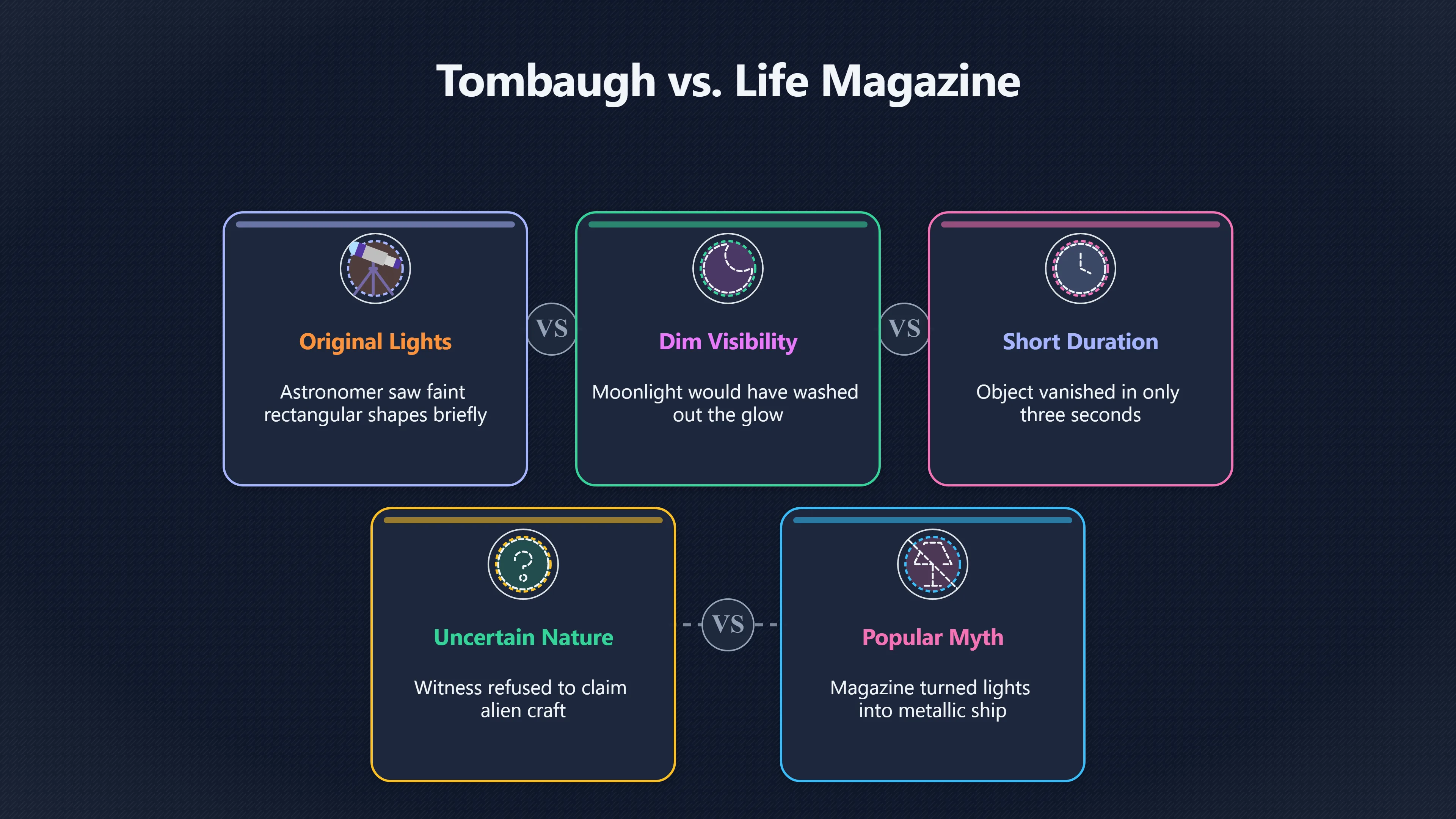
- a brief formation of faint rectangular lights;
- visibility under exceptionally dark sky conditions;
- no clearly outlined solid body;
- a duration of only a few seconds;
- uncertainty about what the phenomenon actually was.
The popular retelling compressed or blurred many of those qualifiers. As the story spread through magazines, newspaper summaries, UFO books, and later television programmes, the phrase “Tombaugh saw a UFO” increasingly implied that he had observed a clearly defined spaceship-like object. In practice, his original report was much narrower and more cautious.[Project Gutenberg]gutenberg.orgProject GutenbergThe World of Flying Saucers, by Donald H. Menzel…A scientific examination of a major myth of the space age. Donald H….
The cultural setting amplified the distortion. By 1952, “flying saucer” imagery had already become strongly associated with metallic craft and extraterrestrial visitation in American popular culture. Life magazine’s enormous circulation meant that even subtle wording shifts could permanently reshape public memory of a case.[Wikipedia]WikipediaHave We Visitors From Space?B. Darrach Jr. and Robert Emmett Ginna Jr. that appeared in the April 7, 1952 edition…Read more…
The errors Menzel and Boyd identified
Donald H. Menzel and Lyle G. Boyd later used the Tombaugh case as an example of how UFO stories changed through repetition. In The World of Flying Saucers, they argued that the Life presentation and later retellings overstated what Tombaugh actually reported.[Project Gutenberg]gutenberg.orgProject GutenbergThe World of Flying Saucers, by Donald H. Menzel…A scientific examination of a major myth of the space age. Donald H….
Their criticism focused on several recurring distortions.
The lights became a “ship”
Tombaugh described individual luminous rectangles arranged in formation. He did not report a metallic hull, visible surface, cockpit, or solid craft outline. Yet many later summaries implicitly converted the formation itself into a single structured vehicle.
That transformation substantially altered the evidential meaning of the sighting. A trained astronomer briefly seeing faint lights is one kind of event; a trained astronomer clearly observing a constructed craft is another entirely.
The faintness was forgotten
One of Tombaugh’s most important comments was that the lights were extremely dim. He specifically noted that moonlight would probably have made them invisible. This detail strongly suggests a low-luminosity atmospheric or optical phenomenon rather than a brightly illuminated machine.[Project Gutenberg]gutenberg.orgProject GutenbergThe World of Flying Saucers, by Donald H. Menzel…A scientific examination of a major myth of the space age. Donald H….
In popular retellings, however, the faintness often disappeared. Readers instead encountered a simplified narrative in which Tombaugh supposedly witnessed an obvious UFO crossing the sky.
Menzel and Boyd argued that removing this context made the report sound far more extraordinary than it originally was.
The brevity became less important
The original observation lasted only around three seconds. Such short duration greatly limits certainty about distance, size, speed, and structure.
Later retellings frequently reduced emphasis on that brevity. The result was a psychological shift: readers imagined prolonged inspection when the witness in fact saw only a quick, puzzling passage overhead.

Tombaugh’s caution was replaced by implied certainty
Perhaps the most important distortion involved interpretation rather than raw description. Tombaugh repeatedly avoided claiming that he had seen an extraterrestrial spacecraft. Although he regarded the phenomenon as unusual, he remained open to atmospheric or optical explanations.[Project Gutenberg]gutenberg.orgProject GutenbergThe World of Flying Saucers, by Donald H. Menzel…A scientific examination of a major myth of the space age. Donald H….
In later UFO culture, however, the mere fact that a famous astronomer reported an unidentified aerial phenomenon was often treated as indirect confirmation of alien craft. Menzel and Boyd objected that this collapsed the distinction between “unidentified” and “extraterrestrial”.
Why the retellings changed the evidential weight
The distortions mattered because the Tombaugh case derived most of its force from witness credibility. Tombaugh was respected precisely because he was a careful observer with deep astronomical experience.[Lowell Observatory]lowell.eduObservatory Who Was Clyde Tombaugh?He began helping his father around the farm at an early age, planting corn, threshing oats and wheat.Read more…
But witness credibility cannot compensate for inaccurate retelling. Once the details changed, the evidential value changed as well.
A modest anomaly became apparent hard evidence
In its strongest defensible form, the Tombaugh sighting is an unresolved but limited observation:
- several witnesses;
- excellent sky conditions;
- a highly competent observer;
- no physical evidence;
- no photographs;
- no radar confirmation;
- only a few seconds of viewing time.
The Life-era popular version subtly shifted the case toward something much stronger: apparent expert testimony for a structured alien craft. That shift increased the case’s rhetorical power within UFO debates even though the underlying evidence had not changed.

The authority of the witness overshadowed the quality of the observation
Public memory often compresses complicated cases into symbolic shorthand. In Tombaugh’s case, the shorthand became:
“the discoverer of Pluto saw a flying saucer”.(#endnote-4 “Endnote 4”)[Wikipedia]WikipediaFlying saucerFlying saucer
That slogan-like version travelled far more effectively than the actual details about dimness, ambiguity, and duration. The witness’s prestige became detached from the weaknesses and limits of the observation itself.
This pattern became common in UFO literature. Famous or technically trained witnesses were often cited as authority figures while the narrower wording of their reports received much less attention.
The case illustrates how UFO narratives evolve
The Tombaugh retelling became a classic example of narrative escalation:
- an ambiguous event is reported cautiously;
- media summaries simplify the account;
- later writers omit qualifications;
- readers remember the strongest version.
By the time a case enters popular mythology, uncertainty can largely disappear.
The Tombaugh sighting is therefore historically important not only because of what was allegedly seen in 1949, but because it demonstrates how UFO stories were shaped during the early Cold War flying-saucer era. Life magazine did not invent the sighting, but its framing helped push the event from a limited observational puzzle into a culturally powerful UFO legend.[Wikipedia]WikipediaFlying saucerFlying saucer[Wikipedia]WikipediaDonald Howard MenzelDonald Howard MenzelDonald Howard Menzel (April 11, 1901 – December 14, 1976) was one of the first theoretical astronomers and astroph…
Amazon book picks
Further Reading
Books and field guides related to How a Faint Sighting Became a UFO Ship. Use these as the next step if you want deeper reading beyond the article.
Ufos and Government
Reviews the early media environment and the role that national magazines played in shaping the public UFO narrative.
The UFO Book
Provides the encyclopedic timeline detailing exactly how the 1952 magazine retelling systematically altered Tombaugh's original claims.
Scientific Paranormal Investigation
Discusses why dramatic witness retellings gain more cultural traction than restrained initial reports and how to detect the difference.
Lovetalk; how to Say what You Mean to Someone You Love
Detailed, expert analysis by Donald Menzel that specifically contrasts the actual sighting data with the magazine's sensationalized retel...
Endnotes
1.
Source: gutenberg.org
Link:https://www.gutenberg.org/files/66639/66639-h/66639-h.htm
2.
Source: Wikipedia
Title: Have We Visitors From Space?
Link:https://en.wikipedia.org/wiki/Have_We_Visitors_From_Space
3.
Source: Wikipedia
Title: Have We Visitors From Space?
Link:https://en.wikipedia.org/wiki/Have_We_Visitors_From_Space%3F
Source snippet
B. Darrach Jr. and Robert Emmett Ginna Jr. that appeared in the April 7, 1952 edition...Read more...
Published: April 7, 1952
4.
Source: Wikipedia
Title: Flying saucer
Link:https://en.wikipedia.org/wiki/Flying_saucer
5.
Source: Wikipedia
Title: Donald Howard Menzel
Link:https://en.wikipedia.org/wiki/Donald_Howard_Menzel
Source snippet
Donald Howard MenzelDonald Howard Menzel (April 11, 1901 – December 14, 1976) was one of the first theoretical astronomers and astroph...
Published: April 11, 1901
6.
Source: lowell.edu
Title: Observatory Who Was Clyde Tombaugh?
Link:https://lowell.edu/who-was-clyde-tombaugh/
Source snippet
He began helping his father around the farm at an early age, planting corn, threshing oats and wheat.Read more...
7.
Source: Wikipedia
Title: Clyde Tombaugh
Link:https://en.wikipedia.org/wiki/Clyde_Tombaugh
Source snippet
Clyde TombaughClyde William Tombaugh was an American astronomer and telescope maker, best known for discovering Pluto in 1930, marking...
8.
Source: space.com
Title: 19824 clyde tombaugh
Link:https://www.space.com/19824-clyde-tombaugh.html
Source snippet
Clyde Tombaugh — The astronomer who discovered Pluto8 Jan 2025 — In 1928, the amateur astronomer was offered a job at Lowell Observatory...
9.
Source: lindahall.org
Title: clyde tombaugh
Link:https://www.lindahall.org/about/news/scientist-of-the-day/clyde-tombaugh/
Source snippet
4 Feb 2021 — Clyde Tombaugh, an American astronomer, was born Feb. 4, 1906. Tombaugh was born in Illinois, but he was raised on a farm in...
10.
Source: achievement.org
Title: clyde tombaugh
Link:https://achievement.org/achiever/clyde-tombaugh/
Source snippet
4 Feb 2022 — Clyde Tombaugh, discoverer of the planet Pluto. It's very tedious work and you go through tens of thousands of star images.R...
Additional References
11.
Source: everand.com
Link:https://www.everand.com/book/612411658/The-World-of-Flying-Saucers-A-Scientific-Examination-of-a-Major-Myths-of-the-Space-Age
Source snippet
Menzel skillfully bridge scientific inquiry with cultural phenomena, offering readers a comprehensive exploration...Read more...
12.
Source: facebook.com
Title: on this day 1997 clyde tombaugh the astronomer who discovered pluto died at age
Link:https://www.facebook.com/airandspace/posts/on-this-day-1997-clyde-tombaugh-the-astronomer-who-discovered-pluto-died-at-age-/1283843270445745/
Source snippet
On this day 1997, Clyde Tombaugh, the astronomer who...On this day 1997, Clyde Tombaugh, the astronomer who discovered Pluto, died at ag...
13.
Source: arxiv.org
Link:https://arxiv.org/html/2502.06794v2
Source snippet
Menzel, Donald Menzel to Lyle...Read more...
14.
Source: astronomy.com
Title: remembering clyde tombaugh on plutos doorstep
Link:https://www.astronomy.com/science/remembering-clyde-tombaugh-on-plutos-doorstep/
Source snippet
Remembering Clyde Tombaugh on Pluto's doorstep26 May 2015 — Clyde Tombaugh is best known for finding Pluto, but he's also remembered for...
Published: May 2015
15.
Source: skyatnightmagazine.com
Title: clyde tombaugh astronomer discovered pluto
Link:https://www.skyatnightmagazine.com/space-science/clyde-tombaugh-astronomer-discovered-pluto
Source snippet
Clyde Tombaugh: the astronomer who discovered Pluto9 Jul 2024 — Dwarf planet Pluto was discovered by Clyde Tombaugh at Lowell Observatory...
16.
Source: archive.org
Link:https://archive.org/stream/DTIC_AD0688332/DTIC_AD0688332_djvu.txt
Source snippet
Full text of "DTIC AD0688332: UFOs AND RELATED...Donald Menzel's explanations that UFO sightings are attributable to natural atmospheric...
17.
Source: governmentattic.org
Title: An Annotated Bibliography, Lynn E
Link:https://www.governmentattic.org/13docs/UFOsRelatedSubjBiblio_Catoe_1969.pdf
Source snippet
Catoe, Prepared byMenzel and Lyle G. Boyd, Aime Michel, and Harold. Wilkins. Earley... Donald Menzel' s explanations that UFO sightings...
18.
Source: documents.theblackvault.com
Title: A703 580 1 1 Part 7 646548
Link:https://documents.theblackvault.com/documents/ufos/australia/A703_580-1-1_Part%207_646548.pdf
Source snippet
theblackvault.comA703_580-1-1_Part 7_646548.pdfEnclosed herewith is a copy of a lecture given by. Professor James E. McDONALD in WASHINGT...
19.
Source: skyandtelescope.com
Title: stindex thru Mar 2018.txt
Link:https://www.skyandtelescope.com/wp-content/uploads/stindex-thru-Mar-2018.txt
Source snippet
stindex-thru-Mar-2018.txt... Biography -- The SKY "Lockwood, Marian" 1941 11 7 Biography -- The Telescope "Menzel, Donald H." 1941 11 7 "...
20.
Source: skyandtelescope.org
Title: stindex thru May 2020.txt
Link:https://skyandtelescope.org/wp-content/uploads/stindex-thru-May-2020.txt
Source snippet
stindex-thru-May-2020.txt... Biography -- The SKY "Lockwood, Marian" 1941 11 7 Biography -- The Telescope "Menzel, Donald H." 1941 11 7 "...
Published: May 2020
Topic Tree