Did Ubatuba Leave Real UFO Evidence?
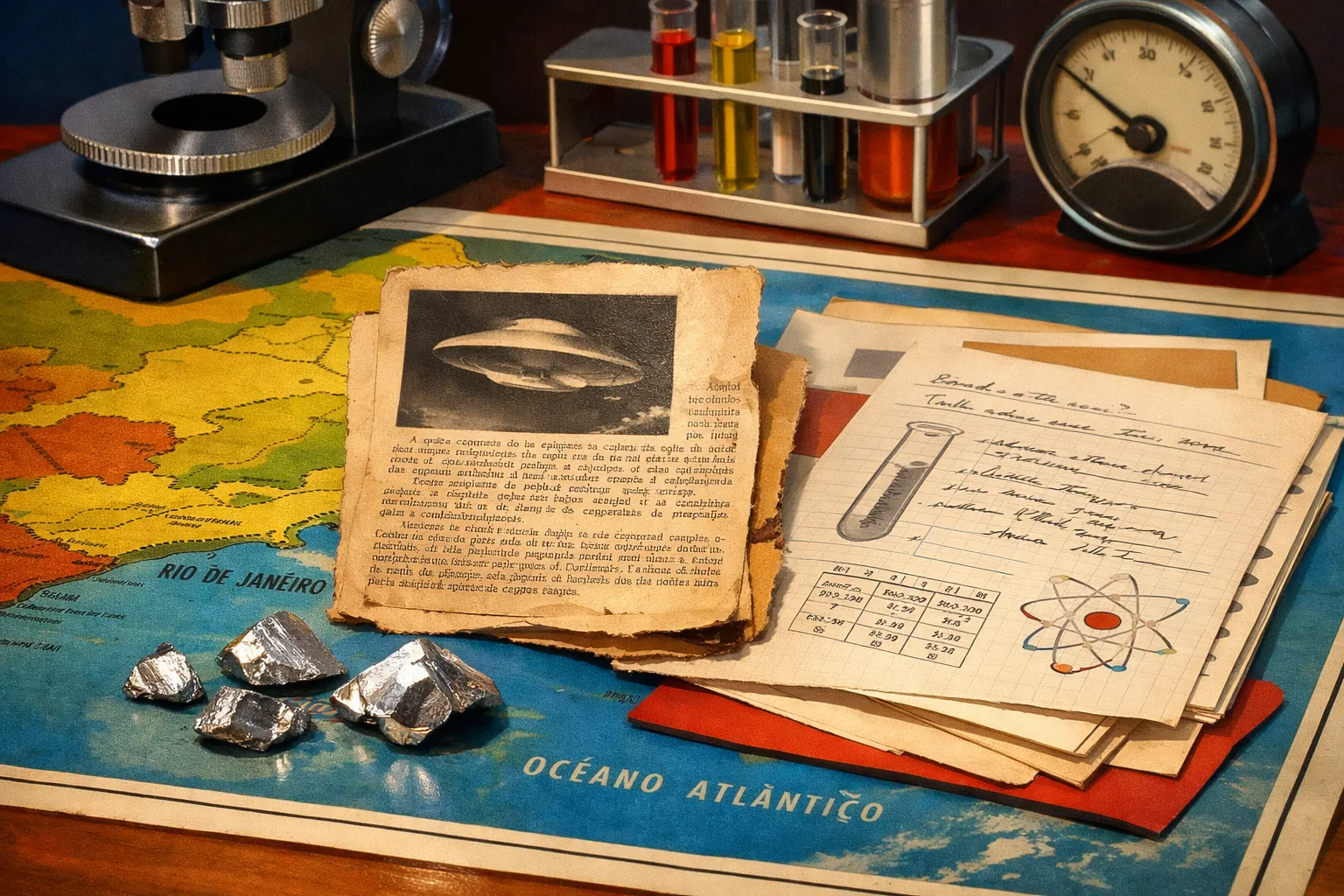
The Ubatuba incident is a 1957 Brazilian UFO case built around three small fragments of metal said to have fallen from a “flying disk” that exploded near the coastal town of Ubatuba, in São Paulo state. Its significance is not that the sighting itself is well corroborated; it is not.
Page outline Jump by section
Introduction
The case therefore sits in an unusual middle ground. It is not just a witness tale, because physical samples were examined by Brazilian laboratories, Oak Ridge, Dow Chemical, the University of Colorado UFO project, Stanford-linked researchers, and later analysts. Yet it is not a strong crash-retrieval case either, because no original witness has been identified, no independent local witness has confirmed the explosion, and later searches in Ubatuba failed to establish that the metal really came from the reported event.[Journal of Scientific Exploration]journalofscientificexploration.orgJournal of Scientific Exploration
What was alleged to have happened near Ubatuba?
The public story began in the Rio de Janeiro newspaper O Globo on 14 September 1957, when columnist Ibrahim Sued published a letter from an unnamed reader. In the letter, the writer said he had been fishing with friends near Ubatuba “some days” earlier when a disc-shaped object approached the beach at great speed, climbed abruptly, exploded in flames, and scattered many bright fragments. The letter said most fragments fell into the sea, while some small pieces landed near the beach and were collected. A transcription of the O Globo item was later reproduced in Peter Sturrock’s 2001 technical review of the case.[researchgate.net]researchgate.netPDF) On Events Possibly Related to the ''Brazil MagnesiumPDF) On Events Possibly Related to the ''Brazil Magnesium
That first account contains the case’s central weakness. The alleged witness did not give a legible name, the precise date of the event was not stated, and the report reached investigators only through a newspaper column. The fragments can be traced to Sued and then to Dr Olavo Teixeira Fontes, a Brazilian physician and representative of the Aerial Phenomena Research Organization, but the chain cannot be carried back to a named person on the beach. Powell, Swords, Rodeghier, and Budinger, writing in 2022, put the problem plainly: the samples cannot be conclusively tied either to an unknown aerial explosion or even to Ubatuba itself.[Journal of Scientific Exploration]journalofscientificexploration.orgJournal of Scientific Exploration
Attempts to find corroboration did not solve the problem. Fontes later visited the Ubatuba area but did not identify a direct witness to the event. According to a later review by P. Kaufmann and P. Sturrock, Fontes heard second-hand recollections from fishermen about tourists who had claimed to see something, while journalist João Martins conducted his own search and likewise found no solid local confirmation. The absence of identifiable witnesses is especially damaging because the claimed event was spectacular: a daytime aerial explosion raining fragments over a beach should have been locally memorable if many people had seen it.[researchgate.net]researchgate.netComposition Analysis of the Brazil MagnesiumComposition Analysis of the Brazil Magnesium
How the fragments moved from newspaper column to laboratories
After the O Globo column appeared, the fragments were handed to Fontes. The later sample history reconstructed by Powell and colleagues says Fontes arranged tests in Brazil, then passed the samples to Coral Lorenzen of the Aerial Phenomena Research Organization in late 1957. In 1987 Lorenzen transferred material to Stanford physicist Peter Sturrock, and a piece from Sturrock’s material became the basis for later high-resolution isotope work.[Journal of Scientific Exploration]journalofscientificexploration.orgJournal of Scientific Exploration
This chain is better than in many folklore-like UFO stories, because several later holders of the samples are named. But it is still not a clean forensic chain. The critical missing section is the first one: from the alleged beach recovery to Sued’s envelope. Kevin Randle, a sceptical UFO writer, highlighted this point sharply, arguing that the fragments can be traced to the columnist but not to the beach or to the claimed explosion. That is not merely a paperwork complaint; it means the physical sample and the dramatic sighting may be unrelated.[Kevin Randle]kevinrandle.blogspot.comKevin Randle A Different Perspective: The Ubatuba UFO SampleKevin Randle A Different Perspective: The Ubatuba UFO Sample
The sample history also became complicated because small pieces were subdivided, sent to different laboratories, and not always logged in a way that would satisfy modern evidence handling. Sturrock noted that some early claims about one “Sample 1” being ultra-pure could not be checked properly because the surviving pieces in APRO’s possession were not tracked with enough precision to identify every original fragment later.[researchgate.net]researchgate.netOpen source on researchgate.net.
Why the “pure magnesium” claim became controversial
The first laboratory results were the reason the case became famous. In November 1957, Brazilian testing reportedly found no detectable impurities in one sample, leading to the repeated claim that the fragment was “100% magnesium” or “absolutely pure” magnesium. Powell and colleagues argue that this was the origin of the extraterrestrial interpretation: if the metal was purer than anything available on Earth at the time, then perhaps it required an extraordinary origin.[Journal of Scientific Exploration]journalofscientificexploration.orgJournal of Scientific Exploration
Later work undermined that simple claim. The key point is that “no impurities detected” is not the same as “no impurities exist”. Early spectrographic equipment had limits, and later methods could see trace elements that the first tests did not detect. Powell and colleagues explicitly describe the “100% pure magnesium” conclusion as erroneous: the trace elements were not absent, but below the detection capacity of the Brazilian equipment used at the time.[Journal of Scientific Exploration]journalofscientificexploration.orgJournal of Scientific Exploration
The University of Colorado UFO project, better known through the Condon Report, tested a chip from the material using neutron activation analysis and gamma spectrometry. It found magnesium with measurable impurities, including zinc, chromium, barium and strontium. The report concluded that the fragment was not as pure as magnesium produced by known earthly technology before 1957, and that the claim of unusual purity had been disproved.[NCAS Files]files.ncas.orgCondon Report Section III, Chapter 3: Direct Physical Evidence…
Sturrock’s 2001 review reached a more nuanced but still non-extraterrestrial conclusion. His analysis found that the existing Brazil magnesium samples were not as pure as magnesium specimens readily available in the 1950s, and that isotopic departures were small and compatible with normal fractionation caused by heating or processing. He concluded that the origin remained unidentified, but that there was no evidence the specimens were extraterrestrial.[researchgate.net]researchgate.netOpen source on researchgate.net.
What later chemical and isotope tests actually showed
The most useful way to read the laboratory history is to separate three questions: what the metal is, whether it is unusual, and whether it proves a non-terrestrial origin. On the first question, the answer is clear: the fragments are magnesium-rich metal. On the second, some features drew interest, especially the presence of strontium and barium in some analyses. On the third, the answer remains negative: the tests have not shown an extraterrestrial origin.[NCAS Files]files.ncas.orgCondon Report Section III, Chapter 3: Direct Physical Evidence…
The Condon Report found strontium at about 500 parts per million and barium at about 160 parts per million in the tested fragment. It considered the strontium especially interesting because it was not expected in ordinary magnesium production, but the report also found that Dow Chemical had made experimental magnesium-strontium batches before 1957, including a 1940 batch with a comparable strontium level. That finding did not identify the Ubatuba sample’s source, but it showed that such a composition was technologically possible on Earth before the alleged event.[NCAS Files]files.ncas.orgCondon Report Section III, Chapter 3: Direct Physical Evidence…
Sturrock later reviewed surface, internal and isotopic analyses of surviving material. His abstract records that some impurities could plausibly come from sand or seawater, while others suggested a technological setting. But he also reported that the internal analyses showed calcium at a few thousand parts per million and strontium and barium at a few hundred parts per million, making the samples less pure than available 1950s magnesium.[researchgate.net]researchgate.netPDF) On Events Possibly Related to the ''Brazil MagnesiumPDF) On Events Possibly Related to the ''Brazil Magnesium
The 2022 analysis by Powell, Swords, Rodeghier and Budinger used improved high-resolution inductively coupled plasma mass spectrometry, a technique for measuring elemental and isotopic composition at very low concentrations. Their results found magnesium isotope ratios within terrestrial limits, while the isotope ratios of trace elements such as strontium, barium, copper and zinc were inconclusive. The paper recommended improved future testing, especially chemical separation of trace elements before isotope measurement.[Journal of Scientific Exploration]journalofscientificexploration.orgJournal of Scientific Exploration

Official and quasi-official investigations did not resolve the origin
The most important official-style investigation was the University of Colorado study funded by the United States Air Force, whose final report is usually called the Condon Report. Its Ubatuba section is notable because it treated the fragment as physical evidence rather than simply dismissing the story. The test protocol included cleaning the chip with hydrochloric acid to remove surface contamination and using neutron activation methods to identify impurities.[NCAS Files]files.ncas.orgCondon Report Section III, Chapter 3: Direct Physical Evidence…
The Condon Report’s conclusion was sceptical. It found that the sample was not uniquely pure, that its isotopic content did not support the idea of pure magnesium-26, and that the material could have been produced using terrestrial technology known before 1957. It also noted metallographic evidence suggesting the material had not been worked after solidification, making it doubtful that the sample had been part of a fabricated metal object.[NCAS Files]files.ncas.orgCondon Report Section III, Chapter 3: Direct Physical Evidence…
Sturrock later criticised the Colorado project for not sending an investigator to Brazil or making stronger official inquiries there. In his view, the laboratory work was useful but incomplete because the provenance problem required field investigation as well as chemical testing. That criticism does not rescue the extraterrestrial claim; it clarifies why the case remains historically unresolved even after many laboratory tests.[researchgate.net]researchgate.netComposition Analysis of the Brazil MagnesiumComposition Analysis of the Brazil Magnesium
The strongest arguments for keeping the case open
The best argument for continuing to study the Ubatuba fragments is not that they prove a crashed flying saucer. They do not. The better argument is that the samples are unusual enough, and have enough testing history, to remain a useful case study in how physical UFO evidence should be handled. Powell and colleagues describe the samples as rare because most UFO reports leave no durable material for laboratory examination, while also acknowledging that the Ubatuba samples are not conclusively tied to a UFO event.[Journal of Scientific Exploration]journalofscientificexploration.orgJournal of Scientific Exploration
Several features explain why some researchers still find the case interesting:
- The material is not imaginary. Physical fragments were tested by multiple laboratories over decades.
- The composition prompted real technical questions. Strontium and barium were repeatedly discussed because they were not obvious ordinary impurities in magnesium.
- The case has a long paper trail. It connects a 1957 newspaper report, Brazilian analysis, APRO files, the Condon Report, Sturrock’s review, and later isotope testing.
- The evidence has not been fully exhausted. The 2022 authors argued that future trace-isotope work would need better preparation of minor constituents before testing could be more decisive.[Journal of Scientific Exploration]journalofscientificexploration.orgJournal of Scientific Exploration[NCAS Files]files.ncas.orgCondon Report Section III, Chapter 3: Direct Physical Evidence…
The case also illustrates a recurring issue in physical-trace UFO claims: a laboratory can sometimes say what a sample is, but not where it came from. Even a chemically odd sample does not establish the witness story unless the recovery circumstances are secure. In Ubatuba, the metal survives better than the sighting does.[researchgate.net]researchgate.netOpen source on researchgate.net.
The strongest sceptical reading
The sceptical reading is straightforward. An anonymous person sent magnesium fragments to a newspaper with a dramatic story. No named witness has ever been produced. Investigators did not locate direct local confirmation. The claim that the material was impossibly pure was weakened by later testing. And the composition, including strontium, was shown by the Condon Report to be within the range of terrestrial experimental metallurgy before 1957.[NCAS Files]files.ncas.orgCondon Report Section III, Chapter 3: Direct Physical Evidence… 2researchgate.net
This does not prove a deliberate hoax, but it makes a mundane explanation plausible. The fragments could have been industrial or experimental magnesium presented with a false or embellished story. They could also have been genuine debris from some terrestrial source misinterpreted by the sender. Because the chain of custody begins only at Sued’s newspaper office, no laboratory result can repair the missing link between the metal and the alleged aerial explosion.[Kevin Randle]kevinrandle.blogspot.comKevin Randle A Different Perspective: The Ubatuba UFO SampleKevin Randle A Different Perspective: The Ubatuba UFO Sample
A careful sceptical position should not overstate the case either. The exact origin of the surviving samples has not been identified, and some researchers with technical expertise have regarded the composition as interesting. But “unidentified origin” is not the same as “extraterrestrial origin”. Sturrock’s conclusion remains a useful baseline: the origin of the fragments is a mystery, but available analyses do not provide evidence that they came from beyond Earth.[researchgate.net]researchgate.netOpen source on researchgate.net.
How the Ubatuba incident should be assessed today
The Ubatuba incident is best understood as a physical-evidence case with a weak sighting foundation. Its evidential value depends on two separate pillars: the testimony behind the beach explosion and the laboratory character of the fragments. The first pillar is poor, because the original witness is anonymous and uncorroborated. The second pillar is stronger but limited, because the fragments are real and testable, yet their chemistry has not shown anything that requires a non-terrestrial explanation.[Journal of Scientific Exploration]journalofscientificexploration.orgJournal of Scientific Exploration[NCAS Files]files.ncas.orgCondon Report Section III, Chapter 3: Direct Physical Evidence…
For a case dossier, the most responsible classification is therefore “unresolved provenance, non-probative material”. The samples deserve mention because they are among the better-known alleged UFO fragments and because the testing history is unusually extensive. But they should not be presented as confirmed crash debris, nor as proof of advanced non-human technology. The central lesson of Ubatuba is that physical samples only become strong evidence when the recovery story, witness chain, custody trail and laboratory results all support one another. Here, they do not.

Amazon book picks
Further Reading
Books and field guides related to Did Ubatuba Leave Real UFO Evidence?. Use these as the next step if you want deeper reading beyond the article.
Ufos and Government
Tracks how the declassified O Globo letter files moved through Brazilian labs, Oak Ridge, and Dow Chemical loops.
Scientific Paranormal Investigation
Provides structural forensic guidelines to evaluate why a total lack of witness provenance keeps samples suspended as simple curiosities.
The Skeptics' Guide to the Universe
An all-encompassing guide to skeptical thinking from podcast host and academic neurologist at Yale University School of Medicine Steven N...
Confrontations: A Scientist's Search for Alien Contact
Reviews the complete analytical history of the three magnesium-based fragments, logging his personal tests alongside Stanford researchers.
eBay marketplace picks
Marketplace Samples
Example marketplace items related to this page. Use the search link to explore similar finds on eBay.



Endnotes
1.
Source: journalofscientificexploration.org
Title: Journal of Scientific Exploration
Link:https://journalofscientificexploration.org/index.php/jse/article/view/2415/1565
2.
Source: files.ncas.org
Link:https://files.ncas.org/condon/text/s3chap03.htm
Source snippet
Condon Report Section III, Chapter 3: Direct Physical Evidence...
3.
Source: researchgate.net
Title: (PDF) On Events Possibly Related to the ‘‘Brazil Magnesium
Link:https://www.researchgate.net/publication/237309319On_Events_Possibly_Related_to_the%27%27Brazil_Magnesium
4.
Source: researchgate.net
Title: Composition Analysis of the Brazil Magnesium
Link:https://www.researchgate.net/profile/Peter_Sturrock/publication/237233241_Composition_Analysis_of_the_Brazil_Magnesium/links/5474a9cb0cf29afed60f8e5c/Composition-Analysis-of-the-Brazil-Magnesium.pdf
5.
Source: researchgate.net
Link:https://www.researchgate.net/publication/360788800_Isotope_Ratios_and_Chemical_Analysis_of_the_1957_Brazilian_Ubatuba_Fragment
6.
Source: researchgate.net
Link:https://www.researchgate.net/publication/237233241_Composition_Analysis_of_the_Brazil_Magnesium
7.
Source: kevinrandle.blogspot.com
Title: Kevin Randle A Different Perspective: The Ubatuba UFO Sample
Link:https://kevinrandle.blogspot.com/2010/05/ubatuba-ufo-sample.html
8.
Source: journalofscientificexploration.org
Link:https://journalofscientificexploration.org/index.php/jse/article/view/2415
9.
Source: theblackarchive.net
Link:https://theblackarchive.net/en/case/14
Additional References
10.
Source: arxiv.org
Link:https://arxiv.org/html/2502.06794v2
11.
Source: youtube.com
Title: UFO Crash Debris! (Art’s Parts)
Link:https://www.youtube.com/watch?v=v4HWxOel7zw
Source snippet
Ancient Aliens: Metallic Fragments Sent by ETs?! (Season 18) | History...
12.
Source: youtube.com
Title: The most fascinating UFO encounter | Garry Nolan and Lex Fridman
Link:https://www.youtube.com/watch?v=bb1cuYU09Ck
Source snippet
UFO Crash Debris! (Art's Parts) - Jimmy Akin's Mysterious World...
13.
Source: youtube.com
Title: Garry Nolan: UFOs and Aliens | Lex Fridman Podcast #262
Link:https://www.youtube.com/watch?v=uTCc2-1tbBQ
Source snippet
The most fascinating UFO encounter | Garry Nolan and Lex Fridman...
14.
Source: reddit.com
Link:https://www.reddit.com/r/ufo/comments/gezuyj/analysis_of_the_ubatuba_material_by_robert_powell/
15.
Source: semanticscholar.org
Link:https://www.semanticscholar.org/paper/Composition-Analysis-of-the-Brazil-Magnesium-Sturrock-Sturrock/c1f8a88ed69cf2a6dcccacebe992db42df814bef
16.
Source: medium.com
Link:https://medium.com/%40dulararatnayaka/the-ubatuba-incident-a-brief-analysis-5ed113a0be47
17.
Source: ufoevidence.org
Link:https://www.ufoevidence.org/cases/case829.htm
18.
Source: nicap.org
Link:https://www.nicap.org/5709XXubatuba_dir.htm
19.
Source: scirp.org
Link:https://www.scirp.org/journal/paperinformation?paperid=149827
Topic Tree
Follow this branch
Related pages 106
- Godfrey Encounter
- Hamilton Airship
- Andreasson
- Villas Boas
- Apollo 11 Sightings
- +101 more in sidebar