What Did Bonilla Really Capture in 1883?
José A. y Bonilla’s 1883 photographs are often described as among the earliest photographs later claimed as “UFO” evidence, but the historical case is more precise than that label suggests.
Page outline Jump by section
What Bonilla said he saw
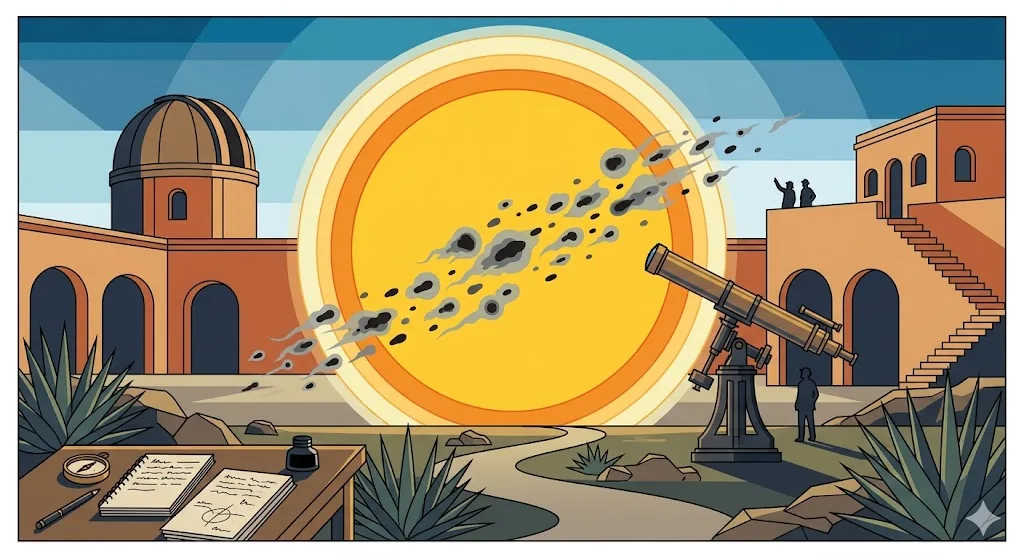
Bonilla’s observation took place at the Astronomical Observatory of Zacatecas, a setting that matters because he was not a casual sky-watcher. Historical work on Mexican sunspot records describes José Árbol Bonilla as the founder and first director of the Astronomical Observatory of Zacatecas and notes that he was mainly devoted to studying solar activity. Mexico in the late nineteenth century had a growing network of astronomical and meteorological activity, including the National Astronomical Observatory, smaller observatories in Puebla and Zacatecas, and published solar observations, although many records are now lost or hard to access.[SciELO]scielo.org.mxSci ELOHistorical sunspot records from MexicoSci ELOHistorical sunspot records from Mexico
According to the 2011 reanalysis by Héctor Javier Durand Manterola, María de la Paz Ramos Lara and Guadalupe Cordero of the National Autonomous University of Mexico, Bonilla reported objects crossing the solar disc on 12 and 13 August 1883. The objects were described as surrounded by a mist, leaving a similar mist-like trace, appearing dark against the Sun but bright outside the solar disc. The same paper says Bonilla recorded 447 bodies during the observation windows and that L’Astronomie published his account on 1 January 1886 without Bonilla offering a definite explanation.[arXiv]arxiv.org201010051520 Año 1883 al borde de la extinción…
The reported timing is important. Later summaries of the case state that Bonilla observed in intermittent clear-sky periods totalling about 3 hours and 25 minutes across the two days, not continuously for the full interval. Space Safety Magazine, summarising the reanalysis, gives the detail that Bonilla counted 447 objects between 8:00 a.m. on 12 August and 8:40 a.m. on 13 August during clear observation windows, an average rate later extrapolated by the 2011 authors to a much larger total number of possible passages.[spacesafetymagazine.com]spacesafetymagazine.comSource details in endnotes.
Why the photographs became famous
The fame of the Bonilla photographs comes less from the image quality than from their timing. They predate the twentieth-century flying saucer era by decades, so later UFO writers treated them as possible “first UFO photographs”. Universe Today notes that the photographs were not released publicly until their 1886 publication in L’Astronomie and that UFO writers later promoted them as early photographic UFO evidence.[Universe Today]universetoday.comUniverse Today Was the "First Photographed UFO" a Comet?Universe TodayWas the "First Photographed UFO" a Comet? - Universe Today…
That later label can mislead. “Unidentified flying object” simply means an object in the sky that has not been identified at the time of observation. It does not mean spacecraft, alien technology or a controlled vehicle. In Bonilla’s case, the objects were reported as transits across the Sun seen through astronomical equipment. The page belongs more naturally to the history of anomalous astronomical observations than to modern close-encounter narratives.
The photographs also have limitations. They were produced in an era of wet-plate photography, under solar observing conditions, and survived mainly as published or reproduced images rather than as a modern chain of original negatives with full metadata. Their value lies in corroborating that Bonilla observed and recorded something, but they do not independently settle distance, size, altitude, composition or origin. Those variables are inferred from Bonilla’s timings, descriptions, and the absence of reports from other locations.
The first sceptical explanation: birds, insects or dust
The earliest sceptical reading came from the astronomical community around the publication itself. The 2011 reanalysis says the editor of L’Astronomie could not find a suitable explanation and supposed that the objects may have been birds, insects or dust crossing in front of the telescope. ABC Science’s archive gives the same broad summary: Bonilla did not explain the objects, while the journal editor suggested birds, insects or dust.[arXiv]arxiv.org201010051520 Año 1883 al borde de la extinción…
This explanation has a basic strength: it does not require a rare celestial near-miss. Small nearby objects can cross a telescope’s field of view and create misleading silhouettes, especially when the observer is focused on the Sun. It also fits the uncomfortable fact that Bonilla appears to have been the only confirmed observer of the phenomenon.
Its weakness is the scale and regularity reported by Bonilla. A total of 447 recorded passages, some reportedly misty or trailed, is harder to reduce to a few accidental flecks or insects without assuming repeated local contamination, misperception, or a prolonged stream of nearby biological or atmospheric objects. The sceptical explanation is therefore plausible but not conclusively demonstrated from the surviving evidence.
The comet-fragment hypothesis
The most developed modern reinterpretation is the 2011 UNAM-affiliated arXiv paper, which argues that Bonilla may have seen a highly fragmented comet passing close to Earth. The authors’ central reasoning is that Bonilla’s descriptions of mist and traces are more comet-like than bird- or dust-like, and that the lack of observations from Mexico City or Puebla could be explained by parallax: the fragments were close enough that they crossed the Sun from Zacatecas but not from other places.[arXiv]arxiv.org201010051520 Año 1883 al borde de la extinción…
The paper estimated that the objects passed between about 538 km and 8,062 km above Earth’s surface, with widths between 46 m and 795 m, lengths between 68 m and 1,022 m, and individual masses between 5.58 × 10⁸ kg and 2.5 × 10¹² kg. It further estimated that the original comet’s mass may have ranged from 1.83 × 10¹² kg to 8.19 × 10¹⁵ kg, potentially comparable in scale to known cometary masses.[arXiv]arxiv.org201010051520 Año 1883 al borde de la extinción…
The hypothesis is interesting because comet fragmentation is real. The authors cite known examples such as Biela’s comet and later highly fragmented comets, and they argue that Bonilla’s nineteenth-century observers may not have had enough precedent to recognise such a possibility. They also note that the annual Perseid meteor shower occurs around 12 and 13 August, but argue that Bonilla’s reported geometry does not match a broad normal Perseid display visible across the northern hemisphere.[arXiv]arxiv.org201010051520 Año 1883 al borde de la extinción…
The dramatic part of the paper is its implication: if the fragments had actually hit Earth, the authors suggest the outcome could have been catastrophic, comparing the possible energy scale with the 1908 Tunguska event. That claim is best read as a consequence of the model’s assumptions, not as a settled historical finding.[arXiv]arxiv.org201010051520 Año 1883 al borde de la extinción…
Why the comet explanation remains contested
The comet-fragment model has not ended the debate. Universe Today called the comet explanation plausible but “generally unconvincing”, pointing out that the hypothesis rests heavily on Bonilla’s descriptions of fuzziness and trails, and that an extremely close comet breakup might be expected to leave broader meteor evidence. The same critique notes that meteor records for that year did not clearly show an exceptional Perseid display or an obvious unusual radiant tied to such a dramatic event.[Universe Today]universetoday.comUniverse Today Was the "First Photographed UFO" a Comet?Universe TodayWas the "First Photographed UFO" a Comet? - Universe Today…
ABC Science reported an even stronger objection from astronomer Paul Francis of the Australian National University’s Mount Stromlo Observatory. Francis argued that if a comet as large and close as proposed had passed near Earth, it is difficult to believe no one else noticed it; in his view, the original birds, insects or dust explanation was probably correct.[ABC News]abc.net.auABC News Study suggests Earth survived near miss — ABC Science ArchiveABC News Study suggests Earth survived near miss — ABC Science Archive
That objection strikes at the case’s central weakness: Bonilla’s report is strong enough to be interesting, but too isolated to be decisive. The comet hypothesis explains the lack of observations elsewhere by making the objects very close to Earth and visible in transit only from a narrow geometry. The sceptical counterargument says that such a close, massive, fragmenting body should likely have produced other visible effects, independent reports, meteor activity, or later astronomical traces. Both sides are trying to solve the same evidential gap in different ways.
How credible was Bonilla as a witness?
Bonilla’s credibility should not be dismissed casually. He was embedded in serious scientific work in Zacatecas, associated with solar observation, meteorology and technical education. A local historical account from La Jornada Zacatecas describes him as one of the notable students of the Instituto de Ciencias de Zacatecas, born in Zacatecas in 1853, trained as a topographical engineer, later active as a teacher and scientist, and founder of astronomical and meteorological observatories in Zacatecas.[La Jornada Zacatecas]ljz.mxSource details in endnotes.
His background makes it more likely that he knew how to observe and record solar phenomena than an ordinary witness would. It does not, however, make him immune to observational error. Telescopic solar work is vulnerable to foreground objects, instrumental effects and interpretive traps, especially when the apparent phenomenon is unexpected and lacks independent confirmation.
The fairest assessment is that Bonilla was probably a competent observer who recorded a genuine apparent transit phenomenon. The unresolved part is not whether he was honest, but what distance and nature should be assigned to the objects. That distinction is crucial: witness credibility can support the occurrence of an observation without proving a particular extraordinary interpretation.
What is known, what is not
The best-supported facts are narrow but meaningful. Bonilla was a real astronomer in Zacatecas; he reported many objects crossing the Sun on 12 and 13 August 1883; his account and images were published in L’Astronomie in 1886; and later analysts have debated explanations ranging from nearby birds, insects or dust to fragments of a comet passing close to Earth.[Universe Today]universetoday.comUniverse Today Was the "First Photographed UFO" a Comet?Universe TodayWas the "First Photographed UFO" a Comet? - Universe Today… 3arXiv[Online Books Page]onlinebooks.library.upenn.eduOnline Books Page L'Astronomie archivesOnline Books Page L'Astronomie archives
What remains uncertain is larger. The surviving record does not prove the objects’ distance. Without distance, their size cannot be securely determined. Without size and distance, the case cannot establish whether they were small nearby objects, atmospheric contaminants, birds, insects, dust, or large astronomical fragments. The photographs alone do not carry that burden.
The most responsible reading is therefore cautious. Bonilla’s 1883 photographs are historically important as early anomalous astronomical photographs later absorbed into UFO lore. They are not good evidence for extraterrestrial craft. The comet-fragment hypothesis is the most ambitious scientific reinterpretation and gives the case a striking possible astronomical significance, but it remains disputed because it depends on assumptions that are difficult to verify from a single nineteenth-century report. The mundane foreground-object explanation remains viable, especially because of the lack of corroborating observations, but it too is not proven in detail.
Why this case still matters
The Bonilla case is valuable precisely because it resists a neat slogan. For UFO history, it shows how later communities can reframe old anomalies through modern expectations. For astronomy history, it highlights the fragility and value of nineteenth-century observational records from outside the usual European and North American centres. For evidence assessment, it is a compact lesson in why photographs are not self-explanatory: an image may document that something crossed a field of view, but interpretation depends on context, instruments, comparison reports, timing, geometry and independent corroboration.
Within a wider case dossier, the Bonilla photographs belong alongside other early “pre-flying saucer” astronomical anomalies, but they should be kept clearly labelled. They are not a modern UFO encounter with close witnesses, radar, pilots or official investigation files. They are a solar-transit observation by a trained astronomer, published years later in an astronomy journal, later reinterpreted through both sceptical and cometary models. That makes the case historically intriguing, but evidentially limited.
Amazon book picks
Further Reading
Books and field guides related to What Did Bonilla Really Capture in 1883?. Use these as the next step if you want deeper reading beyond the article.
The UFO Book
Profiles the Bonilla solar transits objectively, situating the 1883 observations within the history of astronomical photography.
The Skeptics' Guide to the Universe
Explains why historical observational anomalies are often retrofitted into UFO myths without proof of ET origins.
Scientific Paranormal Investigation
Teaches forensic standards for evaluating old photographic evidence for optical artifacts and natural transits.
Sister States, Enemy States
Details the importance of checking telescope optics and camera-plate limitations when evaluating early sky sightings.
eBay marketplace picks
Marketplace Samples
Example marketplace items related to this page. Use the search link to explore similar finds on eBay.
Endnotes
1.
Source: arxiv.org
Link:https://arxiv.org/pdf/1110.2798
Source snippet
201010051520 Año 1883 al borde de la extinción...
2.
Source: spacesafetymagazine.com
Link:https://www.spacesafetymagazine.com/space-hazards/asteroid-hitting-earth/reanalysis-observations-recorded-1883-zacatecas-mexico-suggest-fragments-billion-ton-comet-close-earth/
3.
Source: arxiv.org
Link:https://arxiv.org/abs/1110.2798
4.
Source: dn790004.ca.archive.org
Link:https://dn790004.ca.archive.org/0/items/bookofdamnedbych00fortrich/bookofdamnedbych00fortrich.pdf
5.
Source: onlinebooks.library.upenn.edu
Title: Online Books Page L’Astronomie archives
Link:https://onlinebooks.library.upenn.edu/webbin/serial?id=astronomie
6.
Source: universetoday.com
Title: Universe Today Was the “First Photographed UFO” a Comet?
Link:https://www.universetoday.com/articles/was-the-first-photographed-ufo-a-comet
Source snippet
Universe TodayWas the "First Photographed UFO" a Comet? - Universe Today...
7.
Source: scielo.org.mx
Title: Sci ELOHistorical sunspot records from Mexico
Link:https://www.scielo.org.mx/scielo.php?pid=S0016-71692008000300009&script=sci_arttext
8.
Source: abc.net.au
Title: ABC News Study suggests Earth survived near miss — ABC Science Archive
Link:https://www.abc.net.au/science/articles/2011/10/20/3343484.htm
9.
Source: ljz.mx
Link:https://ljz.mx/16/03/2022/instituto-de-ciencias-de-zacatecas-jose-arbol-y-bonilla-breves-de-la-historia-3/
10.
Source: scielo.sa.cr
Link:https://www.scielo.sa.cr/scielo.php?pid=S0034-77442007000100031&script=sci_arttext
11.
Source: sis-group.org.uk
Link:https://www.sis-group.org.uk/news/2023/01/12/bonilla/
Additional References
12.
Source: academia.edu
Link:https://www.academia.edu/71337593/UFOs_and_the_extraterrestrial_contact_movement_a_bibliography
13.
Source: researchgate.net
Link:https://www.researchgate.net/publication/51945342_Interpretation_of_the_observations_made_in_1883_in_Zacatecas_Mexico_Afragmented_Comet_that_nearly_hits_the_Earth
14.
Source: researchgate.net
Link:https://www.researchgate.net/figure/Image-of-the-sun-captured-by-Jose-Arbol-y-Bonilla-during-an-April-1883-observation-The_fig1_376328702
Published: April 1883
15.
Source: facebook.com
Link:https://www.facebook.com/planetariodecancun/photos/jos%C3%A9-%C3%A1rbol-y-bonilla-astr%C3%B3nomo-naci%C3%B3-el-5-de-febrero-de1853en-la-ciudad-de-zacat/531677137014567/
16.
Source: facebook.com
Link:https://www.facebook.com/NotiUAZ/posts/observatorio-astron%C3%B3mico-jos%C3%A9-%C3%A1rbol-y-bonilla-perteneciente-a-la-unidad-acad%C3%A9mic/856668333171179/
17.
Source: medium.com
Link:https://medium.com/%40adrieneadams09/witness-the-moment-ufos-were-first-photographed-9078266cdbcf
18.
Source: instagram.com
Link:https://www.instagram.com/p/DWbwZ-EkW7H/
19.
Source: presentations.copernicus.org
Link:https://presentations.copernicus.org/EPSC-DPS2025/EPSC-DPS2025-12_supplement.pdf
20.
Source: discovermagazine.com
Link:https://www.discovermagazine.com/did-a-fragmenting-comet-nearly-hit-the-earth-in-1883-color-me-very-skeptical-23066
21.
Source: medium.com
Link:https://medium.com/%40ignacio.emerio/the-bonilla-observation-a-puzzling-event-in-the-history-of-astronomy-e0d0b1655bb0
Topic Tree
Follow this branch
Related pages 106
- Godfrey Encounter
- Hamilton Airship
- Andreasson
- Villas Boas
- Apollo 11 Sightings
- +101 more in sidebar