Within Bonilla 1883
Were Bonilla’s Observations Birds, Dust, or Comet Fragments?
Covers competing explanations for Bonilla’s sightings, from birds and dust to comet fragments and their plausibility.
On this page
- Skeptical interpretations: birds, insects, dust
- Comet fragment hypothesis and models
- Challenges and counterarguments
Page outline Jump by section
Introduction
The question that has animated more than a century of discussion about the Bonilla observation pertains not to UFO folklore but to the physical nature of the hundreds of small bodies recorded by Mexican astronomer José A. y Bonilla on 12–13 August 1883. What did Bonilla’s photographs actually show? Researchers have proposed competing explanations that range from mundane atmospheric artefacts to dramatic celestial events. This article examines these competing hypotheses, assesses their plausibility, and considers the scientific debates around them.
Skeptical Interpretations: Birds, Insects and Dust
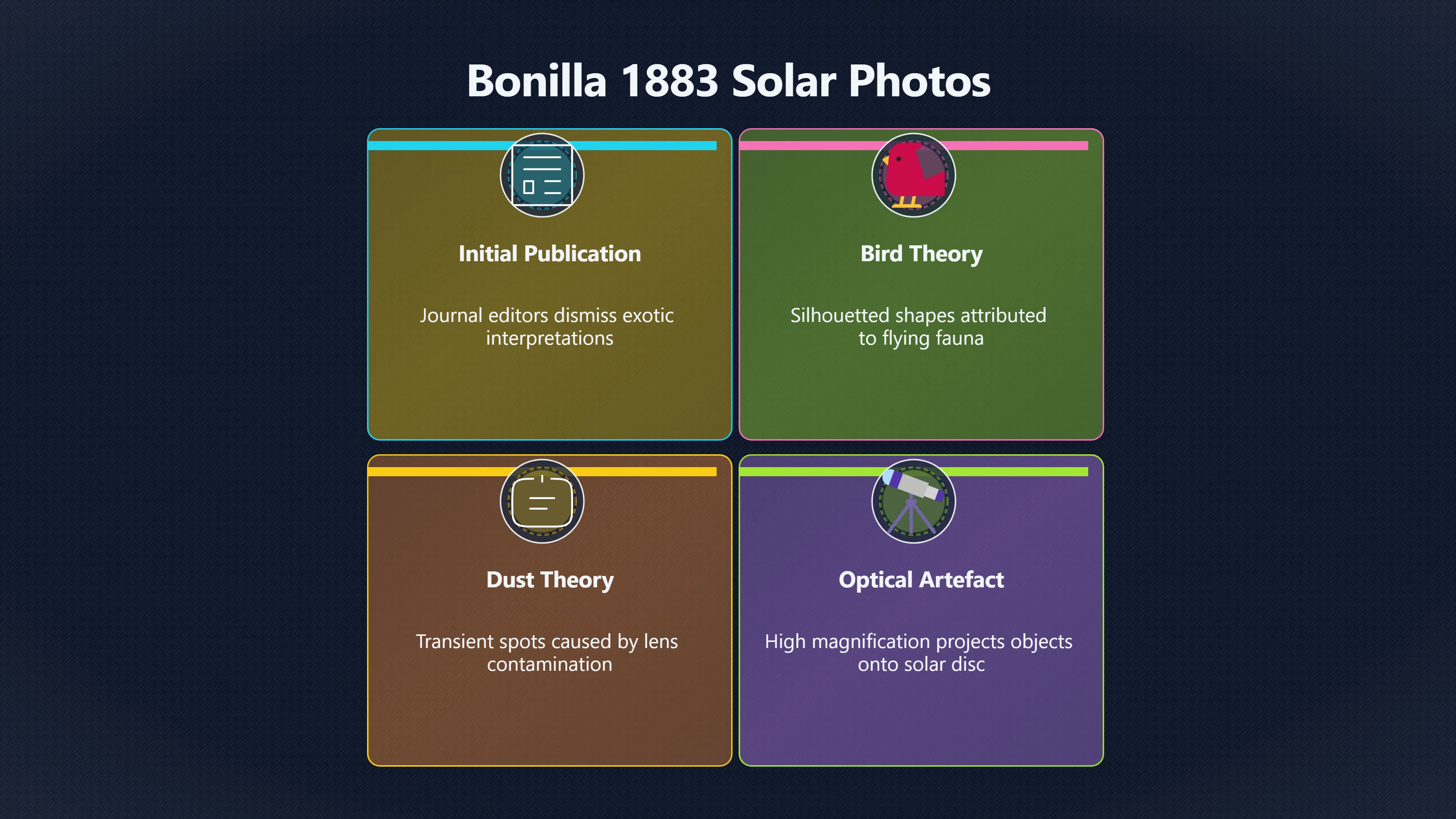
When Bonilla’s observations were first published in the French astronomy journal L’Astronomie in 1886, the editorial response was cautious and dismissive of exotic interpretation. The journal’s editors suggested that Bonilla may simply have seen birds, insects, or high-altitude dust passing close to the telescope’s objective, appearing against the solar disc owing to projection or optical artefacts. This reflected a conservative approach to unexplained transits in an era before modern solar imaging and space-based observations.[Wikipedia]WikipediaBonilla observationBonilla observation
These mundane explanations have endured largely because they require no unusual cosmic circumstances:
- Birds or insects flying near the telescope can, when projected at high magnification, appear as silhouetted shapes crossing the solar disc.
- Dust particles on or near the lens can produce transient dark spots or “misty” features in early wet‑plate photography, especially in direct sunlight.
Such interpretations were viewed as plausible by contemporaries familiar with observational artefacts. Critics of exotic explanations note that Bonilla’s descriptions — referring to the bodies as “fuzzy” and mist‑surrounded — do not uniquely point to a particular source and could be the result of instrument or environmental effects.[Isaac Koi Archive]isaackoi.com18830812 bonilla photosIsaac Koi Archive1883.0812 Bonilla photos…
Comet‑Fragment Hypothesis and Astronomical Models
Over a century after the original observation, a new hypothesis gained traction: that Bonilla was recording a fragmented comet or debris stream passing near Earth. In 2011, Hector Javier Durand Manterola and colleagues from the National Autonomous University of Mexico published a reanalysis suggesting that the objects were part of a comet that had broken up and passed extremely close — possibly within a few hundred to several thousand kilometres — to Earth. Their calculations, based on the timing and apparent transit speeds recorded by Bonilla, estimated the objects’ distances and sizes and even the mass of the original cometary body.[arXiv]arxiv.orgInterpretation of the observations made in 1883 in Zacatecas (Mexico): A fragmented Comet that nearly hits the EarthOctober 12, 2011…
The essence of the fragmented‑comet model is straightforward:
- A comet’s nucleus can disintegrate into numerous fragments under solar heating and tidal stresses.
- If such fragments passed between Earth and the Sun at relatively close range, only observers in a narrow geographical band (such as Zacatecas) would see them transit the solar disc due to parallax effects.
- Bonilla’s count of 447 transits over parts of two days suggests a chain of fragments stretched along the original comet’s orbit.
This hypothesis attempts to account for the large number of discrete objects, their misty appearance (cometary material typically has a surrounding coma of gas and dust), and the absence of corroboration from other observatories due to alignment geometry.[AAAS]aaas.orgdid comet almost cause doomsday 1883Did a comet almost cause Doomsday in 1883? | American Association for the Advancement of Science (AAAS)November 2, 2011…

Challenges and Counterarguments
Despite its dramatic implications, the comet‑fragment interpretation has attracted significant scepticism from astronomers. One key critic, astrophysicist Phil Plait, pointed out several difficulties with the model. First, cometary debris tends to disperse over vast distances once a nucleus breaks up, making the notion of a tightly collimated stream that would be visible only from a narrow location on Earth highly improbable. Plait argues that such a fragmented and constrained formation is inconsistent with known comet dynamics and with the absence of reports of meteoric phenomena that would accompany massive nearby debris.[Discover Magazine]discovermagazine.comdid a fragmenting comet nearly hit the earth in 1883 color me very skepticalDiscover MagazineDid a fragmenting comet nearly hit the Earth in 1883? Color me very skeptical | Discover Magazine…
Moreover, if such fragments were so close to Earth, there should have been visible consequences beyond Bonilla’s telescope. Large fragments entering the upper atmosphere would produce bright fireballs or meteor showers, yet there are no reliable records of such observations elsewhere — either historically or in independent observations at the time. This absence casts doubt on the idea that the objects were large comet fragments rather than more prosaic phenomena.[AAAS]aaas.orgdid comet almost cause doomsday 1883Did a comet almost cause Doomsday in 1883? | American Association for the Advancement of Science (AAAS)November 2, 2011…
Some commentators also caution against retrofitting high‑stakes astronomical scenarios on limited data. Bonilla’s reports, while meticulous for their time, lack the precision and triangulation modern science would require to fix distances or physical properties of the objects, meaning any hypothesis about their nature is constrained by significant uncertainty.
Weighing the Evidence
The debate over the nature of the objects in Bonilla’s 1883 observations illustrates how interpretation depends heavily on context and available evidence. On one hand, mundane atmospheric or optical explanations align with known observational artefacts and avoid invoking rare cosmic events. On the other, a fragmented comet model fits within broader knowledge of comet behaviour — albeit with assumptions that strain against probability and lack independent corroboration.
Contemporary consensus among historians of astronomy tends to treat the comet hypothesis as an interesting but unconfirmed model, while recognising that Bonilla likely did observe a genuine physical transit phenomenon rather than purely instrumental defects. What remains clear is that the objects Bonilla photographed continue to stimulate discussion about how astronomers distinguish between near‑field, instrument‑related effects and genuine celestial events.[Society for Interdisciplinary Studies]sis-group.org.ukSociety for Interdisciplinary Studies BonillaSociety for Interdisciplinary StudiesBonilla - Society for Interdisciplinary StudiesJanuary 12, 2023…
Amazon book picks
Further Reading
Books and field guides related to Were Bonilla’s Observations Birds, Dust, or Comet Fragments?. Use these as the next step if you want deeper reading beyond the article.
The UFO Book
Summarizes the comet and bird/dust theories that researchers have proposed for the 1883 observations.
Scientific Paranormal Investigation
Offers forensic methodologies for examining alternative natural explanations, such as insects, dust, and solar transients.
The Skeptics' Guide to the Universe
Deconstructs why prosaic environmental factors like birds or dust are often misread as astronomical events when viewed through old lenses.
Sister States, Enemy States
Discusses the physics of optical reflections within early telescopes and how they create false objects in photos.
eBay marketplace picks
Marketplace Samples
Example marketplace items related to this page. Use the search link to explore similar finds on eBay.


References
- José A. y Bonilla’s 1883 observations were first published in L’Astronomie in 1886, with initial scepticism about their nature. Wikipedia
- Critiques of the comet hypothesis emphasise dispersion of fragments and lack of corroborative evidence. [Discover Magazine](#endnote-9 “
Source snippet
Discover MagazineDid a fragmenting comet nearly hit the Earth in 1883? Color me very skeptical | Discover Magazine")...
- Modern reanalysis by Manterola et al. argues for comet fragments based on parallax and transit timing. [arXiv](#endnote-2 “
Source snippet
arXivInterpretation of the observations made in 1883 in Zacatecas (Mexico): A fragmented Comet that nearly hits the EarthOctober 12, 2011")...
Endnotes
1.
Source: Wikipedia
Title: Bonilla observation
Link:https://en.wikipedia.org/wiki/Bonilla_observation
2.
Source: arxiv.org
Link:https://arxiv.org/abs/1110.2798
Source snippet
Interpretation of the observations made in 1883 in Zacatecas (Mexico): A fragmented Comet that nearly hits the EarthOctober 12, 2011...
Published: October 12, 2011
3.
Source: aaas.org
Title: did comet almost cause doomsday 1883
Link:https://www.aaas.org/taxonomy/term/10/did-comet-almost-cause-doomsday-1883
Source snippet
Did a comet almost cause Doomsday in 1883? | American Association for the Advancement of Science (AAAS)November 2, 2011...
Published: November 2, 2011
4.
Source: nature.com
Title: Meteor | Nature
Link:https://www.nature.com/articles/029104b0
Source snippet
T. MOTT^{1} Nature volume 29, page 104 (1883) ABSTRACT A REMARKABLE meteor appeared in the eastern sky this evening at about 8.30. Coming...
5.
Source: nature.com
Title: A Remarkable Rainbow | Nature
Link:https://www.nature.com/articles/028541c0
Source snippet
C.^{1} Nature volume 28, page 541 (1883) * 169 Accesses ABSTRACT ON Monday, September 24, I saw at Chertsey, in Surrey, a remarka...
6.
Source: nature.com
Title: A Remarkable Meteor | Nature
Link:https://www.nature.com/articles/028269b0
Source snippet
F. D.^{1} Nature volume 28, page 269 (1883) ABSTRACT A METEOR was seen at Hendon on the 6th inst., at 8.53 p.m., in a clear sky, and b...
7.
Source: nature.com
Title: Meteor | Nature
Link:https://www.nature.com/articles/028126d0
Source snippet
HALL^{1} Nature volume 28, page 126 (1883) * 431 Accesses * Metrics details ABSTRACT I HAVE just seen a very...
8.
Source: isaackoi.com
Title: 18830812 bonilla photos
Link:https://www.isaackoi.com/ufo-history/ufo/18830812-bonilla-photos.html
Source snippet
Isaac Koi Archive1883.0812 Bonilla photos...
9.
Source: discovermagazine.com
Title: did a fragmenting comet nearly hit the earth in 1883 color me very skeptical
Link:https://www.discovermagazine.com/the-sciences/did-a-fragmenting-comet-nearly-hit-the-earth-in-1883-color-me-very-skeptical
Source snippet
Discover MagazineDid a fragmenting comet nearly hit the Earth in 1883? Color me very skeptical | Discover Magazine...
10.
Source: sis-group.org.uk
Title: Society for Interdisciplinary Studies Bonilla
Link:https://www.sis-group.org.uk/news/2023/01/12/bonilla/
Source snippet
Society for Interdisciplinary StudiesBonilla - Society for Interdisciplinary StudiesJanuary 12, 2023...
Published: January 12, 2023
11.
Source: discovermagazine.com
Link:https://www.discovermagazine.com/did-a-fragmenting-comet-nearly-hit-the-earth-in-1883-color-me-very-skeptical-23066
Source snippet
Color me very skeptical | Discover MagazineOctober 17, 2011 — * * The Sciences DID A FRAGMENTING COMET NEARLY HIT THE EARTH IN 1883? COLO...
Published: October 17, 2011
13.
Source: academia-lab.com
Link:https://academia-lab.com/enciclopedia/observacion-de-bonilla/
Source snippet
Observación de bonilla _ AcademiaLabOBSERVACIÓN DE BONILLA format_list_bulleted Contenido keyboard_arrow_down Imprimir Citar Una de las f...
14.
Source: spaceref.com
Link:https://spaceref.com/status-report/interpretation-of-the-observations-made-in-1883-in-zacatecas-a-fragmented-comet-that-nearly-hits-the-earth/
Source snippet
Interpretation of the observations made in 1883 in Zacatecas: A fragmented Comet that nearly hits the Earth - SpaceRefNovember 25, 2012 —...
Published: November 25, 2012
15.
Source: backup.africsis.org
Title: reanalysis of 1883 observations suggests a billion ton comet buzzed earth
Link:https://backup.africsis.org/reanalysis-of-1883-observations-suggests-a-billion-ton-comet-buzzed-earth/
Source snippet
of 1883 Observations Suggests a Billion-Ton Comet Buzzed Earth – AFRICSISSeptember 16, 2013 — REANALYSIS OF 1883 OBSERVATIONS SUGGESTS A...
Published: September 16, 2013
16.
Source: slashgear.com
Link:https://www.slashgear.com/could-a-gigantic-comet-have-missed-earth-by-only-a-few-hundred-km-in-1883-18188668/
Source snippet
By Shane McGlaun Updated: Oct. 18, 2011 11:11 am EST Image This has to be one of the most interesting and disturbing thin...
17.
Source: oratoryprepomega.org
Title: Image Courtesy of Wikipedia A picture taken by Jose Bonilla, A Stra
Link:https://www.oratoryprepomega.org/2019/01/30/1883-the-year-the-world-almost-ended/
Source snippet
1883: The Year the World Almost Ended – The ΩmegaJanuary 30, 2019 — 1883: THE YEAR THE WORLD ALMOST ENDED Image: A picture taken by Jose...
Published: January 30, 2019
18.
Source: youtube.com
Link:http://www.youtube.com/watch?v=CYbMHXHS-gs
Source snippet
Jose A y Bonilla comet fragment 1883 Olhar Espacial: A intrigante observação solar de José Bonilla de 1883 Olhar Digital...
19.
Source: collection.sciencemuseumgroup.org.uk
Title: photograph of the great nebula in orion 1883
Link:https://collection.sciencemuseumgroup.org.uk/objects/co486047/photograph-of-the-great-nebula-in-orion-1883
Source snippet
of the Great Nebula in Orion, 1883 | Science Museum Group CollectionFebruary 26, 1883 — PHOTOGRAPH OF THE GREAT NEBULA IN ORION, 1883 PAR...
Published: February 26, 1883
20.
Source: ibtimes.com
Title: giant comet almost hit earth 1883 324469
Link:https://www.ibtimes.com/giant-comet-almost-hit-earth-1883-324469
Source snippet
Giant Comet Almost Hit Earth in 1883 | IBTimesGIANT COMET ALMOST HIT EARTH IN 1883 RESEARCHERS EXAMINING HUNDRED YEAR OLD DATA FIND TROUB...
21.
Source: astropt.org
Title: 1ª fotografia de OVNI era um cometa?
Link:https://www.astropt.org/2011/10/22/1%C2%AA-fotografia-de-ovni-era-um-cometa/
Source snippet
* By Carlos Oliveira in Cometas, OVNIs A 12 de Agosto de 1883, o astrónomo Mexicano José Bonilla estava a observar o Sol a partir do Obse...
22.
Source: visionair.nl
Title: aarde in 1883 op haartje na aan wereldwijd uitsterven ontsnapt
Link:https://www.visionair.nl/ideeen/wereld/aarde-in-1883-op-haartje-na-aan-wereldwijd-uitsterven-ontsnapt/
Source snippet
17 oktober 201117 oktober 2011 Germen Roding ‘AARDE IN 1883 OP HAARTJE NA AAN WERELDWIJD UITSTERVEN...
Topic Tree