The Stanford Encounter
The Stanford, Kentucky abduction of 6 January 1976 is a UFO case built around three adult witnesses — Louise Smith, Mona Stafford and Elaine Thomas — who said that a late-night drive home from a birthday dinner turned into a close encounter, missing time and later memories of being taken from the car and examined.
Page outline Jump by section
Introduction
The Stanford, Kentucky abduction of 6 January 1976 is a UFO case built around three adult witnesses — Louise Smith, Mona Stafford and Elaine Thomas — who said that a late-night drive home from a birthday dinner turned into a close encounter, missing time and later memories of being taken from the car and examined. The case matters less because it proves any single conclusion than because it shows how a UFO report can become a layered historical problem: there are named witnesses, a tight route and time frame, investigators, hypnosis sessions, polygraph claims and alleged corroborating sightings, but also serious weaknesses involving memory, publicity, suggestive interviewing and the lack of independent physical proof.
The strongest cautious reading is this: something frightened the women on the road between Stanford and Liberty, and their distress appears to have been genuine. The leap from that to a literal extraterrestrial abduction is not established by the surviving public evidence.
What the women said happened that night
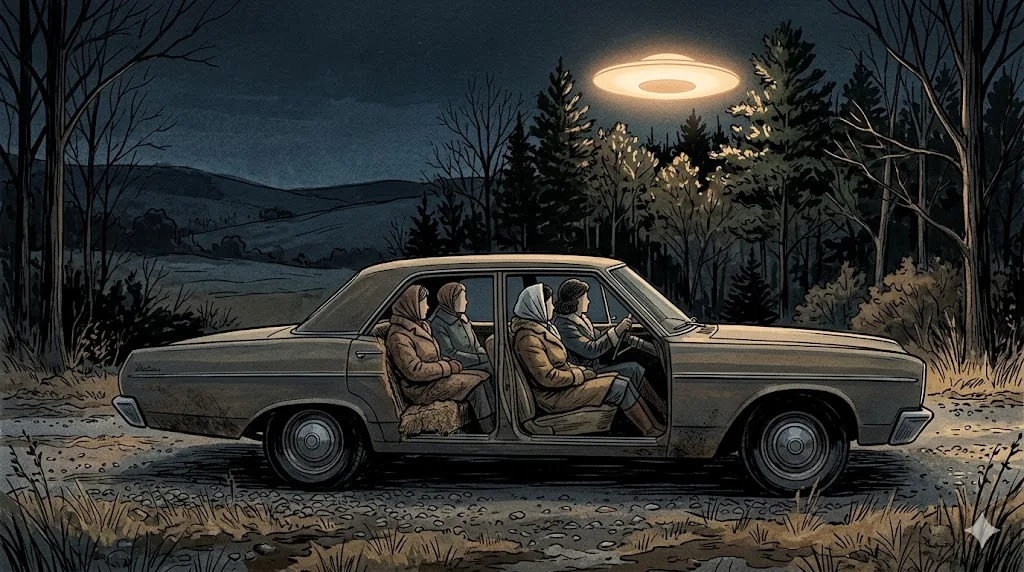
The core incident began as a routine trip. Accounts in UFO case summaries and later press profiles identify the witnesses as Louise Smith, Mona Stafford and Elaine Thomas, travelling home after a birthday dinner connected with Stafford’s thirty-sixth birthday. They had gone to the Redwoods restaurant near the Stanford-Lancaster area and were heading back towards Liberty late at night in Smith’s 1967 Chevrolet Nova. A contemporary-style APRO account reproduced by The Black Vault says the restaurant was north of Stanford and that the women left around 11:15 p.m.; it also states that they should have reached home around midnight but arrived at about 1:25 a.m., leaving an apparent loss of roughly one hour and twenty-five minutes.[theblackvault.com]theblackvault.com1976 stanford kentucky abductions1976 stanford kentucky abductions
The first reported sighting was of a red object descending in the sky. Stafford reportedly thought it might be an aircraft on fire, and Smith was said to have seen it clearly after the women reacted to the apparent descent. The APRO text describes a large disc-shaped object, metallic grey with a glowing white dome, rotating red lights around the middle, steady red and yellow lights beneath, and a bluish beam from the bottom. It places the initial sighting about a mile south of Stanford.[theblackvault.com]theblackvault.com1976 stanford kentucky abductions1976 stanford kentucky abductions
Later retellings add the famous “runaway car” element. In a 2001 CityBeat profile of investigator Jerry Black, Black said the object stopped abruptly, then the car accelerated even though Smith had taken her foot off the pedal, allegedly reaching about 85 miles per hour while the object kept pace near the treetops.[Cincinnati CityBeat]citybeat.comCincinnati City Beat Cover Story: A Close Encounter with Jerry BlackCincinnati City Beat Cover Story: A Close Encounter with Jerry Black This claim is one of the most dramatic parts of the case, but it rests on witness recollection and investigator retelling rather than instrument data, police measurement or mechanical reconstruction.
The transition from close encounter to abduction came later. The women reportedly remembered the drive, the object and the time gap, but not a continuous sequence explaining the missing interval. In UFO-investigator accounts, that gap became the central mystery: where were they during the missing time, and why did they feel physically and emotionally changed afterwards?

How the case was investigated
The case attracted attention from several UFO organisations rather than from a continuing official Air Force UFO programme. That distinction matters. The US Air Force’s Project Blue Book had ended in 1969; the Air Force later summarised its earlier UFO work by saying it had found no UFO evidence indicating a threat to national security, no evidence of technology beyond scientific knowledge, and no evidence that unidentified sightings represented extraterrestrial vehicles.[Air Force]af.milSource details in endnotes. By 1976, therefore, the Stanford case developed mainly through civilian UFO networks, local press interest and private investigators.
The principal named organisations and figures in the Stanford file include MUFON, APRO, CUFOS-linked figures and J. Allen Hynek’s circle. The Black Vault’s case page says Walter Andrus of MUFON and J. Allen Hynek of CUFOS were informed, and that investigators considered regressive hypnosis because the missing-time element suggested, to them, a possible abduction.[theblackvault.com]theblackvault.com1976 stanford kentucky abductions1976 stanford kentucky abductions The same account says Dr R. Leo Sprinkle, a psychologist associated with UFO abduction research, became involved after other options were limited by distance, scheduling and funding.[theblackvault.com]theblackvault.com1976 stanford kentucky abductions1976 stanford kentucky abductions
The January 1977 MUFON UFO Journal is especially useful because it shows the case while it was still being debated inside UFO circles, not merely repeated decades later. It records arguments over confidentiality, funding and how much of the hypnosis material should be released, and it says the investigators had initially agreed not to publish the hypnosis results while the women were in a vulnerable condition.[sciences-faits-histoires.com]sciences-faits-histoires.commufonufojournal 19771 january 130429023417 phpapp02mufonufojournal 19771 january 130429023417 phpapp02
That same journal also documents a major complication: Jerry Black made an arrangement with the National Enquirer for funding connected with a return visit by Sprinkle and polygraph testing. The journal states that the tabloid would receive first publication rights if the time-lapse case became an abduction case backed by professional testimony, and that the women would receive remuneration for their cooperation.[sciences-faits-histoires.com]sciences-faits-histoires.commufonufojournal 19771 january 130429023417 phpapp02mufonufojournal 19771 january 130429023417 phpapp02 This does not prove a hoax, but it does affect source evaluation. Money, exclusivity and media pressure can change how witnesses, investigators and readers frame a case.
The evidence that supporters find persuasive
Supporters of the Stanford case usually point to five features: three witnesses, emotional distress, missing time, polygraph claims, hypnosis narratives and alleged independent sightings. Each is worth separating, because they do not carry the same evidential weight.
Three named adult witnesses. The case is stronger than a solitary anonymous story because it involved three women who knew one another but, according to APRO’s account, did not all have the same long-standing relationship: Smith and Thomas had known each other for years, Stafford had known Thomas for some time, but Smith had only recently become acquainted with Stafford. APRO’s staff concluded that the women were of good reputation, sincere and without obvious motive to invent the story.[theblackvault.com]theblackvault.com1976 stanford kentucky abductions1976 stanford kentucky abductions That assessment is relevant, but it is still an investigator’s character judgement, not a direct test of what happened.
Physical and emotional after-effects. UFO accounts describe weight loss, weakness, eye irritation, burning sensations, fatigue and anxiety after the incident. The Black Vault’s reproduced material says the women suffered ill health and weakness, and later cites Sprinkle’s note that they reported renewed fatigue, listlessness, skin sensitivity, burning feelings on the face and eyes, and fluid discharge after hypnosis.[theblackvault.com]theblackvault.com1976 stanford kentucky abductions1976 stanford kentucky abductions These symptoms may show distress, but they are not specific to an abduction; they could arise from fear, stress, illness, suggestion or unrelated causes.
Polygraph testing. The MUFON journal and later case summaries state that Lexington Police Department detective James Young conducted private polygraph examinations and concluded that the women appeared credible.[sciences-faits-histoires.com]sciences-faits-histoires.commufonufojournal 19771 january 130429023417 phpapp02mufonufojournal 19771 january 130429023417 phpapp02 Yet even the APRO material includes an important limitation from Young: because the witnesses had already been interviewed by Sprinkle and MUFON members, he could not determine how much those prior interviews affected what they now believed about the alleged encounter.[theblackvault.com]theblackvault.com1976 stanford kentucky abductions1976 stanford kentucky abductions A polygraph, even at its best, is not a truth machine for extraordinary events; it may suggest that people are not consciously lying, but it cannot prove that their interpretation is accurate.
Hypnotic regression. The most detailed abduction imagery — examinations, beings, dark rooms, instruments, telepathy and fear — came through or around hypnotic regression sessions. The Black Vault’s account says Stafford first recalled only part of the experience and became exhausted, while later sessions with Smith, Stafford and Thomas produced more elaborate accounts of being taken aboard a craft and examined.[theblackvault.com]theblackvault.com1976 stanford kentucky abductions1976 stanford kentucky abductions The MUFON journal likewise presents hypnosis as the method used to “get to the roots” of the time-lapse material.[sciences-faits-histoires.com]sciences-faits-histoires.commufonufojournal 19771 january 130429023417 phpapp02mufonufojournal 19771 january 130429023417 phpapp02
Other reported sightings. The case is often described as corroborated because other people in Casey and Lincoln counties reportedly saw unusual lights or objects that night. The Black Vault account mentions a couple near the alleged abduction site seeing a large luminous object around 11:30 p.m., other witnesses describing reddish-orange lights around a disc-shaped object, two teenagers allegedly chasing a low-flying UFO towards Danville, and a farmer reporting a low-level glowing object with a white beam near the area.[theblackvault.com]theblackvault.com1976 stanford kentucky abductions1976 stanford kentucky abductions The MUFON journal’s scan similarly says additional witnesses reported a luminous object near Stanford and other UFO sightings in the same general region.[sciences-faits-histoires.com]sciences-faits-histoires.commufonufojournal 19771 january 130429023417 phpapp02mufonufojournal 19771 january 130429023417 phpapp02 These reports are relevant, but many are anonymised, retrospective or filtered through UFO investigators, so they do not remove the need for caution.

Why the abduction claim remains difficult to prove
The case’s central weakness is not that the women were obviously unreliable. It is that the most extraordinary details depend on methods and circumstances that are themselves vulnerable to error.
Hypnosis is the largest problem. Modern memory research does not support treating hypnotically recovered material as a simple replay of hidden facts. In a study of people reporting recovered or repressed memories of alien abduction, Susan Clancy and colleagues found that those participants were more prone than controls to false recall and false recognition in a laboratory memory task.[PubMed]pubmed.ncbi.nlm.nih.govSource details in endnotes. Harvard’s later public account of this research stressed a point that is especially relevant here: people reporting alien-abduction memories were generally not portrayed as mentally ill; rather, the research suggested that normal people can sincerely form extraordinary memories through ordinary cognitive processes.[Harvard Gazette]news.harvard.eduGazette Starship memories: — Harvard GazetteGazette Starship memories: — Harvard Gazette
The Stanford hypnosis sessions also included some features that would trouble a careful evidence review. The APRO material says the women were interviewed separately during initial descriptions, but later were invited to attend additional hypnosis sessions and observe one another’s reactions; Sprinkle noted that one witness’s description could “trigger” a memory in another witness.[theblackvault.com]theblackvault.com1976 stanford kentucky abductions1976 stanford kentucky abductions That is an honest and important admission. It means similarity between later accounts cannot be treated as fully independent corroboration.
The physical evidence is also weak by scientific standards. Claims about skin sensations, weight loss, eye pain, electrical problems in the car, a spinning watch hand and a failed alarm clock are striking, but the public case record does not provide a controlled medical report, mechanical inspection, laboratory finding or chain of custody that would distinguish paranormal causation from ordinary failure, stress response or coincidence. The Black Vault summary notes watch, clock and car electrical issues, but presents them as reported anomalies rather than documented forensic evidence.[theblackvault.com]theblackvault.com1976 stanford kentucky abductions1976 stanford kentucky abductions
Finally, the National Enquirer arrangement complicates the provenance of later public versions. The MUFON journal records that funding, publication rights and witness remuneration became part of the investigative process.[sciences-faits-histoires.com]sciences-faits-histoires.commufonufojournal 19771 january 130429023417 phpapp02mufonufojournal 19771 january 130429023417 phpapp02 That does not make the story false, and it may have been a practical attempt to fund interviews and testing. But it does mean later narratives must be read with attention to incentives, editing and publicity.
The most plausible interpretations
A fair assessment should keep several possibilities open without treating them as equally proven.
The literal abduction interpretation is the one favoured by many UFO writers: the women encountered a structured craft, lost time because they were removed from the car, and recovered partial memories of examination under hypnosis. Its strongest points are the three witnesses, apparent distress, missing-time claim and local sighting reports. Its weakest points are the reliance on hypnosis, the lack of hard physical evidence and the contamination risk from prior interviews and shared sessions.
The misidentified aerial event plus traumatic interpretation accepts that the women saw something unusual or frightening, but not that it was extraterrestrial. A bright object, aircraft, astronomical object, atmospheric phenomenon or local light could have triggered fear on a dark rural road. The later abduction story could then have developed through stress, expectation, investigator framing and hypnosis. This interpretation fits mainstream memory science better, but it must still explain why the witnesses perceived a close, structured object and why they reported such a large time gap.
The social and investigative construction interpretation places more weight on how the case evolved after the first report: UFO investigators entered early, the missing-time framework became dominant, hypnosis was used, witnesses later heard or observed one another’s material, and media incentives entered the case. This does not require conscious deception. It suggests that sincere people and sincere investigators can co-create a detailed narrative from fragments, fear, cultural imagery and suggestive recall.
A deliberate hoax is the least necessary explanation. The surviving sources repeatedly describe the women as distressed and reluctant, and even sceptical investigator comments in the case record tend to question memory and procedure rather than accuse them of fraud. The better sceptical question is not “Were they lying?” but “What can this evidence actually prove?”
What the Stanford case adds to the wider dossier
Within the Stanford, Kentucky abduction dossier, this case sits at the intersection of three themes: rural close-encounter testimony, missing-time abduction claims and the 1970s UFO-investigation culture that relied heavily on civilian groups. It is not a clean official file with instrument records and forensic testing. It is a human testimony case with unusual internal documentation and serious evidential hazards.
Its strongest historical value lies in the early paper trail: the APRO and MUFON material, the named investigators, the route and timing, and the way the case was handled before later internet retellings flattened it into folklore. Its weakest point is the gap between witness sincerity and evidential proof. Sincerity can make a case worth investigating; it cannot by itself establish that a physical abduction occurred.
The result is a case that remains genuinely interesting but not conclusively solved. It is credible as a report of a frightening experience by three women near Stanford in January 1976. It is much less secure as proof of alien abduction. The page’s most careful conclusion is therefore narrower than the legend: the Stanford case is an important, well-known example of how extraordinary UFO-abduction narratives form around real witnesses, real distress, disputed memories and incomplete evidence.
Amazon book picks
Further Reading
Books and field guides related to What Really Happened Near Stanford?. Use these as the next step if you want deeper reading beyond the article.
The UFO Book
Profiles the Stanford case, outlining the witness stories, the investigative trail, and the long-term historical impact.
Abduction: Human Encounters with Aliens
Provides comparative context for interpreting abduction claims and the evolution of the genre.
The Myth of Repressed Memory
Explains why hypnotically recovered memories—a cornerstone of the Stanford file—are scientifically contested.
Missing Time
Details the documentation techniques common to 1970s abduction research and the 'missing time' framework.
eBay marketplace picks
Marketplace Samples
Example marketplace items related to this page. Use the search link to explore similar finds on eBay.


Endnotes
1.
Source: theblackvault.com
Title: 1976 stanford kentucky abductions
Link:https://www.theblackvault.com/casefiles/1976-stanford-kentucky-abductions/
2.
Source: citybeat.com
Title: Cincinnati City Beat Cover Story: A Close Encounter with Jerry Black
Link:https://www.citybeat.com/news/cover-story-a-close-encounter-with-jerry-black-12215115/
3.
Source: sciences-faits-histoires.com
Title: mufonufojournal 19771 january 130429023417 phpapp02
Link:https://www.sciences-faits-histoires.com/medias/files/mufonufojournal-19771-january-130429023417-phpapp02.pdf
4.
Source: news.harvard.edu
Title: Gazette Starship memories: — Harvard Gazette
Link:https://news.harvard.edu/gazette/story/2002/10/starship-memories-2/
5.
Source: dash.harvard.edu
Title: alien abduction
Link:https://dash.harvard.edu/bitstream/handle/1/8862147/alien_abduction.pdf
6.
Source: news.harvard.edu
Title: alien abduction claims examined 2
Link:https://news.harvard.edu/gazette/story/2003/02/alien-abduction-claims-examined-2/
7.
Source: af.mil
Link:https://www.af.mil/About-Us/Fact-Sheets/Display/Article/104590/unidentified-flying-objects-and-air-force-project-blue-book/
8.
Source: pubmed.ncbi.nlm.nih.gov
Link:https://pubmed.ncbi.nlm.nih.gov/12150421/
9.
Source: archives.gov
Title: Project BLUE BOOK
Link:https://www.archives.gov/research/military/air-force/ufos
10.
Source: Wikipedia
Title: Susan Clancy
Link:https://en.wikipedia.org/wiki/Susan_Clancy
11.
Source: Wikipedia
Title: Alien abduction
Link:https://en.wikipedia.org/wiki/Alien_abduction
12.
Source: Wikipedia
Title: Project Blue Book
Link:https://en.wikipedia.org/wiki/Project_Blue_Book
13.
Source: youtube.com
Link:https://www.youtube.com/watch?v=P1YVfdOzG7c
14.
Source: origins.osu.edu
Title: air force investigation ufos
Link:https://origins.osu.edu/read/air-force-investigation-ufos
15.
Source: britannica.com
Title: Project Blue Book
Link:https://www.britannica.com/topic/Project-Blue-Book
16.
Source: vault.fbi.gov
Link:https://vault.fbi.gov/Project%20Blue%20Book%20%28UFO%29%20/Project%20Blue%20Book%20%28UFO%29%20Part%2001%20%28Final%29/at_download/file
17.
Source: ufocasebook.com
Link:https://ufocasebook.com/Stanford.html
18.
Source: susanblackmore.uk
Title: Alien abduction
Link:https://www.susanblackmore.uk/journalism/alien-abduction/
Additional References
19.
Source: youtube.com
Link:https://www.youtube.com/watch?v=FAAFOzax29g
Source snippet
Witches, Magic, Murder, & Mystery Podcast, Ep. 32: The Stanford Alien Encounter...
20.
Source: youtube.com
Link:https://www.youtube.com/watch?v=HnisLLYP8nQ
Source snippet
Unsolved Mysteries: The 1976 Alien Abduction in Stanford, KY...
21.
Source: nsa.gov
Link:https://www.nsa.gov/portals/75/documents/news-features/declassified-documents/ufo/usaf_fact_sheet_95_03.pdf
22.
Source: archivesfoundation.org
Link:https://archivesfoundation.org/documents/50-years-ago-government-stops-investigating-ufos/
23.
Source: psychologytoday.com
Link:https://www.psychologytoday.com/gb/articles/200303/alien-abductions-the-real-deal
24.
Source: facebook.com
Link:https://www.facebook.com/groups/397294058643766/posts/979135217126311/
25.
Source: facebook.com
Link:https://www.facebook.com/BBCRadio4/posts/did-the-cold-war-influence-witnesses-of-the-first-ever-supposedly-paranormal-ufo/1458086863027672/
26.
Source: instagram.com
Link:https://www.instagram.com/p/DQ97vNPCFXa/?hl=en-gb
27.
Source: apa.org
Link:https://www.apa.org/news/podcasts/speaking-of-psychology/memory-manipulated
28.
Source: skepticalinquirer.org
Link:https://skepticalinquirer.org/wp-content/uploads/sites/29/2019/03/Issue-02-15.pdf
Topic Tree
Follow this branch
Related pages 106
- Godfrey Encounter
- Hamilton Airship
- Andreasson
- Villas Boas
- Apollo 11 Sightings
- +101 more in sidebar