Within Lakenheath
Was There Really a Venom Chase?
The alleged Venom chase is the dramatic heart of the case, but later aircrew memories complicate the classic version.
On this page
- The classic tail chase account
- Perkins's later testimony
- Conflicting aircrew memories
Page outline Jump by section
Introduction
The alleged RAF Venom interception is the dramatic centrepiece of the 1956 Lakenheath episode. Without it, the incident would mainly be remembered as a confusing series of radar anomalies and distant lights seen during the Perseid meteor shower. With it, the case became one of the most famous “radar-visual” UFO incidents of the Cold War: a military jet supposedly locked onto an unknown target, only for the target to manoeuvre behind the aircraft and pursue it across East Anglia.[Kirk McDonald]kirkmcd.princeton.eduKirk Mc Donaldufos over lakenheathKirk McDonaldufos over lakenheath - 1956RATCC reported that "as the Venom passed the target on radar, the target began a tail chase of th…
 The difficulty is that the classic version of the chase was built largely from radar-room recollections and official summaries written after the fact, while later interviews with the surviving RAF aircrew produced a far less dramatic story. Those conflicting memories did not fully debunk the Lakenheath episode, but they changed the argument. The question shifted from “Did a UFO outfly an RAF interceptor?” to “What exactly happened during the interception, and whose recollection is most reliable?”[Wikipedia]WikipediaLakenheath-Bentwaters incidentLakenheath-Bentwaters incident
The classic tail-chase account
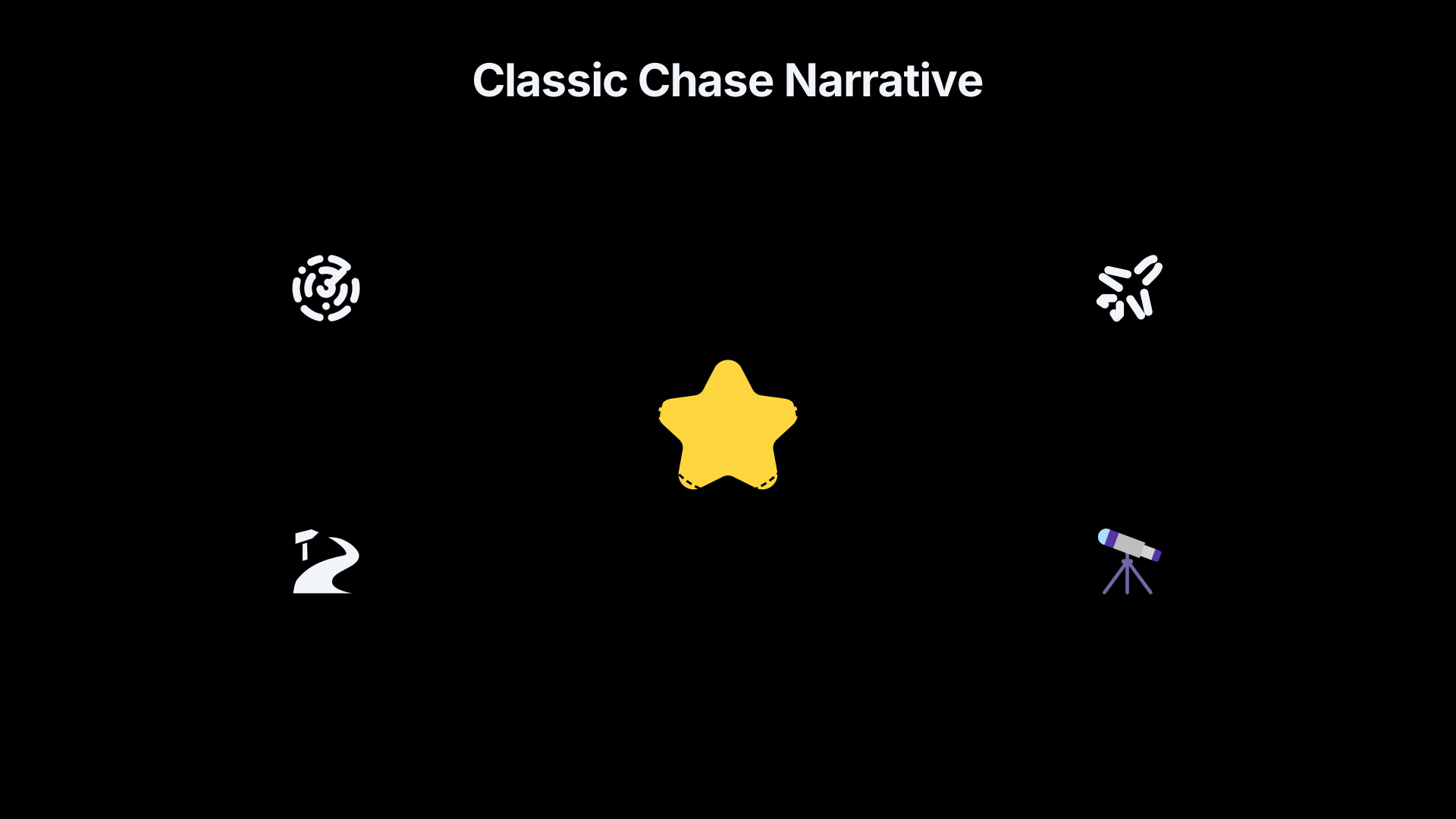
The best-known version of events emerged from US Air Force records, the later Condon Committee investigation, and especially the recollections of Technical Sergeant Forrest Perkins, who supervised radar operations at Lakenheath that night. According to this narrative, two RAF de Havilland Venom night-fighters from RAF Waterbeach were scrambled after ground radar operators tracked unusual targets performing abrupt movements and stationary pauses near Lakenheath.[Wikipedia]WikipediaIncidente Lakenheath-BentwatersIncidente Lakenheath-Bentwaters[CIA]cia.govUFO ENCOUNTER II, SAMPLE CASE SELECTED BY THE…The pilot of the Venom intercep- tor tried numerous evasive maneuv- ers, but he was…
The first Venom reportedly approached a radar contact successfully. In the standard retelling, the pilot achieved airborne radar contact on the target while ground controllers simultaneously tracked both aircraft and unknown object. Then the situation supposedly reversed. As the Venom passed the target, the unknown return moved behind the fighter and followed it. Radar operators allegedly watched the object mirror the Venom’s evasive turns for several minutes. Perkins later recalled that the pilot became increasingly alarmed while trying unsuccessfully to shake the target.[Kirk McDonald]kirkmcd.princeton.eduKirk Mc Donaldufos over lakenheathKirk McDonaldufos over lakenheath - 1956RATCC reported that "as the Venom passed the target on radar, the target began a tail chase of th…
This “tail chase” became the defining image of the entire Lakenheath case because it appeared to combine several layers of evidence at once:
- Ground radar tracking. * Airborne interception radar.[cia.gov]cia.govorne radar, seems to rule out this hypothesis. The detec- tion…Read more… * Pilot reactions over radio.[kirkmcd.princeton.edu]kirkmcd.princeton.eduKirk Mc Donaldufos over lakenheathKirk McDonaldufos over lakenheath - 1956RATCC reported that "as the Venom passed the target on radar, the target began a tail chase of th…
- Simultaneous visual reports from the ground.
- Behaviour seemingly inconsistent with known aircraft.
The Condon Committee treated the incident unusually seriously. Physicist Gordon David Thayer, who analysed the radar and visual evidence for the committee, concluded that ordinary explanations seemed inadequate for at least part of the event. He called it “the most puzzling and unusual case” in the radar-visual files and suggested that anomalous radar propagation alone did not comfortably explain the behaviour reported during the interception phase.[Wikipedia]WikipediaLakenheath-Bentwaters incidentLakenheath-Bentwaters incident
That conclusion gave the Venom chase enormous importance in UFO literature. Many radar cases involved only strange blips; many visual cases depended on uncertain eyewitness testimony. Lakenheath appeared to offer both at once, tied together by a military interception attempt.
Why the Venom mattered so much
The Venom itself became symbolically important because it was not a random aircraft. The de Havilland Venom NF series was a dedicated night-fighter equipped with airborne interception radar and designed specifically to locate targets in darkness. In UFO discussions, that detail was often treated as a major credibility boost: trained military crews using purpose-built interception equipment supposedly failed to identify the object they were tracking.[midimagic.sgc-hosting.com]midimagic.sgc-hosting.comLAKENHEAT H-BENTWATERSThe Venom is a 1-seat airplane with a nose RADAR. First plane detected by Air Traffic Control. (H)…Read more…
The story also fit Cold War expectations. In 1956 Britain and the United States were intensely concerned about unidentified radar targets because Soviet bombers and electronic deception were genuine strategic worries. Scrambling fighters at night over eastern England was not done casually. That atmosphere helped later writers argue that the military personnel involved would not have overreacted to ordinary stars or meteors.
At the same time, the Venom account contained weaknesses from the beginning:
- The surviving documentation was incomplete.
- Timings varied between reports.
- Different control centres later claimed responsibility for the interception.
- British records were sparse compared with American summaries.
- Most detailed descriptions came years later rather than immediately after the event.
Those gaps became increasingly important once researchers began locating surviving participants decades afterward.
Perkins’s later testimony
Forrest Perkins played a decisive role in shaping the modern narrative because his 1968 letter to the University of Colorado UFO study revived official attention to the case. Much of the dramatic language associated with the interception comes from his recollections rather than from contemporary operational transcripts.[Wikipedia]WikipediaIncidente Lakenheath-BentwatersIncidente Lakenheath-Bentwaters
Perkins described the pilot as frightened and struggling to evade the pursuing object. He also emphasised that the target appeared under intelligent control, changing position in response to the fighter’s manoeuvres. His account aligned broadly with a classified teleprinter message later obtained by the Condon investigators, which helped give his story institutional weight.[Wikipedia]WikipediaIncidente Lakenheath-BentwatersIncidente Lakenheath-Bentwaters
However, historians later noted several complications:
The testimony came more than a decade later
Human memory is reconstructive rather than photographic. By 1968, the Lakenheath incident had already become a famous UFO case inside specialist circles. Perkins was recalling events from twelve years earlier, after the story had circulated and evolved. That does not make his account false, but it does reduce confidence in precise details such as timings, wording, and the emotional state of the pilot.
Perkins was a radar supervisor, not an aircrew witness
He observed events indirectly through radar scopes and radio traffic. His reconstruction depended partly on interpretation and partly on what he believed the pilot was experiencing. Researchers later argued that some details may have become compressed or merged over time.
His version may have blended multiple interceptions
Later investigations suggested that more than one Venom sortie and more than one control centre may have been involved during the night. Some modern researchers believe Perkins unintentionally fused separate events into a single dramatic sequence.[Wikipedia]WikipediaIncidente Lakenheath-BentwatersIncidente Lakenheath-Bentwaters
Even so, Perkins’s testimony cannot simply be dismissed. Parts of it match surviving military documentation, and other witnesses independently recalled an attempted interception. The dispute concerns how dramatic and unusual the encounter actually was.
Freddie Wimbledon and the competing controller narrative
Another important figure was Flight Lieutenant Freddie Wimbledon, a radar controller at RAF Neatishead. In 1978 he publicly challenged sceptical claims that the case had effectively been explained away. Wimbledon insisted the radar contacts had been genuine and remembered the interception as a serious event tracked simultaneously by multiple radar systems.[Wikipedia]WikipediaIncidente Lakenheath-BentwatersIncidente Lakenheath-Bentwaters
His testimony strengthened the traditional narrative in several ways:
- He independently supported the idea of a target following the Venom.
- He rejected the suggestion that operators had merely watched meteor-related clutter.
- He claimed the targets were solid returns tracked from several stations.
But Wimbledon also complicated the story because his recollections differed from Perkins’s on operational details. Wimbledon said that Neatishead controllers directed the interception and that the Americans at Lakenheath were mainly monitoring events rather than leading them.[Wikipedia]WikipediaIncidente Lakenheath-BentwatersIncidente Lakenheath-Bentwaters
That disagreement mattered historically because it hinted at fragmented memories and overlapping command structures. If experienced participants could not agree on who controlled the interception, confidence in the precise chase narrative naturally weakened.
The aircrew interviews that changed the debate
The largest challenge to the classic story arrived decades later, when researchers including David Clarke, Andy Roberts, Martin Shough, and Jenny Randles tracked down surviving RAF aircrew connected to the incident. Their interviews significantly altered the historical picture.[Wikipedia]WikipediaIncidente Lakenheath-BentwatersIncidente Lakenheath-Bentwaters
The crews identified included:
- Flying Officers David Chambers and John Brady from one Venom.
- Flying Officers Ian Fraser-Ker and Ivan Logan from another.
According to these later interviews, the pilots did not remember a spectacular UFO pursuit at all. They acknowledged radar contacts of some kind, but denied the dramatic “tail chase” described in UFO literature. The airborne returns reportedly seemed weak or unimpressive, and the crews did not recall being pursued by an unknown object during violent evasive manoeuvres.[Wikipedia]WikipediaIncidente Lakenheath-BentwatersIncidente Lakenheath-Bentwaters
This was a major blow to the strongest version of the case because the pilots themselves were the people supposedly at the centre of the encounter.
Several further problems emerged from the interviews:
The timings did not match the classic account
The recovered crews recalled being scrambled around 02:00 and 02:40 on 14 August, roughly two hours later than the times associated with the famous interception narrative.[Wikipedia]WikipediaIncidente Lakenheath-BentwatersIncidente Lakenheath-Bentwaters
That discrepancy suggested either:
- The classic chronology was wrong.
- Another interception had occurred.
- Witness memories had drifted.
- Different events had become merged into a single narrative.
Another Venom pilot may have been involved
Research also indicated that Wing Commander A. N. Davis may have flown a separate Venom investigation flight in the same period. Some historians think Davis and another pilot could have been the aircrew described indirectly by Perkins and Wimbledon.[Wikipedia]WikipediaIncidente Lakenheath-BentwatersIncidente Lakenheath-Bentwaters
This possibility partially rescues the traditional story because it leaves open the chance that the dramatic interception involved aircrew other than the later-interviewed pilots. But no definitive documentation proving this has surfaced.
The pilots remembered routine ambiguity, not terror
Perhaps the most striking contrast concerns tone. In the classic version, the pilot sounds frightened and overwhelmed. In the later interviews, the surviving crews described nothing especially extraordinary. One interpretation is that the radar controllers overinterpreted a confusing interception. Another is that the most dramatic pilot was simply never located.
Did the later recollections debunk the chase?
The answer depends on what level of claim is being examined.
The later pilot interviews clearly weakened the strongest UFO interpretation. The image of a Venom desperately trying to escape a mechanically intelligent object no longer rests on uncontested testimony. The most direct witnesses did not confirm the famous pursuit in the form later popularised.[Wikipedia]WikipediaIncidente Lakenheath-BentwatersIncidente Lakenheath-Bentwaters
But the interviews did not erase the case entirely.
Several elements remained difficult to explain away cleanly:
- Multiple radar stations reported unusual returns.
- Controllers independently remembered the interception as serious.
- Some military documentation referenced a pursuit scenario.
- Witnesses disagreed about details, but not about the fact that unusual radar activity prompted real operational concern.
The dispute therefore shifted from “did something happen?” to “how extraordinary was it?”
That distinction matters because UFO history often turns on narrative escalation. A confused radar interception during a meteor-rich night is unusual but not astonishing. A target intelligently stalking a military interceptor is far more dramatic. The later recollection dispute mostly attacked the second claim, not the first.
Sceptical interpretations of the Venom episode
Sceptics such as aviation writer Philip J. Klass argued that the interception story could emerge naturally from a mixture of radar anomalies, meteor sightings, psychological expectation, and communication confusion.[Wikipedia]WikipediaIncidente Lakenheath-BentwatersIncidente Lakenheath-Bentwaters
Several mechanisms have been proposed:
Radar anomalies and anomalous propagation
Temperature inversions can sometimes bend radar beams and create false or displaced returns. Ground clutter and intermittent targets may appear to move abruptly or stop suddenly. Critics argue that excited operators under Cold War pressure could interpret these returns as controlled objects.
Meteor distraction
The Perseid meteor shower was active that night. Fast-moving bright meteors could reinforce the impression that strange objects corresponded to radar contacts, even when the phenomena were unrelated.
Interception confusion
Night interceptions in the 1950s were technically difficult. Weak airborne radar contacts, shifting bearings, radio lag, and multiple controllers could easily generate contradictory impressions about what the aircraft was actually tracking.
Memory contamination
Because the famous versions of the story emerged years later, sceptics argue that witnesses unintentionally absorbed details from retellings, discussions, and official summaries. Under this view, the dramatic chase evolved gradually rather than being fabricated deliberately.
Some modern writers have also speculated about military radar spoofing or electronic warfare experimentation, though hard evidence for such tests during the Lakenheath episode remains limited.[Wikipedia]WikipediaIncidente Lakenheath-BentwatersIncidente Lakenheath-Bentwaters
Why the Venom dispute still matters
The Venom controversy is important because it illustrates how historical UFO cases change over time. Lakenheath is often cited as one of the strongest radar-visual incidents ever recorded, yet its most famous episode depends on layered testimony with substantial inconsistencies.
The case remains historically significant for several reasons:
- Contemporary military personnel treated the situation seriously.
- Some official investigators considered ordinary explanations insufficient.
- The surviving records show genuine operational confusion.
- Later witness interviews complicated rather than cleanly solved the mystery.
The result is neither a straightforward extraterrestrial encounter nor a fully demolished myth. Instead, the Venom interception stands as a case study in how radar evidence, pilot testimony, institutional memory, and later reinterpretation can pull a famous incident in different directions at once.[Wikipedia]WikipediaIncidente Lakenheath-BentwatersIncidente Lakenheath-Bentwaters[CIA]cia.govorne radar, seems to rule out this hypothesis. The detec- tion…Read more…
Amazon book picks
Further Reading
Books and field guides related to Was There Really a Venom Chase?. Use these as the next step if you want deeper reading beyond the article.
The Report on Unidentified Flying Objects
Details his first-hand involvement, investigative conclusions, and his formal 'dogfight' assessment within the Project Blue Book files.
The UFO Book
Summarizes the controversy behind the interception and the fallout for UFO literature when witnesses are interviewed later.
Scientific Paranormal Investigation
Teaches investigative methodology for analyzing credibility issues, contradictions, and narrative inflation in UFO testimony.
Ufos and Government
Provides institutional background on how 1950s investigative bureaus indexed and eventually rejected exaggerated sighting claims.
eBay marketplace picks
Marketplace Samples
Example marketplace items related to this page. Use the search link to explore similar finds on eBay.
Endnotes
1.
Source: Wikipedia
Title: Lakenheath-Bentwaters incident
Link:https://en.wikipedia.org/wiki/Lakenheath-Bentwaters_incident
2.
Source: cia.gov
Link:https://www.cia.gov/readingroom/docs/CIA-RDP81R00560R000100010010-0.pdf
Source snippet
UFO ENCOUNTER II, SAMPLE CASE SELECTED BY THE...The pilot of the Venom intercep- tor tried numerous evasive maneuv- ers, but he was...
3.
Source: cia.gov
Link:https://www.cia.gov/readingroom/document/cia-rdp81r00560r000100010010-0
Source snippet
orne radar, seems to rule out this hypothesis. The detec- tion...Read more...
4.
Source: Wikipedia
Title: Incidente Lakenheath-Bentwaters
Link:https://es.wikipedia.org/wiki/Incidente_Lakenheath-Bentwaters
5.
Source: midimagic.sgc-hosting.com
Title: LAKENHEAT H-BENTWATERS
Link:https://midimagic.sgc-hosting.com/lakenhea.htm
Source snippet
The Venom is a 1-seat airplane with a nose RADAR. First plane detected by Air Traffic Control. (H)...Read more...
6.
Source: kirkmcd.princeton.edu
Title: Kirk Mc Donaldufos over lakenheath
Link:https://kirkmcd.princeton.edu/JEMcDonald/mcdonald_fsr_16_9_70.pdf
Source snippet
Kirk McDonaldufos over lakenheath - 1956RATCC reported that "as the Venom passed the target on radar, the target began a tail chase of th...
Additional References
7.
Source: facebook.com
Link:https://www.facebook.com/groups/514090932384738/posts/524739197986578/
Source snippet
There was a previous UFO incident above RAF Bentwaters / Woodbridge England. In 1956 there were...
8.
Source: academia.edu
Title: (PDF) RAF Bentwaters/Lakenheath, Air-visual/Radar UFO
Link:https://www.academia.edu/90805219/RAF_Bentwaters_Lakenheath_Air_visual_Radar_UFO_Observation_13_14_August_1956
Source snippet
Lakenheath. After some discussion, Wimbledon recounts, "I scrambled a Venom night-fighter from the Battle Flight [stationed at RAF Waterb...
9.
Source: facebook.com
Link:https://www.facebook.com/cwealthforces/posts/are-aliens-still-lurking-near-the-former-raf-bentwaters-and-raf-woodbridge-usaf-/980100621208435/
Source snippet
r Traffic Control Centre at Lakenheath that night, wrote directly to...Read more...
10.
Source: uapedia.ai
Title: lakenheath bentwaters 1956 uap incident case study
Link:https://www.uapedia.ai/wiki/lakenheath-bentwaters-1956-uap-incident-case-study/
Source snippet
Lakenheath-Bentwaters 1956 UAP Incident Case Study10 May 2026 — Discover the 1956 Lakenheath-Bentwaters UAP incident, an extraordinary Co...
Published: May 2026
11.
Source: reddit.com
Title: on 13 august 1956 military radar at multiple
Link:https://www.reddit.com/r/UnresolvedMysteries/comments/17gdyu6/on_13_august_1956_military_radar_at_multiple/
Source snippet
On 13 August 1956, military radar at multiple bases in...In Chapter 5 of the Condon Report, "Optical and Radar Analyses of... Because w...
Published: august 1956
12.
Source: abovethenormnews.com
Title: the lakenheath incident of 1956
Link:https://www.abovethenormnews.com/2023/09/10/the-lakenheath-incident-of-1956/
Source snippet
The Lakenheath UFO Incident of 195610 Sept 2023 — The first Venom took to the sky, piloted by an experienced officer, Flight Lieutenant F...
13.
Source: youtube.com
Link:https://www.youtube.com/watch?v=t8QIt5Gtj8U
Source snippet
Top 10 Concerning UFO Evidence The Pentagon Is Hiding From Us - Part 3...
14.
Source: airandspaceforces.com
Title: Almanac2024 Fullissue V11
Link:https://www.airandspaceforces.com/app/uploads/2024/06/Almanac2024_Fullissue_V11.pdf
Source snippet
Weapons School Turns 75 15... recollections of some of his service history with Air & Space Forces... 1956, when he took command of the...
15.
Source: ufoinsight.com
Title: lakenheath ufo chase
Link:https://www.ufoinsight.com/ufos/cover-ups/lakenheath-ufo-chase
Source snippet
The Lakenheath UFO Chase Incident26 Jul 2018 — And what's more, their recollections of the incident were largely in line with the origina...
16.
Source: youtube.com
Title: Top 10 Concerning UFO Evidence The Pentagon Is Hiding From Us
Link:https://www.youtube.com/watch?v=1NYCy6YFLp8
Source snippet
Rendlesham Forest UFO Trail - Britain's Roswell / Bentwaters Incident...
Topic Tree