Within Walton
Could the Walton Case Have Been Staged?
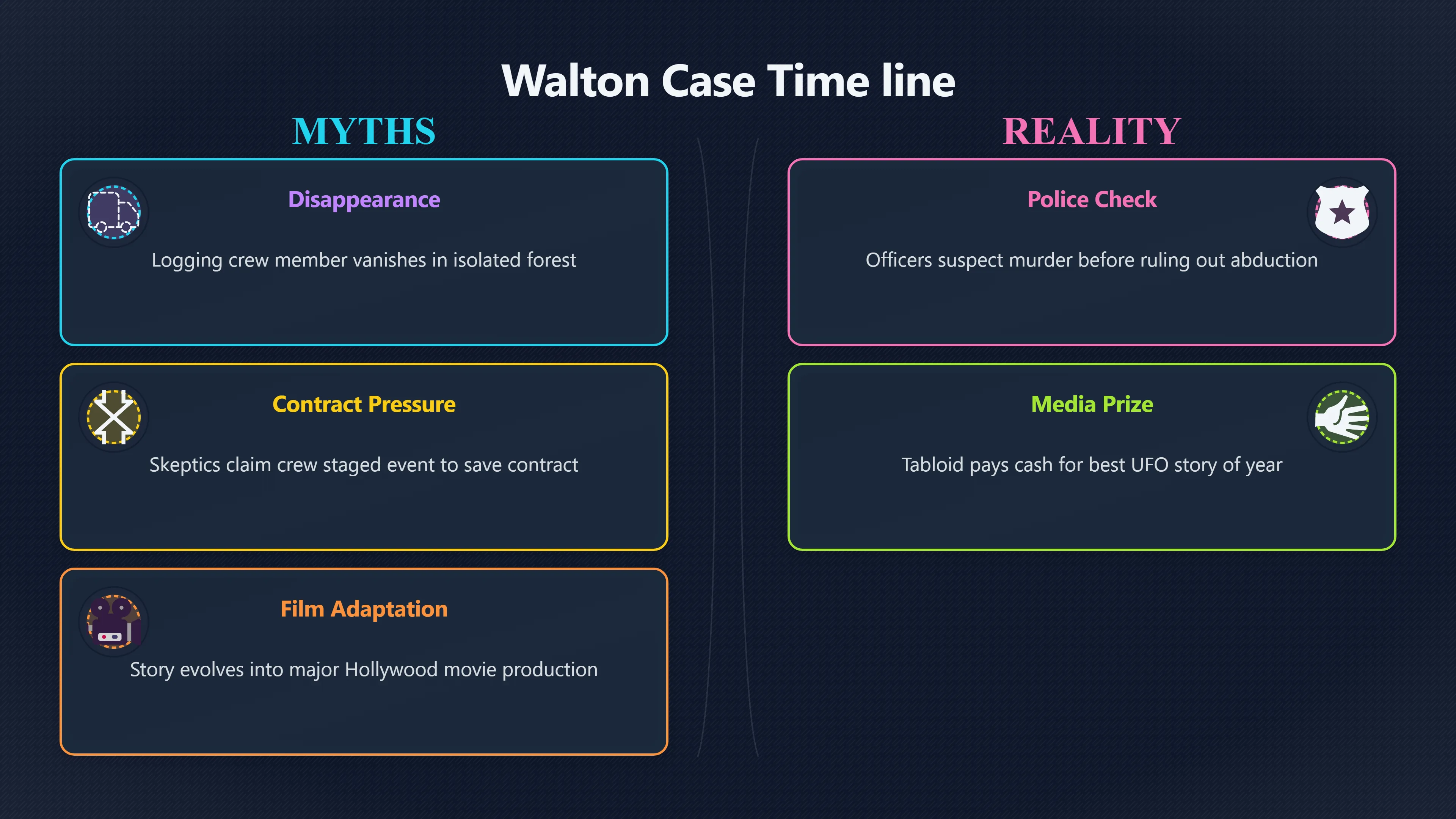
Skeptics argue the case may reflect incentives, failed or disputed lie-detector claims, and a story strengthened by publicity.
On this page
- Klass's contract pressure theory
- Why polygraphs cannot prove abduction
- Money, media, and the hardening of the story
Page outline Jump by section
Introduction
The Travis Walton case has survived for decades partly because it contains elements that many UFO stories lack: multiple witnesses, a documented missing-person investigation, and a narrative that remained publicly consistent over time. Yet the strongest sceptical arguments focus on a different point entirely. Critics contend that the case depends almost entirely on testimony, that the most celebrated polygraph claims were selectively presented, and that publicity incentives may have encouraged the story to harden into a cultural phenomenon rather than collapse under scrutiny.
 The dispute matters because the Walton case became a template for later alien-abduction narratives. Believers often point to the logging crew’s corroboration and the emotional intensity of the early reports. Sceptics instead focus on motive, media involvement, contradictions in the lie-detector history, and the role played by UFO organisations and tabloids in shaping public perception. The result is not a settled debunking, but a long-running argument over whether the case represents extraordinary testimony or a well-supported folklore event built on weak evidentiary foundations.[2Hangar1publishing]hangar1publishing.comThe Travis Walton Abduction: America's Most CompellingTravis's own polygraph results were more complicated. His first examination… Klass developed a comprehensive theory that the entire in…
Could the Walton Case Have Been Staged?
The core sceptical position is not merely that Walton misidentified something in the forest. It is that the entire disappearance may have been orchestrated. The most influential version of that theory came from aviation journalist and UFO sceptic Philip J. Klass, who spent years investigating the case and arguing that the incident reflected fraud rather than unexplained phenomena.[Wikipedia]WikipediaTravis Walton incidentTravis Walton incident
Klass believed the strongest clue was timing. The logging crew led by Mike Rogers had reportedly fallen behind on a US Forest Service contract. According to Klass’s reconstruction, a dramatic event could have provided a face-saving explanation for poor performance or potential penalties. Walton disappeared on 5 November 1975 and reappeared just before the contract deadline became critical, which sceptics have long viewed as suspicious.[Hangar1publishing]hangar1publishing.comThe Travis Walton Abduction: America's Most CompellingTravis's own polygraph results were more complicated. His first examination… Klass developed a comprehensive theory that the entire in…
This “contract-pressure theory” became one of the central sceptical explanations because it offered a practical motive rather than a purely psychological one. Critics argued that:
- the crew already shared close social ties;
- several members had prior interest in UFO stories;
- the event occurred in an isolated forest with no outside witnesses;
- and the subsequent media attention produced financial and reputational rewards.
Supporters of Walton dispute nearly every part of this argument. They note that the financial gain was modest compared with the ridicule and scrutiny the men experienced. They also argue that staging a disappearance lasting several days would have required unusual coordination and nerve, especially under police pressure during a homicide-style investigation.
Still, sceptics respond that successful hoaxes do not require perfect planning. They argue that once the story attracted national attention, social reinforcement and public commitment may have helped keep the witnesses aligned. In this interpretation, the case evolved from a local incident into a self-sustaining mythology.[2Hangar1publishing]hangar1publishing.comThe Travis Walton Abduction: America's Most CompellingTravis's own polygraph results were more complicated. His first examination… Klass developed a comprehensive theory that the entire in…
The National Enquirer and the incentive problem
One of the most controversial details is the involvement of the tabloid newspaper the National Enquirer. Shortly after Walton returned, the paper financed aspects of the case and later awarded the crew a cash prize for the “best UFO case of the year”.[Wikipedia]WikipediaPhilip J. KlassPhilip J. Klass
For sceptics, this immediately complicated the credibility question. The case was no longer simply a strange disappearance under investigation by Arizona authorities. It had become a commercial media story.
Critics argue that the Enquirer’s involvement created at least three problems:
- It introduced financial incentives into a case already dependent on testimony.
- It encouraged sensational framing.
- It blurred the line between investigation and promotion.
Defenders of Walton counter that the amount of money involved was relatively small when divided among the men and could not plausibly compensate for decades of ridicule. They also note that media organisations routinely pay for exclusives without automatically invalidating a story.
Even so, sceptics maintain that the issue is not whether the crew became rich, but whether publicity and attention reinforced commitment to the narrative. Once the case entered books, documentaries, television interviews and eventually the film Fire in the Sky, backing away from the original claim became increasingly unlikely.[Wikipedia]WikipediaOpen source on wikipedia.org.
Why the Polygraph Story Became So Contested
For many casual readers, the Walton case is synonymous with “the men passed lie-detector tests”. In reality, the polygraph history is far more complicated.
Immediately after Walton disappeared, police suspected the crew might have harmed him. Arizona Department of Public Safety examiner C. E. Gilson questioned the men to determine whether they had murdered Walton or concealed his whereabouts. Five of the six men were judged truthful on those narrow questions, while one result was considered inconclusive.[Wikipedia]WikipediaDoug Williams (polygraph criticDoug Williams (polygraph critic
That distinction matters. The tests did not establish that aliens existed or that an abduction occurred. They addressed whether the crew appeared truthful when denying violence against Walton and when describing an unusual sighting. Sceptics argue that these results were later exaggerated in public retellings into proof of extraterrestrial contact.[Wikipedia]WikipediaTravis Walton incidentTravis Walton incident
The most damaging issue for Walton’s supporters emerged later: an early private polygraph examination reportedly concluded that Walton himself was engaging in “gross deception”. According to sceptical accounts, examiner John J. McCarthy believed Walton was deliberately attempting to manipulate the machine, including through controlled breathing techniques.[Center for Inquiry]centerforinquiry.s3.amazonaws.comNational Enquirer, from A PRO members, and even from members of a blue-ribbon panel of UFOlogists…
This became central to the criticism advanced by Klass and later sceptical writers. They argued that public discussions highlighted the favourable tests while downplaying or omitting the failed examination. Michael Shermer and other sceptics later cited this selective presentation as evidence that the case had been publicly curated rather than neutrally investigated.[Wikipedia]WikipediaPhilip J. KlassPhilip J. Klass
Walton and his supporters disputed the significance of the failed test. They argued that:
- McCarthy was hostile and confrontational;
- the questioning environment was biased;
- irrelevant personal accusations were introduced during testing;
- and later examinations were more favourable to Walton.
This dispute over examiner bias became almost as important as the test outcome itself. Believers portrayed the failed test as contaminated by antagonistic questioning, while sceptics portrayed the later favourable tests as arranged through UFO-friendly intermediaries.[Hangar1publishing]hangar1publishing.comThe Travis Walton Abduction: America's Most CompellingTravis's own polygraph results were more complicated. His first examination… Klass developed a comprehensive theory that the entire in…
Why Polygraphs Cannot Resolve the Walton Case
The Walton controversy also exposes a broader problem: polygraphs are often misunderstood as scientific truth machines when they are really stress-measurement tools interpreted by humans.
Modern critics of lie detectors note that polygraphs do not directly detect lies. They monitor physiological responses such as breathing, pulse and perspiration. Anxiety, confusion, fear, anger or deliberate countermeasures can all affect outcomes. Even intelligence agencies and criminal investigations have documented false positives and false negatives.[Wikipedia]WikipediaOpen source on wikipedia.org.
That broader scientific criticism weakens both sides of the Walton argument.
Believers cannot legitimately claim that passing a polygraph proves alien abduction. At best, it suggests a subject appeared sincere during questioning. But sceptics also cannot treat a failed polygraph as definitive proof of fraud, because the tests themselves remain disputed and examiner interpretation plays a large role.
This is why the Walton case remains stuck in an unusual evidentiary position. The strongest “evidence” for authenticity is testimonial consistency reinforced by supportive polygraph interpretations. The strongest sceptical rebuttal is that the same polygraph history is internally contradictory and scientifically weak.
The debate therefore becomes less about machines and more about credibility:
- Did the witnesses honestly report a frightening but misinterpreted experience?
- Did some or all participants knowingly stage an event?
- Or did the story gradually become fixed through repetition, media reinforcement and community belief?
Polygraphs cannot answer those questions conclusively. They only became symbolic weapons in a larger credibility battle.[Wikipedia]WikipediaDoug Williams (polygraph criticDoug Williams (polygraph critic
Money, Media and the Hardening of the Story
One reason the Walton case still divides opinion is that it evolved during a major cultural shift in UFO mythology. By the late 1970s and early 1980s, alien-abduction narratives were becoming more elaborate and commercially visible in books, television specials and paranormal media. Walton’s story fit that emerging landscape unusually well.[Wikipedia]WikipediaDoug Williams (polygraph criticDoug Williams (polygraph critic
Sceptics argue that this environment rewarded dramatic consistency. Once Walton published The Walton Experience and the story later inspired the film Fire in the Sky, the incident ceased to be merely a local Arizona mystery. It became intellectual property, a convention topic and a foundational abduction narrative.[Wikipedia]WikipediaDoug Williams (polygraph criticDoug Williams (polygraph critic
Critics therefore focus less on proving a specific mechanical hoax and more on how stories become culturally stabilised. Several factors contributed to that hardening process:
- repeated retellings across decades;
- reinforcement within UFO communities;
- commercial adaptation into books and film;
- public identification with the role of witness or survivor;
- and the emotional cost of retracting a famous claim.
This does not automatically mean the story was fabricated. Many witnesses to unusual experiences become more certain over time, not less. But sceptics argue that cultural reinforcement can increase confidence even when the original event was misunderstood or exaggerated.
The Walton case ultimately survives because neither side possesses decisive evidence. There is no verified physical trace proving abduction, but there is also no conclusive demonstration of a staged disappearance. Instead, the dispute persists in a space where testimony, memory, media incentives and belief overlap — a setting in which certainty is difficult to achieve and debate becomes self-perpetuating.[2Hangar1publishing]hangar1publishing.comThe Travis Walton Abduction: America's Most CompellingTravis's own polygraph results were more complicated. His first examination… Klass developed a comprehensive theory that the entire in…

Amazon book picks
Further Reading
Books and field guides related to Could the Walton Case Have Been Staged?. Use these as the next step if you want deeper reading beyond the article.
Fire in the Sky
Contains Walton's counterarguments against Klass, detailing his views on the lie-detector tests and media tabloid rewards.
UFOs Explained
Devotes multiple chapters to the logging contract deadlines, tracking financial penalties and deconstructing the selective presentation o...
The Cowboy Girl
Breaks down the scientific reasons why polygraphs measure physiological stress loops rather than objective truth, explaining the case's m...
The UFO Book
Details the long-running dispute between National Enquirer publicity funding and the early APRO investigation metrics.
eBay marketplace picks
Marketplace Samples
Example marketplace items related to this page. Use the search link to explore similar finds on eBay.




Endnotes
1.
Source: Wikipedia
Title: Travis Walton incident
Link:https://en.wikipedia.org/wiki/Travis_Walton_incident
2.
Source: hangar1publishing.com
Title: The Travis Walton Abduction: America’s Most Compelling
Link:https://hangar1publishing.com/blogs/ufos-uaps-and-aliens/travis-walton-abduction?srsltid=AfmBOopeU3Su8A2xzQF5yTRfbuVaJUAlJ1AR4W1N5D5rGSPMDdYoExl0
Source snippet
Travis's own polygraph results were more complicated. His first examination... Klass developed a comprehensive theory that the entire in...
3.
Source: Wikipedia
Title: Philip J. Klass
Link:https://en.wikipedia.org/wiki/Philip_J._Klass
4.
Source: Wikipedia
Link:https://en.wikipedia.org/wiki/Polygraph
5.
Source: Wikipedia
Title: Doug Williams (polygraph critic)
Link:https://en.wikipedia.org/wiki/Doug_Williams_%28polygraph_critic%29
6.
Source: centerforinquiry.s3.amazonaws.com
Link:https://centerforinquiry.s3.amazonaws.com/wp-content/uploads/sites/29/1981/07/22165430/p49.pdf
Source snippet
National Enquirer, from A PRO members, and even from members of a blue-ribbon panel of UFOlogists...
Additional References
7.
Source: scribd.com
Link:https://www.scribd.com/document/442980703/KlassContraWalton
Source snippet
Travis Walton UFO Abduction Case | PDF | UfologyTravis Walton failed a polygraph examination on November 15, 1975 regarding his alleged U...
Published: November 15, 1975
8.
Source: reddit.com
Link:https://www.reddit.com/r/UFOs/comments/1pxxk1a/how_much_do_you_trust_travis_walton/
9.
Source: facebook.com
Link:https://www.facebook.com/groups/lufos/posts/2009864576573269/
Source snippet
Walton and his co-workers passed multiple polygraph tests, but some skeptics argue that the tests were flawed...Read more...
10.
Source: facebook.com
Link:https://www.facebook.com/ParamountScares/videos/what-happened-to-travis-walton-still-sparks-debate-decades-later-fireinthesky/1234537528752275/
Source snippet
Also listen to him telll his actual story its really nothing like the movie. Its really fascinating...
11.
Source: scribd.com
Link:https://www.scribd.com/document/375602394/Travis-Walton-Part-1-MUFON-Case-File
Source snippet
McCarthy, director of the Arizona Polygraph Laboratory in Phoenix. McCarthy, who has...Read more...
12.
Source: razs-midnight-macabre.com
Title: myths and legends the travis walton ufo incident
Link:https://razs-midnight-macabre.com/2019/11/25/myths-and-legends-the-travis-walton-ufo-incident/
Source snippet
Myths And Legends: The Travis Walton UFO Incident25 Nov 2019 — Walton would later take and pass two additional polygraph exams, though th...
13.
Source: kjzz.org
Title: His Arizona UFO abduction story became legend
Link:https://www.kjzz.org/the-show/2025-07-03/his-arizona-ufo-abduction-story-became-legend-after-50-years-hes-sick-of-attempts-to-debunk-it
Source snippet
After 50...3 Jul 2025 — Arizona was the site of one of the most famous reported UFO abductions. In 1975, Travis Walton was working on a...
14.
Source: dn721804.ca.archive.org
Title: Bad UFOs critical thinking about UFO claims
Link:https://dn721804.ca.archive.org/0/items/bad-ufos/Bad%20UFOs%20-%20critical%20thinking%20about%20UFO%20claims.pdf
Source snippet
Internet ArchiveBad UFOs_ Critical Thinking About UFO Claims14 Jan 2016 — But Karl Pflock had a different interpretation of the Walton ho...
15.
Source: reddit.com
Link:https://www.reddit.com/r/HighStrangeness/comments/16fgi4u/regarding_the_likeliness_of_the_walton_abduction/
Source snippet
was holding a $100,000 contest that year for best ufo story. That...
16.
Source: ufoevidence.org
Title: The Travis Walton UFO Abduction Case
Link:https://www.ufoevidence.org/documents/doc347.htm
Source snippet
lie detection is referred to as the psychophysical detection of deception (PDD). The most common PDD technique is the polygraph, a genera...
Topic Tree