the RB 47: The Case Record
The RB-47 radar/visual incident of 17 July 1957 is one of the best-known Cold War UFO cases because it did not rest on a single startled witness.
Page outline Jump by section
Introduction
Its importance lies in the tension between two facts. On one side, the crew were trained military personnel flying an aircraft designed to detect and analyse radar emissions. On the other, much of the case now depends on recollections, summaries, and later argument rather than preserved raw radar film, instrument recordings, or a complete contemporaneous investigation file. The result is not a simple “proved” or “debunked” case, but a useful test of how much weight a radar/visual UFO report can carry when its best evidence is partly missing.[NCAS]files.ncas.orgCondon Report, Case 5: B-47 Crew, Radar/Visual Sighting…
What reportedly happened on the RB-47 flight
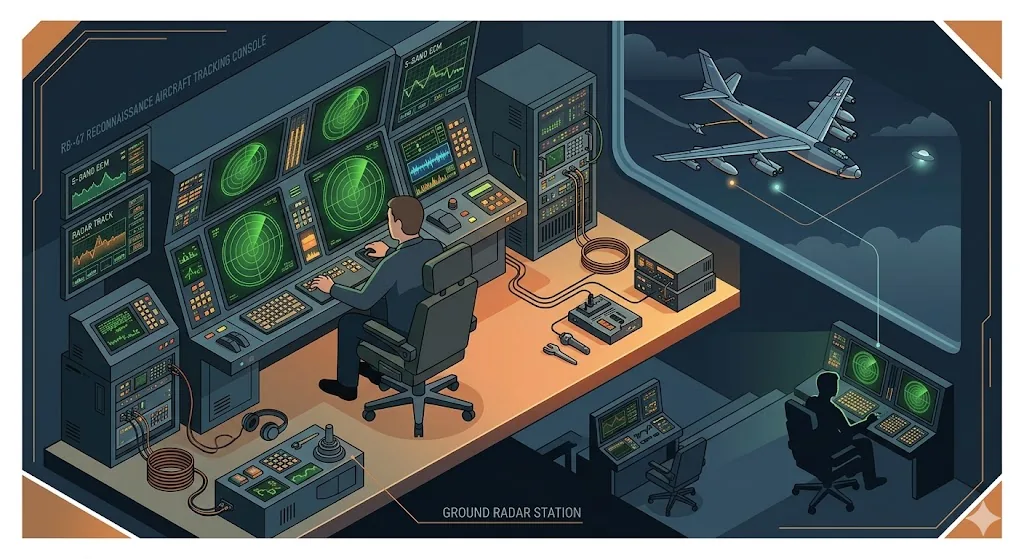
The aircraft was an RB-47H, a reconnaissance version of the B-47, flying from Forbes Air Force Base near Topeka, Kansas, on a mission that included navigation, gunnery, and electronic countermeasures training. Later accounts identify the crew as pilot Lewis D. Chase, co-pilot James H. McCoid, navigator Thomas H. Hanley, and electronic-warfare officers John J. Provenzano, Frank B. McClure, and Walter A. Tuchscherer. Three of the crew were operating electronic monitoring equipment in the rear of the aircraft, a detail that is central to why the case became more than a normal pilot sighting.[Academia]academia.eduThe RB-47 Radar–Electronic Intelligence (ECM) UFOThe RB-47 Radar–Electronic Intelligence (ECM) UFO
The broad chronology usually begins with an electronic signal detected by McClure’s monitoring equipment as the aircraft was near the Gulf Coast region. The signal was later described as a radar-like emission in the S-band range, roughly around 2,800 to 3,000 megahertz depending on the account. The unusual feature, according to the case narrative, was not merely that a signal was detected, but that it appeared to move in a way the operator did not expect from an ordinary fixed ground radar source.[NCAS]files.ncas.orgCondon Report, Case 5: B-47 Crew, Radar/Visual Sighting…
The cockpit crew then reported seeing a bright light. In the Condon Report’s summary of witness recollections, the pilot saw a white light ahead that crossed in front of the aircraft at very high apparent speed; later, a red glow was reported as holding a position relative to the aircraft. The account also says that ground-control radar was contacted and reported a second target near the RB-47, at a position broadly matching the crew’s observations.[NCAS]files.ncas.orgCondon Report, Case 5: B-47 Crew, Radar/Visual Sighting…
The most striking part of the story is the alleged coordination between channels: visual sighting, electronic-monitor bearing, and ground radar. The case narrative describes the target appearing, disappearing, and reappearing in ways that seemed to coincide across these channels. This is why the RB-47 episode is usually grouped with classic radar/visual cases rather than with ordinary nocturnal-light reports.[NCAS]files.ncas.orgCondon Report, Case 5: B-47 Crew, Radar/Visual Sighting…
Why the witnesses mattered
The crew’s credibility is a major reason the case retained its reputation. They were not casual observers looking at the sky from the ground; they were military officers on a specialised aircraft, some of whom were trained to interpret electronic signals. The Condon investigators noted that the available crew members remained strongly impressed by the experience when interviewed years later, and their descriptions were generally consistent in the broad outline, though not identical in every detail.[NCAS]files.ncas.orgCondon Report, Case 5: B-47 Crew, Radar/Visual Sighting…
That credibility has limits. Human testimony is strongest when it is prompt, detailed, and supported by preserved instrument records. In this case, the University of Colorado team, better known as the Condon Committee, investigated the case roughly a decade later and found no original Blue Book record during its search. It therefore had to rely heavily on interviews and memory, which made exact reconstruction difficult.[NCAS]files.ncas.orgCondon Report, Case 5: B-47 Crew, Radar/Visual Sighting…
Later work complicated the picture. James E. McDonald, a physicist and atmospheric scientist who became one of the Condon Report’s most prominent critics, located case-file material that the Colorado investigators had missed and argued that the correct incident date was 17 July 1957, not the later date used in parts of the Condon analysis. His AIAA-published account also argued that the original files and crew interviews made the case stronger than the Condon treatment suggested.[kirkmcd.princeton.edu]kirkmcd.princeton.eduOpen source on princeton.edu.
The documentary trail is both valuable and frustrating
Project Blue Book provides the wider institutional setting. The United States Air Force investigated UFO reports from 1947 to 1969, and the National Archives now holds declassified Blue Book records, including chronological case files and project records. The Air Force later stated that 12,618 sightings had been reported to Blue Book, of which 701 remained unidentified, while also saying that none showed evidence of a national-security threat, unknown scientific principles, or extraterrestrial vehicles.[National Archives]archives.govNational Archives Project BLUE BOOKNational Archives Project BLUE BOOK
For the RB-47 case specifically, the documentary trail is patchy. The Condon Report said Project Blue Book had no record of the case when it looked, and that attempts to locate records failed. It also noted disagreement among crew recollections about whether data had been recorded during the flight: the pilot remembered film or wire-recorded data being removed by intelligence personnel, while the co-pilot and monitoring officer recalled that no such recording media were aboard.[NCAS]files.ncas.orgCondon Report, Case 5: B-47 Crew, Radar/Visual Sighting…
The later case file material matters because it reduces, but does not eliminate, the evidential gap. The Black Vault’s Blue Book compilation and the CUFOS-hosted case packet preserve later-public materials, including official-case material, McDonald’s analysis, and sceptical responses such as Philip J. Klass’s alternative explanation. These are valuable for comparing claims, but they still do not provide a clean set of raw radar recordings or photographs that would settle the event independently of interpretation.[documents2.theblackvault.com]documents2.theblackvault.comSource details in endnotes.
Why the Condon Report did not settle it
The Condon Report’s treatment is often quoted because it reached an unusually cautious result. Its abstract said the crew described an encounter with a large ball of light that was also displayed for a sustained time on airborne radar-monitoring receivers and ground radar, but that the event had occurred ten years before the study and the phenomenon remained unidentified.[NCAS]files.ncas.orgCondon Report, Case 5: B-47 Crew, Radar/Visual Sighting…
The report also made clear why it would not go further. It concluded that if a crew or intelligence report had been submitted in 1957, it was apparently no longer in existence; it added that moving pictures and other recorded radar-scope data apparently never existed. Its final judgement was that the case rested on recollection and that the descriptions were not adequate to identify the phenomenon.[NCAS]files.ncas.orgCondon Report, Case 5: B-47 Crew, Radar/Visual Sighting…
This leaves the Condon handling in an awkward position. On the page, the case was not explained away; it was left unidentified because the evidence was insufficient. Yet the broader Condon Report helped justify closing Project Blue Book, and the Air Force subsequently ended official UFO investigation in December 1969. That wider policy conclusion can easily obscure the fact that individual cases inside the report, including this one, were not always reduced to simple identifications.[National Archives]archives.govNational Archives Project BLUE BOOKNational Archives Project BLUE BOOK
The pro-UFO argument: multiple channels, trained crew, hard-to-fit behaviour
The strongest argument for treating the RB-47 incident as genuinely anomalous is the reported overlap of independent observation channels. A cockpit visual sighting alone could be a meteor, aircraft light, astronomical object, or optical illusion. An electronic signal alone could be a ground radar, equipment problem, or propagation effect. A ground-radar report alone could be a false target. The case becomes more interesting because the main narrative says these channels sometimes lined up.[NCAS]files.ncas.orgCondon Report, Case 5: B-47 Crew, Radar/Visual Sighting…
McDonald’s later account emphasised this point. He argued that simultaneous appearances and disappearances across visual, ground-radar, and electronic-monitor channels were hard to explain as coincidence. He also stressed that the crew included specialists using equipment designed for electronic intelligence work, not ordinary passengers guessing at lights in the sky.[Academia]academia.eduThe RB-47 Radar–Electronic Intelligence (ECM) UFOThe RB-47 Radar–Electronic Intelligence (ECM) UFO
The case also gained strength from what the Condon Report itself rejected. Its discussion said meteors did not fit the reported persistence, conventional aircraft did not fit the described speed, hovering, or apparent instant repositioning, and a plasma explanation was not regarded as tenable by scientists consulted at a plasma conference. That does not prove an extraordinary craft, but it shows why the case resisted a single easy answer in the official scientific study.[NCAS]files.ncas.orgCondon Report, Case 5: B-47 Crew, Radar/Visual Sighting…
The sceptical argument: one dramatic story may be several ordinary events
The best sceptical interpretations do not usually claim that the crew invented the incident. Instead, they argue that several separate events became fused into a single coherent “UFO” pursuit: a bright meteor or fireball, ordinary aircraft or ground lights, radar or electronic signals from known ground installations, and post-event memory effects. Philip J. Klass proposed a combination of equipment malfunction, a bright fireball, an airliner, and ground-radar reception as the source of the mystery; later sceptical writers, including Tim Printy and Robert Sheaffer, argued that the S-band signal looked very much like terrestrial radar rather than an unknown emitter.[badufos.blogspot.com]badufos.blogspot.comrb 47 encounter of 1957 ufologys bestrb 47 encounter of 1957 ufologys best
One key issue is the S-band signal. Sceptical analyses point out that the recorded characteristics of the signal were close to those of known American radar equipment, including CPS-6B or FPS-10-type radars. In the CUFOS-hosted sceptical material, Klass’s analysis notes that McClure’s reported signal characteristics closely matched a vertical-centre beam from a CPS-6B-type radar, with only a small pulse-duration discrepancy that a specialist suggested could be explained by reception effects.[Center for UFO Studies]cufos.orgCenter for UFO Studies
Another issue is timing. The sceptical reconstruction highlights that the later S-band detection came about twenty minutes after the initial visual sighting, weakening the assumption that the light and the signal were necessarily the same object. The same analysis argues that if the signal came from a UFO, the UFO would have had to change course into a position not matched by a visual target at that moment; if it came from a ground radar such as Duncanville, the delay and bearing behaviour become less mysterious.[Center for UFO Studies]cufos.orgCenter for UFO Studies
The sceptical case also benefits from a simple evidential rule: when a dramatic interpretation depends on joining several ambiguous observations, each join has to be justified. A meteor can explain a sudden bright light but not a long chase; a ground radar can explain an electronic signal but not a cockpit light; an airliner can explain some lights but not instant manoeuvres. The sceptical strategy is to separate the chain, not to find one object that explains every reported detail.[badufos.blogspot.com]badufos.blogspot.comrb 47 encounter of 1957 ufologys bestrb 47 encounter of 1957 ufologys best
What the case does and does not prove
The RB-47 case does support the narrower claim that some Cold War UFO reports involved competent military witnesses and more than one kind of observation. It is not a case that can be dismissed as a lone civilian misidentification without engaging the details. The Condon Report itself treated it as unidentified on the evidence then available, and McDonald’s later work strengthened the argument that the case deserved closer treatment than it initially received.[NCAS]files.ncas.orgCondon Report, Case 5: B-47 Crew, Radar/Visual Sighting…
It does not prove that the object was extraterrestrial, non-human technology, or a secret aircraft. The surviving record does not contain raw radar film, full electronic recordings, photographs, or an unbroken contemporaneous investigation file. The Air Force’s broader Blue Book conclusions explicitly stated that unidentified cases did not establish evidence of extraterrestrial vehicles or technological principles beyond known science, even though Blue Book left some reports unexplained.[National Archives]archives.govNational Archives Project BLUE BOOKNational Archives Project BLUE BOOK
The case also illustrates a recurring problem in UFO evidence: high-quality witnesses can still leave low-quality data. The crew may have been honest, skilled, and genuinely puzzled, while the available evidence remains insufficient to reconstruct every bearing, signal source, radar return, and visual observation with confidence. That distinction is essential; witness credibility and physical proof are related, but they are not the same thing.[NCAS]files.ncas.orgCondon Report, Case 5: B-47 Crew, Radar/Visual Sighting…
Best assessment
The fairest assessment is that the RB-47 incident remains an unusually strong historical UFO case in witness quality and narrative complexity, but a weaker case in preserved physical documentation. Its enduring force comes from the reported combination of visual sighting, airborne electronic detection, and ground-radar correlation. Its main weakness is that the decisive raw evidence either was not recorded, was not preserved, or cannot now be verified in the form needed to distinguish cleanly between one extraordinary object and several overlapping conventional events.[NCAS]files.ncas.orgCondon Report, Case 5: B-47 Crew, Radar/Visual Sighting…
For readers comparing major UFO cases, the RB-47 episode belongs with radar/visual cases that are genuinely worth studying rather than casually citing. It is stronger than a simple light-in-the-sky anecdote, weaker than a case with preserved calibrated sensor data, and more instructive than either believers or debunkers sometimes admit. Its real value is not that it delivers a final answer, but that it shows exactly where the hardest UFO cases stand or fall: chronology, instrument provenance, independent correlation, and the gap between “unidentified” and “explained by something extraordinary”.
Amazon book picks
Further Reading
Books and field guides related to What Really Happened to the RB 47?. Use these as the next step if you want deeper reading beyond the article.
The UFO Book
Profiles the RB-47 incident objectively, summarizing the multi-sensor corroboration and the long-term historical debate.
The Report on Unidentified Flying Objects
Documents how early military investigations treated complex radar/visual incidents during the Cold War.
Scientific Paranormal Investigation
Teaches the forensic methodologies needed to evaluate cases relying on multiple sensor sources versus memory-based testimony.
Ufos and Government
Provides institutional background on how intelligence bureaus logged and analyzed airborne intercept reports.
Endnotes
1.
Source: kirkmcd.princeton.edu
Link:https://kirkmcd.princeton.edu/JEMcDonald/mcdonald_aa_9_7_66_71.pdf
2.
Source: files.ncas.org
Link:https://files.ncas.org/condon/text/case05.htm
Source snippet
Condon Report, Case 5: B-47 Crew, Radar/Visual Sighting...
3.
Source: cufos.org
Title: Center for UFO Studies
Link:https://cufos.org/PDFs/cases/1957_07_17_US_MI-LA-TX-OK_AirCraft-RB-47_NICAP_Chase-McCoid-Hanley-Provensano-McClure-Tuchscherer.pdf
4.
Source: academia.edu
Title: The RB-47 Radar–Electronic Intelligence (ECM) UFO
Link:https://www.academia.edu/165502543/The_RB_47_Radar_Electronic_Intelligence_ECM_UFO_Incident_1957_by_James_McDonald
5.
Source: archives.gov
Title: National Archives Project BLUE BOOK
Link:https://www.archives.gov/research/military/air-force/ufos
6.
Source: documents2.theblackvault.com
Link:https://documents2.theblackvault.com/documents/projectbluebook/ProjectBlueBook-RB47-July17-1957.pdf
7.
Source: badufos.blogspot.com
Title: rb 47 encounter of 1957 ufologys best
Link:https://badufos.blogspot.com/2012/01/rb-47-encounter-of-1957-ufologys-best.html
8.
Source: kirkmcd.princeton.edu
Title: mcdonald fsr 16 3 2 70
Link:https://kirkmcd.princeton.edu/JEMcDonald/mcdonald_fsr_16_3_2_70.pdf
9.
Source: war.gov
Link:https://www.war.gov/medialink/ufo/release_1/255_413270_ufo%27s_and_defense_what_should_we_prepare_for.pdf
10.
Source: kevinrandle.blogspot.com
Link:https://kevinrandle.blogspot.com/2014/02/
11.
Source: Wikipedia
Title: Project Blue Book
Link:https://en.wikipedia.org/wiki/Project_Blue_Book
12.
Source: Wikipedia
Title: Condon Committee
Link:https://en.wikipedia.org/wiki/Condon_Committee
13.
Source: dn721804.ca.archive.org
Title: Bad UFOs critical thinking about UFO claims
Link:https://dn721804.ca.archive.org/0/items/bad-ufos/Bad%20UFOs%20-%20critical%20thinking%20about%20UFO%20claims.pdf
Additional References
14.
Source: youtube.com
Title: Two of the Strangest Physical UFO Events Ever Recorded | Close Encounters 111
Link:https://www.youtube.com/watch?v=gJVzp-21yuw
Source snippet
Pilot Spots UFO Zoom Past Mid-Flight (S5) | The Proof Is Out There...
15.
Source: cia.gov
Link:https://www.cia.gov/readingroom/document/cia-rdp81r00560r000100010001-0
16.
Source: cia.gov
Link:https://www.cia.gov/readingroom/docs/CIA-RDP81R00560R000100010010-0.pdf
17.
Source: youtube.com
Title: UFO Chased a US Military Plane (What We Know And Don’t Know)
Link:https://www.youtube.com/watch?v=bJdhQaqmFaY
Source snippet
A UFO Chasing a Military Aircraft? | Colm Kelleher and JMG...
18.
Source: youtube.com
Title: Crop Circles: The Buga Sphere Connection
Link:https://www.youtube.com/watch?v=7r0Qg2N3oCM
Source snippet
Two of the Strangest Physical UFO Events Ever Recorded | Close Encounters 111...
19.
Source: youtube.com
Title: A UFO Chasing a Military Aircraft? | Colm Kelleher and JMG
Link:https://www.youtube.com/watch?v=infRUoeCldc
Source snippet
Crop Circles: The Buga Sphere Connection...
20.
Source: skepticalinquirer.org
Link:https://skepticalinquirer.org/wp-content/uploads/sites/29/2011/03/p57.pdf
21.
Source: archive.org
Link:https://archive.org/stream/pdfy-4vyHjooOJagoGAwN/Scientific%2BStudy%2BOf%2BUnidentified%2BFlying%2BObjects_djvu.txt
22.
Source: scribd.com
Link:https://www.scribd.com/document/78133062/The-RB47-case-Ufology-s-best-evidence-Copyright-2012-Tim-Pritny
23.
Source: amazon.co.uk
Link:https://www.amazon.co.uk/Scientific-Study-Unidentified-Flying-Objects/dp/B000J2VA3K
Topic Tree
Follow this branch
Related pages 106
- Godfrey Encounter
- Hamilton Airship
- Andreasson
- Villas Boas
- Apollo 11 Sightings
- +101 more in sidebar