Within Tunguska
What Witnesses and Trees Reveal
Eyewitnesses, tree-fall patterns, seismic signals, and fragment claims form the core evidence trail.
On this page
- Eyewitness reports and their limits
- Radial forest damage as physical evidence
- Seismic records and microscopic debris
Page outline Jump by section
Introduction
The Tunguska event is remembered not because scientists found a giant crater or recovered a large meteorite, but because the evidence arrived in fragments: frightened eyewitnesses, flattened Siberian forest, unusual seismic recordings, atmospheric pressure waves, and traces of microscopic material embedded in soil and trees. Together, those clues created one of the strongest documented cases of a cosmic airburst in recorded history, even though the object itself effectively vanished in the atmosphere.[ScienceDirect]sciencedirect.comTunguska eyewitness accounts, injuries, and casualtiesby P Jenniskens · 2019 · Cited by 49 — A literature study of over 700…[NASA]nasa.gov115 years ago the tunguska asteroid impact event115 Years Ago: The Tunguska Asteroid Impact Event13 Feb 2026 — On June 30, 1908, an asteroid plunged into Earth's atmosphere and exploded…
 What makes the evidence unusually compelling is that different categories of data point in the same direction. Witnesses described a brilliant object crossing the sky followed by heat, shock waves, and thunderous detonations. Investigators later mapped a massive radial tree-fall pattern consistent with an explosion above the ground rather than a crater-forming impact. Seismographs and atmospheric instruments recorded disturbances far beyond Siberia, while later field studies identified tiny mineral spheres and chemical anomalies interpreted as remnants of extraterrestrial material. ScienceDirect[Wikipedia At the same time]WikipediaTunguska eventTunguska event, the evidence has limits. Most testimony was collected years later, many measurements were indirect, and some dramatic claims grew through repetition rather than documentation. Understanding Tunguska therefore requires separating the strongest physical evidence from later embellishment.
What the eyewitnesses actually described
The Tunguska region was sparsely populated in 1908, but the explosion was still witnessed across a huge area by Evenki reindeer herders, Russian settlers, traders, and railway workers. Their accounts differ in detail, yet several core observations recur consistently.
Witnesses commonly reported:
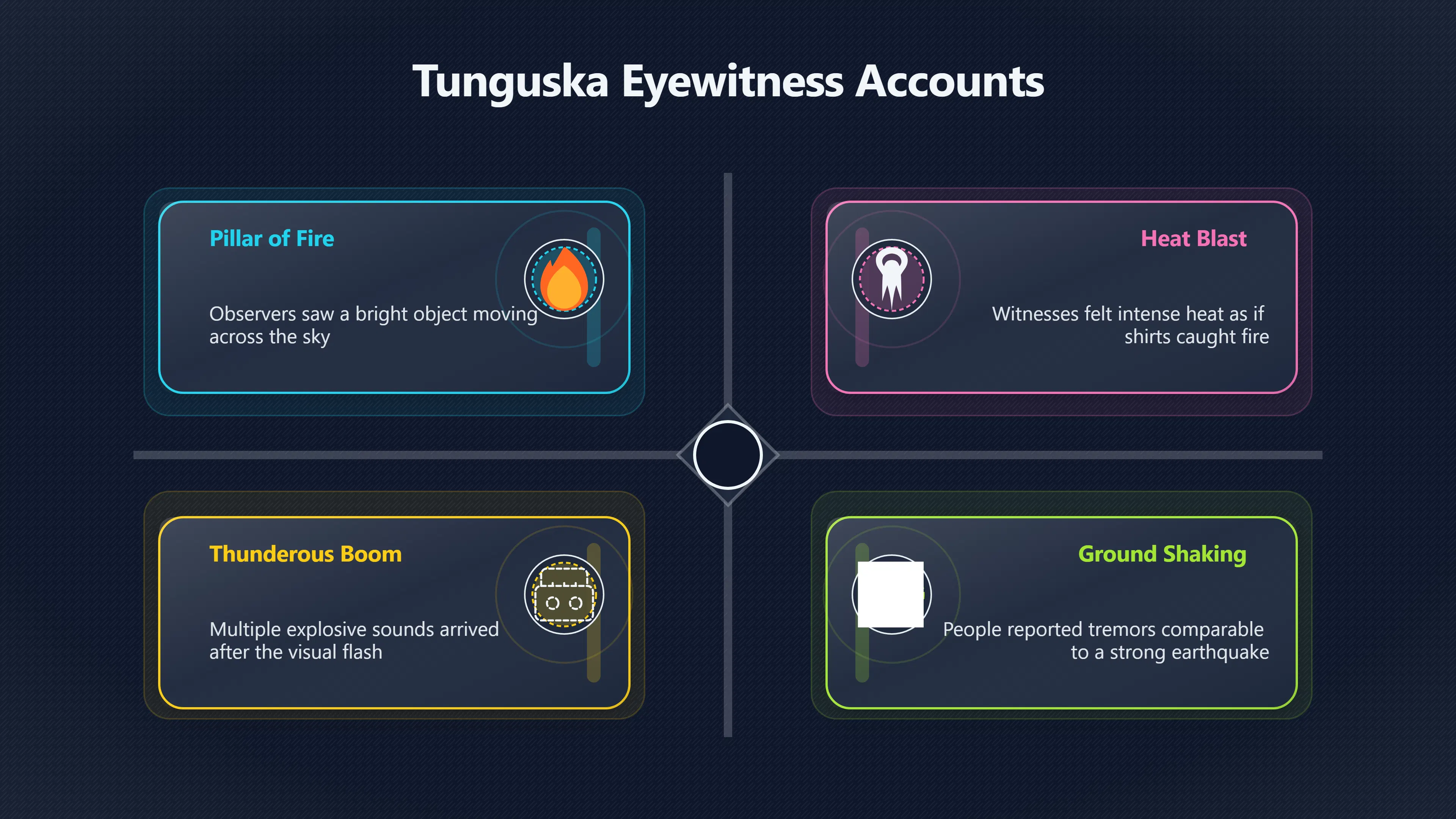
- A bright object or “pillar of fire” moving across the morning sky.
- Intense light and heat before the main blast.
- Multiple explosive sounds rather than a single detonation.
- Violent air pressure that knocked people down or damaged buildings.
- Ground shaking comparable to an earthquake.
- Delayed sound waves arriving after the visual flash.[Ars Technica]arstechnica.commore clues in cosmic cold case tunguska event was probably a stony asteroidNew research on Tunguska finds such events happen less…17 Jul 2019 — But there weren't many human eyewitnesses, given its remote locat… [3ScienceDirect 3NASA]
One of the most cited accounts came from Semyon Semenov, who was roughly 65 kilometres from the explosion. He described being thrown from a chair by a blast wave and feeling intense heat “as if his shirt had caught fire”. Other observers reported horses panicking, windows breaking, and objects being hurled through the air. Several witnesses lost consciousness. ScienceDirect[Wikipedia]WikipediaTunguska eventTunguska event Modern researchers have tried to organise these reports more systematically than early investigators did. A 2019 study by Peter Jenniskens reviewed more than 700 eyewitness accounts and concluded that at least several dozen people were within or near the devastated forest zone. The study argued that human injuries were real and that a small number of deaths probably occurred directly because of the blast, although the exact casualty count remains uncertain.[ScienceDirect]sciencedirect.comTunguska eyewitness accounts, injuries, and casualtiesby P Jenniskens · 2019 · Cited by 49 — A literature study of over 700…
Why the testimony is both valuable and problematic
The witness evidence is powerful because many independent descriptions converge on the same broad sequence: a luminous aerial object, followed by explosive shock waves and physical destruction. That pattern strongly supports an atmospheric explosion rather than folklore or later invention.
However, there are major reliability problems:
- Most testimony was gathered years or even decades after the event.
- Translation issues complicated the recording of indigenous Evenki accounts.
- Some witnesses described events from very large distances.
- Later retellings sometimes merged different stories together.
- Investigators occasionally asked leading questions shaped by existing theories.[NASA Technical Reports Server]ntrs.nasa.govNASA Technical Reports ServerApplying Modern Tools to Understand the 1908 Tunguska…by D Morrison · 2018 · Cited by 6 — The data consis…
The result is that eyewitness evidence is most reliable when used for broad physical reconstruction rather than fine detail. Researchers generally trust the repeated reports of light, heat, shock, and multiple explosions more than precise claims about trajectory angles, colours, or timings.
Some dramatic stories that entered popular culture are also weakly documented. Claims of mass human fatalities, gigantic flaming clouds visible across all Siberia, or bizarre creatures and machines are not supported by the strongest primary records.
Why the fallen forest became the key physical clue
When Leonid Kulik finally reached the central destruction zone in the 1920s, he expected to find a classic meteorite crater. Instead, he encountered one of the strangest blast landscapes ever documented.
Across more than 2,000 square kilometres of taiga, trees lay flattened outward from a central region in a huge radial pattern. Investigators later compared the scene to giant matchsticks knocked away from an invisible centre point.[The Linda Hall Library]lindahall.orgleonid kulikThe Linda Hall LibraryLeonid Kulik30 Jun 2023 — As they explored the area, they found that the fallen trees formed a vast radial ring, wi…[Cambridge University Press & Assessment]cambridge.orgmore…
The geometry of the destruction mattered enormously. If a large asteroid had struck the ground intact, researchers would expect:
- A major crater.
- Massive excavation of soil and rock.
- Ejecta patterns centred on impact.
- Concentrated destruction around a surface collision point.
Instead, Tunguska showed something different: a broad butterfly-shaped blast zone with trees radiating away from a central airburst region and no confirmed impact crater.[Wikipedia]WikipediaTunguska eventTunguska event
The “standing dead trees” puzzle
Perhaps the most famous detail was found near the centre of the explosion area. There, some trees remained upright but had been stripped of branches and bark.
This initially confused investigators because an ordinary surface blast should have levelled everything. The standing trunks became one of the strongest arguments for an aerial explosion.
Modern airburst models explain the effect this way:
- Directly beneath the explosion, the shock wave travelled largely downward.
- That downward force stripped and scorched trees but did not always topple them.
- Farther outward, the expanding shock wave became more horizontal and knocked trees flat away from the centre.[Wikipedia]WikipediaTunguska eventTunguska event
Later experiments using model forests and controlled explosions reproduced similar radial and butterfly-shaped patterns. Soviet studies in the 1960s found that angled mid-air blasts could create destruction closely matching the Tunguska site.[Wikipedia]WikipediaTunguska eventTunguska event
The tree-fall evidence therefore became central to the now-dominant airburst interpretation.
How strong was the blast?
The forest destruction alone demonstrated extraordinary energy release. Early estimates suggested around 80 million trees had been flattened, though later analysis argued that this number was likely exaggerated because the devastated area had originally been overestimated.[Wikipedia]WikipediaTunguska eventTunguska event
Even revised calculations still imply an explosion equivalent to several megatons of TNT. Most modern estimates place the energy somewhere in the range of roughly 3 to 30 megatons, with many studies clustering around 10 to 15 megatons. ScienceDirect[Wikipedia]WikipediaTunguska eventTunguska event The shock wave was not confined to the immediate region. Witnesses hundreds of kilometres away reported tremors and booming sounds. Atmospheric pressure waves travelled around the globe and were recorded by barographs in Europe and elsewhere.[ScienceDirect]sciencedirect.comTunguska eyewitness accounts, injuries, and casualtiesby P Jenniskens · 2019 · Cited by 49 — A literature study of over 700…
Some later retellings greatly exaggerated the thermal effects. Recent critiques have argued that claims about extreme ground temperatures or continent-scale firestorms are inconsistent with realistic airburst physics. Researchers such as Mark Boslough have argued that some popular descriptions of the blast overstate what a Tunguska-scale event could physically produce at ground level.[Nature]nature.comMisunderstandings about the Tunguska event, shock wave…by M Boslough · 2025 · Cited by 5 — A Tunguska sized airburst cannot poss…
That debate highlights an important distinction: the devastation was unquestionably immense, but not every dramatic claim attached to Tunguska is equally well supported.
What the seismic instruments recorded
One reason Tunguska quickly attracted scientific attention was that the explosion registered on instruments far from Siberia.
Seismographs recorded disturbances comparable to a moderate earthquake. Analysis of historical records later suggested that the event produced seismic effects roughly equivalent to a magnitude 5 earthquake in some locations.[ScienceDirect]sciencedirect.comTunguska eyewitness accounts, injuries, and casualtiesby P Jenniskens · 2019 · Cited by 49 — A literature study of over 700…
The seismic data are important because they independently confirm that a very large energy release occurred even though no crater was found.
Researcher A. Ben-Menahem’s influential 1975 analysis compared Tunguska seismograms with records from later atmospheric nuclear explosions. The similarities supported the interpretation of a large airburst rather than a conventional ground impact.[ScienceDirect]sciencedirect.comTunguska eyewitness accounts, injuries, and casualtiesby P Jenniskens · 2019 · Cited by 49 — A literature study of over 700…
Atmospheric pressure disturbances were also detected globally. Instruments measuring air pressure recorded waves moving outward from the explosion across vast distances, much like the pressure signatures generated by volcanic eruptions or nuclear tests.[British Astronomical Association]britastro.orgBritish Astronomical AssociationTunguska: a cosmic airburst paradigm, how we investigate…24 Sept 2009 — This report presents the 1908…
These instrumental traces matter because they are independent of human memory. Even if every eyewitness account vanished, the seismic and atmospheric records would still demonstrate that an enormous explosive event occurred over Siberia in June 1908.
The search for fragments and microscopic debris
The absence of a crater or large meteorite fragments became one of the great puzzles of Tunguska research. That absence fuelled decades of speculation involving antimatter, black holes, alien spacecraft, or secret weapons.
Yet investigators did eventually identify material that may represent remnants of the object, just not in large pieces.
Field studies in the 1950s and later found microscopic silicate and magnetite spheres within soil and peat deposits. Some contained unusually high nickel concentrations associated with meteoritic material.[Wikipedia]WikipediaTunguska eventTunguska event
Researchers also extracted resin from surviving trees and identified trapped particles believed to date from the 1908 explosion. Peat bog studies detected chemical anomalies consistent with atmospheric deposition after an extraterrestrial airburst.[Cambridge University Press & Assessment]cambridge.orgmore…
A 2013 analysis of peat samples reported fragments interpreted as potentially extraterrestrial in origin, although debate continues over how conclusively these particles can be linked to the original body.[Wikipedia]WikipediaTunguska eventTunguska event
Why fragment claims remain controversial
Microscopic debris is easier to reconcile with an airburst than with a classic crater impact. If the incoming body largely disintegrated in the atmosphere, most material would have vaporised or dispersed as fine particles rather than surviving as recoverable meteorites.
However, fragment claims remain controversial for several reasons:
- The site is environmentally complex and difficult to sample cleanly.
- Some particles may have terrestrial origins.
- Different expeditions used different analytical methods.
- Small sample sizes make broad conclusions difficult.
- Researchers disagree about whether the object was primarily rocky or cometary.[ScienceDirect]sciencedirect.comTunguska eyewitness accounts, injuries, and casualtiesby P Jenniskens · 2019 · Cited by 49 — A literature study of over 700…
The evidence therefore supports extraterrestrial material being present, but not all proposed fragment discoveries are equally persuasive.
What the evidence ultimately shows
Taken together, the witness testimony, forest devastation, seismic traces, and microscopic debris create a coherent picture of a large atmospheric explosion caused by a cosmic object entering Earth’s atmosphere.
The strongest evidence is mutually reinforcing:
- Eyewitnesses described a brilliant incoming object and explosive shock waves.
- Tree-fall geometry matched expectations for a high-altitude blast.
- Seismographs and atmospheric instruments recorded global disturbances.
- Microscopic material consistent with extraterrestrial debris was later recovered. NASA Technical Reports Server 3ScienceDirect[Wikipedia]WikipediaTunguska eventTunguska event What remains uncertain are the finer details: the exact size and composition of the object, the precise explosion altitude, whether it was asteroid-like or comet-like, and whether any larger fragments survived.
The evidence trail is therefore unusual but not mysterious in the supernatural sense. Tunguska became famous precisely because it preserved a rare combination of human testimony and large-scale physical effects from a natural cosmic airburst — a disaster powerful enough to reshape a forest while leaving almost no obvious body behind.
Amazon book picks
Further Reading
Books and field guides related to What Witnesses and Trees Reveal. Use these as the next step if you want deeper reading beyond the article.
The Tunguska Mystery
Details Leonid Kulik's historic expeditions, mapping the massive radial forest damage patterns and microscopic mineral spheres embedded i...
The Skeptics' Guide to the Universe
Explains why testimony collected years after a massive event requires careful calibration against raw instrumentation trends.
Impact!
Traces the sensory reports describing brilliant sky streaks, intense thermal detonations, and subsequent pressure shockwaves.
Rain Of Iron And Ice
Analyzes how microscopic cosmic debris patterns are recovered from peat bogs and tree core layers across the blast path.
eBay marketplace picks
Marketplace Samples
Live-tested eBay searches with available results related to this page.



Endnotes
1.
Source: sciencedirect.com
Link:https://www.sciencedirect.com/science/article/abs/pii/S0019103518305104
Source snippet
Tunguska eyewitness accounts, injuries, and casualtiesby P Jenniskens · 2019 · Cited by 49 — A literature study of over 700...
2.
Source: nasa.gov
Title: 115 years ago the tunguska asteroid impact event
Link:https://www.nasa.gov/history/115-years-ago-the-tunguska-asteroid-impact-event/
Source snippet
115 Years Ago: The Tunguska Asteroid Impact Event13 Feb 2026 — On June 30, 1908, an asteroid plunged into Earth's atmosphere and exploded...
Published: June 30, 1908
3.
Source: sciencedirect.com
Link:https://www.sciencedirect.com/science/article/abs/pii/S0032063397001451
Source snippet
The Tunguska Meteorite problem todayby NV Vasilyev · 1998 · Cited by 210 — This paper contains basic data relating to the Tu...
4.
Source: sciencedirect.com
Link:https://www.sciencedirect.com/science/article/pii/0031920175900722
Source snippet
Source parameters of the siberian explosion of June 30...by A Ben-Menahem · 1975 · Cited by 167 — Old seismograms of the Tu...
5.
Source: Wikipedia
Title: Tunguska event
Link:https://en.wikipedia.org/wiki/Tunguska_event
6.
Source: ntrs.nasa.gov
Link:https://ntrs.nasa.gov/api/citations/20190002302/downloads/20190002302.pdf
Source snippet
NASA Technical Reports ServerApplying Modern Tools to Understand the 1908 Tunguska...by D Morrison · 2018 · Cited by 6 — The data consis...
7.
Source: cambridge.org
Link:https://www.cambridge.org/core/journals/international-journal-of-astrobiology/article/tunguska-event-and-cheko-lake-origin-dendrochronological-analysis/1E9BB6F9BC1BF452A8B04C081EE7FFCD
Source snippet
more...
8.
Source: nature.com
Link:https://www.nature.com/articles/s41598-025-98362-9
Source snippet
Misunderstandings about the Tunguska event, shock wave...by M Boslough · 2025 · Cited by 5 — A Tunguska sized airburst cannot poss...
9.
Source: youtube.com
Title: Unraveling the Tunguska Event: Nature’s Greatest Mystery Revealed!
Link:https://www.youtube.com/watch?v=juq4Csq09JI
Source snippet
Tunguska Event | 100 Wonders | Atlas Obscura...
10.
Source: youtube.com
Title: Tunguska Event | 100 Wonders | Atlas Obscura
Link:https://www.youtube.com/watch?v=F7PX51IeMbU
Source snippet
Tunguska: When the Sky Fell to Earth...
11.
Source: mensa.org.uk
Title: the tunguska event
Link:https://mensa.org.uk/the-tunguska-event/
Source snippet
16 May 2025 — Eyewitnesses described feeling the ground shake and seeing a blinding blue light as bright as the sun moving through the sk...
Published: May 2025
12.
Source: arstechnica.com
Title: more clues in cosmic cold case tunguska event was probably a stony asteroid
Link:https://arstechnica.com/science/2019/07/more-clues-in-cosmic-cold-case-tunguska-event-was-probably-a-stony-asteroid/
Source snippet
New research on Tunguska finds such events happen less...17 Jul 2019 — But there weren't many human eyewitnesses, given its remote locat...
13.
Source: lindahall.org
Title: leonid kulik
Link:https://www.lindahall.org/about/news/scientist-of-the-day/leonid-kulik/
Source snippet
The Linda Hall LibraryLeonid Kulik30 Jun 2023 — As they explored the area, they found that the fallen trees formed a vast radial ring, wi...
14.
Source: britastro.org
Link:https://britastro.org/wp-content/uploads/sites/Tunguska_Airburst.pdf
Source snippet
British Astronomical AssociationTunguska: a cosmic airburst paradigm, how we investigate...24 Sept 2009 — This report presents the 1908...
15.
Source: britannica.com
Title: Tunguska event
Link:https://www.britannica.com/event/Tunguska-event
Source snippet
Summary, Cause, & FactsTunguska event, enormous explosion that is estimated to have occurred at 7:14 am plus or minus one minute on June...
Additional References
16.
Source: arxiv.org
Link:https://arxiv.org/pdf/1302.6273
Source snippet
Reconstruction of the Tunguska Event of 1908by V Rubtsov · 2012 · Cited by 1 — Abstract: The Tunguska explosion occurred in the morning o...
17.
Source: researchgate.net
Link:https://www.researchgate.net/figure/The-unified-map-of-fallen-tree-azimuths_fig1_255614504
Source snippet
The unified map of fallen tree azimuths.Kulik reached the conclusion that he had discovered the remains of a large impact crater hidden b...
18.
Source: eartharxiv.org
Link:https://eartharxiv.org/repository/object/8790/download/16372/
Source snippet
The 1908 Tunguska event and forestfallsby A Ol'khovatov · 2025 · Cited by 7 — He discovered inside the forest-fall burnt trees, bushes, a...
19.
Source: frontiersin.org
Link:https://www.frontiersin.org/journals/earth-science/articles/10.3389/feart.2022.777631/full
Source snippet
Suzdalevo Lake (Central Siberia, Russia)—A Tunguska...by R Kavková · 2022 · Cited by 6 — In this study, we present a paleoenvironmental...
20.
Source: facebook.com
Link:https://www.facebook.com/61555920213781/posts/in-a-recent-article-i-wrote-about-the-tunguska-event-which-was-likely-an-airburs/122255560832197340/
Source snippet
rees over an area of 2,150 km squared (830 sq mi), and that the shock...Read more...
21.
Source: facebook.com
Link:https://www.facebook.com/historicalfactsss/posts/a-1928-photograph-reveals-the-aftermath-of-tunguskas-cosmic-blasttwenty-years-af/803216335801328/
Source snippet
ountless animals, though there were no confirmed human casualties due...Read more...
22.
Source: medium.com
Link:https://medium.com/illumination/the-story-of-a-massive-explosion-that-wiped-out-80-million-trees-in-siberia-in-1908-6b657d48f1e4
Source snippet
rk on the face of the earth. Known as the Tunguska event.Read more...
23.
Source: facebook.com
Link:https://www.facebook.com/SCIENCESpaceTamil/posts/on-june-30-1908-a-massive-explosion-tore-through-the-air-above-a-remote-forest-i/1286432143502457/
Source snippet
On June 30, 1908, a massive explosion tore through the air...The trees fell in a radial pattern, pointing away from the blast zone like...
Published: June 30, 1908
24.
Source: scientificamerican.com
Title: the tunguska mystery 100 years later
Link:https://www.scientificamerican.com/article/the-tunguska-mystery-100-years-later/
Source snippet
The Tunguska Mystery--100 Years Later30 Jun 2008 — Finding a piece of the elusive cosmic body that devastated a Siberian forest a century...
25.
Source: gi.alaska.edu
Title: century old blast still mystery
Link:https://www.gi.alaska.edu/alaska-science-forum/century-old-blast-still-mystery
Source snippet
alaska.eduCentury-old blast still a mystery16 Nov 2018 — A photo from the Leonid Kulik expedition to the Tunguska region of Russia in 192...
Topic Tree