What Did the Aguadilla Video Really Show?
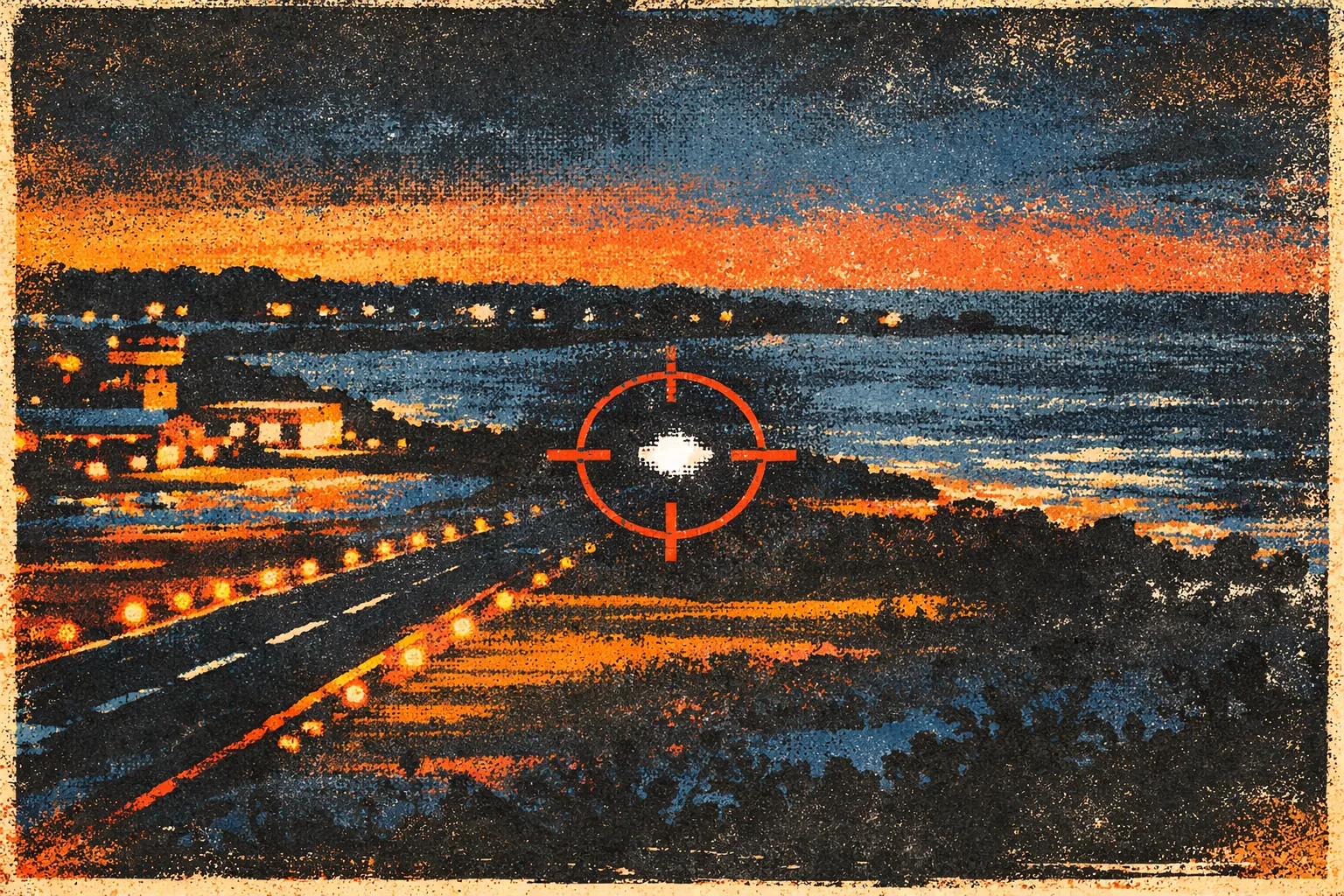
The Puerto Rico infrared video, usually called the 2013 Aguadilla UAP or “Puerto Rico Object”, is a thermal-imaging recording made from a U.S. Customs and Border Protection aircraft near Rafael Hernández Airport in Aguadilla, Puerto Rico, on 26 April 2013.
Page outline Jump by section
Introduction
The case matters because it is not simply a witness story. It has an official video, aircraft telemetry, a known location, later government publication, a formal U.S. case-resolution report, and competing technical analyses. It is therefore one of the better examples of how the same infrared recording can support sharply different conclusions depending on assumptions about camera geometry, wind, distance, parallax and thermal contrast. AARO[DVIDS]dvidshub.netVideo - Puerto Rico Objects…
What was recorded near Aguadilla?
The event took place around Rafael Hernández Airport on Puerto Rico’s north-west coast. The official AARO case synopsis identifies the sensor platform as a U.S. Customs and Border Protection De Havilland Canada 8 aircraft and describes the data type as infrared. The DVIDS-hosted public-domain video entry lists the location as Aguadilla, Puerto Rico, the date taken as 26 April 2013, and the video length as 3 minutes 54 seconds.[AARO]aaro.milPuerto Rico UAP Case ResolutionAARO Puerto Rico UAP Case Resolution…
The raw visual impression is why the footage became famous. A small bright or dark thermal target appears to move across the airfield and surrounding area. Later, when the background changes and the aircraft’s viewing angle becomes steeper, the target appears to separate into two and to vanish near water. DVIDS summarises the apparent behaviour as a UAP moving at high speed, splitting into two objects, and entering and exiting the water before disappearing off Puerto Rico’s north-western coast; the same page also states AARO’s assessment that it did not demonstrate anomalous speeds or flight behaviour.[DVIDS]dvidshub.netVideo - Puerto Rico Objects…
The most important distinction is between what the footage appears to show and what it physically proves. Thermal video does not show ordinary colour, precise distance, or altitude by itself. It records infrared contrast: how distinct an object is from its background in a particular sensor band. That makes the case unusually dependent on geometry. A small drifting object can appear fast if filmed from a moving aircraft with a zoomed sensor, while a fading heat signature can look like a disappearance if the background becomes thermally similar. AARO explicitly relies on both ideas in its 2025 resolution.[AARO]aaro.milUAP Case Resolution ReportsUAP Case Resolution Reports[AARO]aaro.milOpen source on aaro.mil.
How the case reached public attention
The video circulated for years in UAP circles before the U.S. government released public-facing versions and a case resolution. The Scientific Coalition for UAP Studies, an independent group, published a detailed report on Zenodo, listing Robert M. Powell, Morgan Beall, Larry Cates, Carl Paulson, Richard Hoffman and Daina Chaviano as authors or creators. Zenodo describes the work as a detailed analysis of a Homeland Security thermal video, with authenticity checked through radar data correlated to the video metadata, and says the video came from a Wescam MX-15D infrared camera operating in the 3–5 micron infrared region.[Zenodo]zenodo.org2013 Aguadilla Puerto Rico UAP: The detailed analysis of an Unidentified Anomalous Phenomenon captured by the Department of Homelan…
The SCU report framed the footage as a strong anomalous case. Its description states that the object travelled at night without lights through an urban area, at times below tree-top altitude, at speeds approaching 100 mph, and appeared to enter the water, exit, enlarge and split into two equal parts. Those are the claims that made the video compelling to many UAP researchers, because they combine a government sensor platform with apparently unusual movement and possible “transmedium” behaviour, meaning movement between air and water.[Zenodo]zenodo.org2013 Aguadilla Puerto Rico UAP: The detailed analysis of an Unidentified Anomalous Phenomenon captured by the Department of Homelan…
AARO later incorporated the case into its official case-resolution archive. Its “UAP Case Resolution Reports” page summarises the Puerto Rico case and links both the original object video and a reconstruction. AARO’s public position is that an Intelligence Community partner’s reconstruction showed two objects travelling near each other, moving in a straight line at wind speed, and not entering the water at any point.[AARO]aaro.milPuerto Rico UAP Case ResolutionAARO Puerto Rico UAP Case Resolution…
Why the video looked extraordinary
The video’s power comes from several overlapping illusions or uncertainties, not from one simple frame. First, the aircraft is moving around the airport while the sensor is zoomed and tracking a small target. That can create motion parallax: the target appears to sweep quickly across the background even if it is drifting slowly relative to the ground. AARO’s report says the aircraft’s speed, sensor zoom and changing relative position influenced the perceived behaviour.[AARO]aaro.milUAP Case Resolution ReportsUAP Case Resolution Reports
Second, the “split” is not necessarily a single object dividing. AARO says the recording depicts two objects travelling near each other rather than one object splitting into two, noting that separation is visible multiple times within the first minute. In its reconstruction, the changing viewing angle made the separation look more dramatic later in the footage.[AARO]aaro.milOpen source on aaro.mil.
Third, the apparent ocean entry depends on thermal contrast. AARO says the objects remained over land throughout the video and that the impression of transmedium behaviour came from sensor limitations. In particular, it invokes thermal crossover, a situation in which an object’s infrared signature becomes difficult to distinguish from the background. AARO notes that the event occurred at 9:22 p.m. local time, after a 7:48 p.m. sunset, within a period when thermal crossover can affect infrared imagery.[AARO]aaro.milOpen source on aaro.mil.
That does not make the video worthless. It makes it a geometry problem. A small target, a moving aircraft, a changing look angle, a low-resolution infrared signature and a background shift from land to ocean can combine into a very persuasive but misleading visual story. The case is therefore a useful warning against treating infrared footage as self-explanatory.
The official AARO resolution
AARO’s March 2025 case-resolution report gives the clearest official explanation. It assesses with high confidence that the objects did not exhibit anomalous behaviour or transmedium capabilities, and with moderate confidence that they were a pair of sky lanterns. It lists the assessed object altitude as 656 feet, the assessed speed as 8 mph, the shape as indistinct, and the data type as infrared.[AARO]aaro.milOpen source on aaro.mil.
The report says a Systems Toolkit reconstruction found the objects drifted at about 3.6 metres per second, or 8 mph, in a straight line over land. That was consistent with a recorded wind speed of 4.4 metres per second, or 9.8 mph, from the east-north-east. In AARO’s reading, the apparent high speed is attributable to motion parallax, not propulsion.[AARO]aaro.milOpen source on aaro.mil.
AARO also argues that the objects were small. Its pixel analysis estimated them to be under one metre, or three feet, across, and their shapes were considered indistinct. The sky-lantern identification is not stated as absolute: AARO gives it only moderate confidence. Its supporting reasons are the objects’ size, variable thermal signature, wind-matched path and the reported local practice of hotels and resorts releasing sky lanterns for celebrations.[AARO]aaro.milOpen source on aaro.mil.
The report also considers alternatives. It says a marine-bird hypothesis was unlikely because birds at the relevant distances should retain features such as wings or show wingbeat pulsing in infrared. It discusses party balloons as another partner-assessed possibility, but AARO does not concur with a reflected-moonlight explanation for the infrared return. The official bottom line is therefore not “anything could be true”, but a ranked assessment: no anomalous performance with high confidence, sky lanterns with moderate confidence.[AARO]aaro.milOpen source on aaro.mil.
Why independent analysts disagreed
The SCU analysis reached a much stronger unresolved or anomalous conclusion. It argued that the object moved at high speed, at low altitude, apparently interacted with the water, and split into two. Its Zenodo description says the video was broken into individual frames for study and that radar data correlated with the video metadata. This gave the report more substance than a casual online interpretation, even though its conclusions remain disputed.[Zenodo]zenodo.org2013 Aguadilla Puerto Rico UAP: The detailed analysis of an Unidentified Anomalous Phenomenon captured by the Department of Homelan…
The disagreement largely turns on assumptions about location and distance. If the object was close to the ground and really passed behind trees or into the ocean, then its apparent speed and behaviour become difficult to explain as drifting lanterns. If, however, it was higher, farther away, and always over land, then the same video becomes much less extraordinary. AARO explicitly rejects the lower-altitude interpretation, saying pixel analysis found the objects did not pass behind the utility pole and that its STK reconstruction put the objects on a straight wind-driven path over land.[AARO]aaro.milOpen source on aaro.mil.
SCU also publicly rejected the lantern hypothesis advanced by Rubén Lianza and IPACO. On its own Aguadilla page, SCU says Lianza’s paper argues for two Chinese or party lanterns tied together, but SCU objects that matching the lines of sight would require wind-driven objects to travel at a minimum of 16 mph, which it considers too fast for a lantern to remain airborne. SCU also argues that the lantern explanation fails to account for apparent disappearance behind trees and into the water, and that two lanterns should have appeared separate earlier in the video.[The SCU]explorescu.org2013 aguadilla puerto rico uap incident report a detailed analysis2013 aguadilla puerto rico uap incident report a detailed analysis
AARO’s later report directly undercuts several of those objections by saying the objects visibly separate multiple times within the first minute, did not enter the water, and only appeared to vanish because of reduced thermal contrast. That does not prove every detail of the official explanation beyond doubt, but it shows why the case changed once a reconstruction was made central rather than frame-by-frame visual impression alone.[AARO]aaro.milOpen source on aaro.mil.
The lantern explanation and its limits
The lantern explanation predates AARO’s 2025 report. Rubén Lianza’s IPACO report approached the case through four questions: whether the object was self-propelled, whether it was one object or two, whether paired lanterns were plausible, and where they might have come from. Lianza argued from aircraft-video geometry and wind-driven motion, and Metabunk later summarised the conclusion as a likely pair of wind-driven hot-air lanterns, possibly heart-shaped and tied together, released from a beach or resort area upwind from the airport.[ipaco.fr]ipaco.frIPAC O EXPERT´S REPORTIPAC O EXPERT´S REPORT
The appeal of this explanation is that it accounts for several features at once: small size, drifting motion, changing separation, flickering thermal signature and a path compatible with wind. It also fits AARO’s later assessment more closely than birds, drones or a single structured craft. AARO’s version is more cautious than some online debunking discussions, calling the objects “a pair of sky lanterns” with moderate, not high, confidence.[AARO]aaro.milOpen source on aaro.mil.
The limit is that “sky lanterns” is still an attribution, not a recovered object. No lantern remains were produced, no specific event host is publicly identified in AARO’s report, and the original human-witness chain is less robust than the video and metadata. The official case is strongest on the negative claim — no demonstrated anomalous speed or water entry — and weaker on the positive identification, because the video quality does not permit a categorical object match. AARO acknowledges that poor quality reduces its confidence in a definitive identification.[AARO]aaro.milOpen source on aaro.mil.
What the witness evidence adds
The witness component is often described in secondary accounts as involving the aircraft crew or airport personnel seeing a reddish or pinkish light near the airport before the infrared tracking began. The strongest publicly verifiable evidence, however, remains the recording and associated technical data rather than named, cross-examined witness testimony. The SCU report’s public summary emphasises radar correlation and video-frame analysis; AARO’s case synopsis describes the reporter category as publicly available media, originally recorded by U.S. Customs and Border Protection.[Zenodo]zenodo.org2013 Aguadilla Puerto Rico UAP: The detailed analysis of an Unidentified Anomalous Phenomenon captured by the Department of Homelan…
That matters for credibility. A government sensor recording is valuable evidence that something was filmed. It is not, by itself, proof that the object was close, fast, powered or transmedium. Witness impressions can help establish what prompted tracking, but in this case they do not resolve the central dispute unless they reliably constrain the object’s distance, altitude and path. AARO’s reconstruction effectively treats the sensor geometry and wind as more decisive than the subjective impression of an unusual light.[AARO]aaro.milOpen source on aaro.mil.
A fair reading is that the case has unusually good documentary evidence for a UAP discussion, but limited witness evidence for extraordinary performance. The documentary evidence supports the existence of an event and a real infrared track. It does not, after AARO’s reconstruction, securely support claims of a craft entering the ocean or accelerating under intelligent control.

What remains genuinely unresolved?
The biggest unresolved point is not whether the video is real. The video is real enough to have been hosted by DVIDS, included in AARO’s official case archive, and analysed by both independent and government-linked teams. The unresolved part is how much confidence readers should place in the competing reconstructions, especially where earlier SCU assumptions and later AARO assumptions diverge.[DVIDS]dvidshub.netVideo - Puerto Rico Objects…[AARO]aaro.milOpen source on aaro.mil.
The practical uncertainties are narrower than the folklore suggests:
- Exact object identity: AARO favours sky lanterns, but only with moderate confidence.
- Exact launch source: The public record does not identify a confirmed release event.
- Precision of reconstruction: AARO’s STK model is central to the official conclusion, while critics may question inputs, assumptions or whether all visual features are fully accounted for.
- Witness-chain detail: Publicly accessible named testimony is less developed than the video analysis.
What seems much less unresolved, based on the strongest official evidence now available, is the claim that the footage proves a high-speed object entering and exiting the ocean. AARO’s report specifically says the objects remained over land, moved at wind speed, and appeared to vanish because of infrared sensor limitations and thermal contrast effects.[AARO]aaro.milOpen source on aaro.mil.[AARO]aaro.milOpen source on aaro.mil.
Why the case still matters
The Aguadilla video remains useful because it shows both the promise and danger of technical UAP evidence. Unlike a vague sighting report, it gives analysts a real sensor record, a known platform, a defined location and enough metadata to attempt reconstruction. That is exactly the kind of evidence UAP researchers often ask for. But it also shows that technical-looking footage can mislead viewers when distance, background, sensor mode and observer motion are not carefully modelled.[Zenodo]zenodo.org2013 Aguadilla Puerto Rico UAP: The detailed analysis of an Unidentified Anomalous Phenomenon captured by the Department of Homelan…
The case also illustrates a recurring pattern in UAP debates. Early public attention concentrates on the most extraordinary visual interpretation: speed, water entry, splitting. Later technical review shifts attention to mundane but powerful variables: parallax, wind, two nearby objects, thermal crossover, cloud cover and range. The result is not as dramatic, but it is more instructive.[AARO]aaro.milOpen source on aaro.mil.[AARO]aaro.milOpen source on aaro.mil.
For a case dossier, the most defensible summary is this: the Puerto Rico infrared video is an authentic and interesting government-recorded thermal sequence, but the best current official analysis does not support anomalous flight, transmedium travel or a single object splitting in two. The strongest remaining dispute is whether AARO’s sky-lantern attribution is sufficiently proven, not whether the video by itself demonstrates extraordinary technology.
Amazon book picks
Further Reading
Books and field guides related to What Did the Aguadilla Video Really Show?. Use these as the next step if you want deeper reading beyond the article.
Principles of Optics
Covers the fundamental optical physics of thermal imagery sensors, motion parallax metrics, and lens refraction limits.
In Plain Sight: an Investigation Into UFOs and Impossible Sci...
Reviews the competing technical arguments filed by groups like the Scientific Coalition for UAP Studies regarding the Aguadilla object.
The Skeptics' Guide to the Universe
Teaches fundamental analytical reasoning skills to help readers judge raw thermal contrast loops independently of sensational media capti...
Introduction to Airborne Radar
Provides critical data parameters on how airborne target acquisition pods, thermal imaging systems, and aircraft tracking arrays function.
eBay marketplace picks
Marketplace Samples
Example marketplace items related to this page. Use the search link to explore similar finds on eBay.


Endnotes
1.
Source: aaro.mil
Title: Puerto Rico UAP Case Resolution
Link:https://www.aaro.mil/Portals/136/PDFs/case_resolution_reports/AARO_Puerto_Rico_UAP_Case_Resolution.pdf
Source snippet
AARO Puerto Rico UAP Case Resolution...
2.
Source: zenodo.org
Link:https://zenodo.org/records/7844175
Source snippet
2013 Aguadilla Puerto Rico UAP: The detailed analysis of an Unidentified Anomalous Phenomenon captured by the Department of Homelan...
3.
Source: aaro.mil
Title: UAP Case Resolution Reports
Link:https://www.aaro.mil/UAP-Cases/UAP-Case-Resolution-Reports/
4.
Source: ipaco.fr
Title: IPAC O EXPERT´S REPORT
Link:https://www.ipaco.fr/EN_IFO_B_heart_130425.pdf
5.
Source: metabunk.org
Title: Aguadilla Infrared Footage of ‘UFOs’
Link:https://www.metabunk.org/threads/aguadilla-infrared-footage-of-ufos-probably-hot-air-wedding-lanterns.8952/
6.
Source: aaro.mil
Link:https://www.aaro.mil/UAP-Cases/Official-UAP-Imagery/
7.
Source: dvidshub.net
Link:https://www.dvidshub.net/video/944204/puerto-rico-objects
Source snippet
Video - Puerto Rico Objects...
8.
Source: dvidshub.net
Link:https://www.dvidshub.net/video/955936/2013-puerto-rico-object-reconstruction
Source snippet
Video - 2013 Puerto Rico Object Reconstruction...
9.
Source: explorescu.org
Title: 2013 aguadilla puerto rico uap incident report a detailed analysis
Link:https://www.explorescu.org/post/2013-aguadilla-puerto-rico-uap-incident-report-a-detailed-analysis
10.
Source: facebook.com
Title: puerto rico objects
Link:https://www.facebook.com/dvids/videos/puerto-rico-objects/8827501750675573/
11.
Source: academia.edu
Title: 2013 Aguadilla Puerto Rico
Link:https://www.academia.edu/40212895/2013_Aguadilla_Puerto_Rico
Additional References
12.
Source: youtube.com
Link:https://www.youtube.com/watch?v=iSArCxSar6Q
Source snippet
SPLITTING ORB UFO ABOVE PUERTO RICO | The Proof is Out There: Bermuda Triangle Edition (Season 1)...
13.
Source: youtube.com
Link:https://www.youtube.com/watch?v=DD9r-eZmYWI
Source snippet
Aguadilla UAP Video Analysis: Is It "Smoking Gun" Footage? | Rich Hoffman...
14.
Source: youtube.com
Title: Aguadilla UAP Video Analysis: Is It “Smoking Gun” Footage? | Rich Hoffman
Link:https://www.youtube.com/watch?v=NmvHKAbRuFI
Source snippet
Limina Inaugural Symposium Day 3 - Mick West...
15.
Source: facebook.com
Link:https://www.facebook.com/TheAncientLibrary/posts/the-aguadilla-ufo-encounter-took-place-in-puerto-rico-when-a-us-customs-and-bord/636926681393053/
16.
Source: enigmalabs.io
Link:https://enigmalabs.io/library/c5385cb4-c51e-44c6-a6d4-353758563ecb
17.
Source: theblackvault.com
Link:https://www.theblackvault.com/documentarchive/dod-report-says-aguadilla-ufo-was-just-sky-lanterns-previous-scientific-studies-claim-otherwise/
18.
Source: europeafrica.army.mil
Link:https://www.europeafrica.army.mil/VideoPlayer/?videoid=955936
19.
Source: facebook.com
Link:https://www.facebook.com/prinforma/posts/the-aguadilla-ufo-incident-is-being-treated-by-scientists-as-one-of-the-most-ext/4383698645014832/
20.
Source: linkedin.com
Link:https://www.linkedin.com/posts/alejandrotrojas_sightings-s01ep5-2013-aguadilla-puerto-activity-7055300048254861312-BUSo
21.
Source: youtube.com
Title: Limina Inaugural Symposium Day 3
Link:https://www.youtube.com/watch?v=BahEq46t3Uo
Source snippet
Top Declassified UFO Videos Released by the Pentagon...
Topic Tree
Follow this branch
Related pages 106
- Godfrey Encounter
- Hamilton Airship
- Andreasson
- Villas Boas
- Apollo 11 Sightings
- +101 more in sidebar