What Really Flew Over Washington?
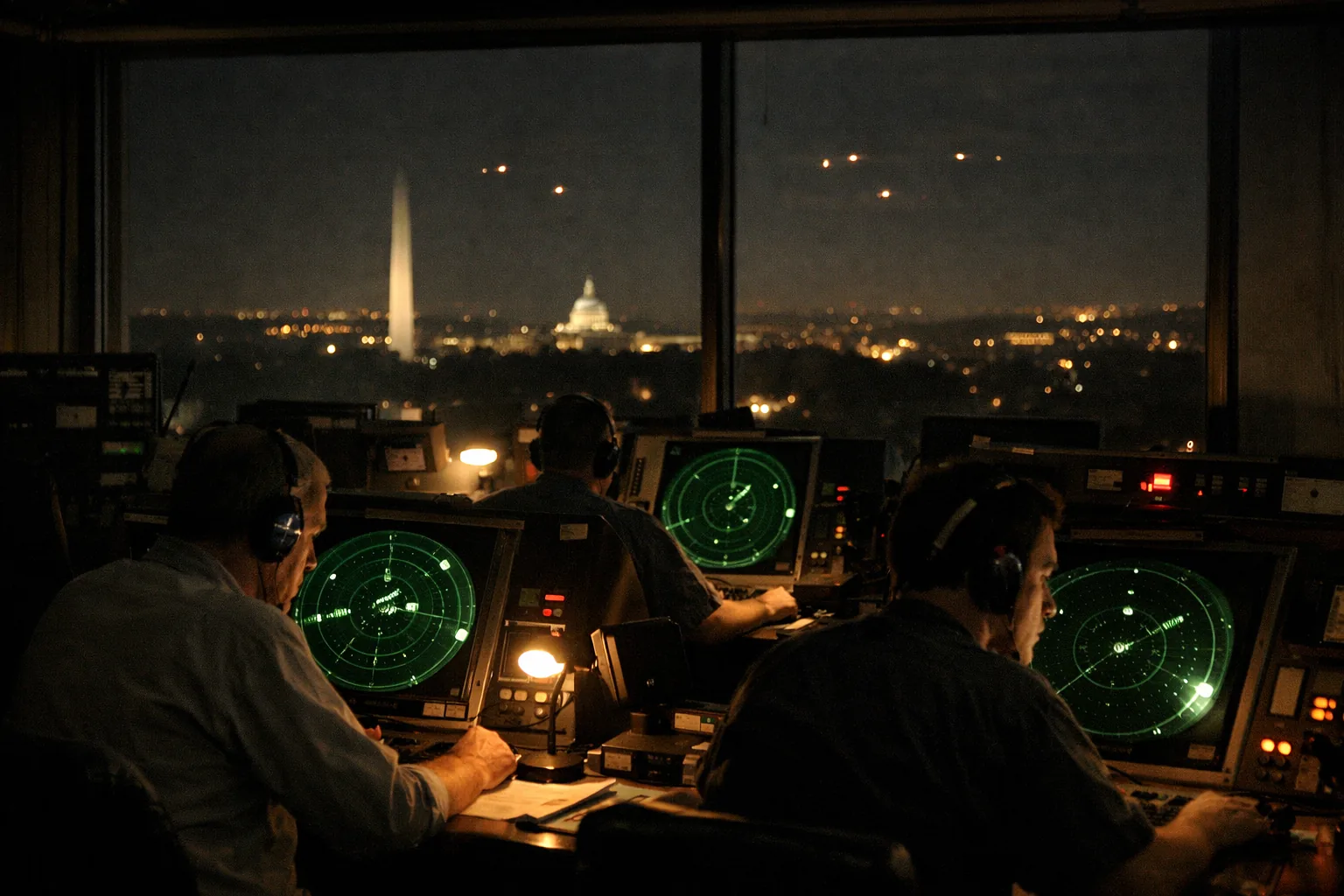
The Washington National sightings of July 1952 were not a single “flying saucer over the White House” moment, but a short, high-pressure series of radar and visual reports around Washington National Airport, Andrews Air Force Base and restricted airspace over the US capital.
Page outline Jump by section
Introduction
The case matters because it became the most politically visible incident of the 1952 UFO wave. It alarmed the Truman administration, pushed the Air Force into a major press conference, drew CIA attention to the national-security implications of mass UFO reporting, and helped set the stage for the Robertson Panel in January 1953. It remains a useful test case because both sides of the debate have something real to work with: credible witnesses and contemporary concern on one side, but plausible technical explanations and weak physical evidence on the other.[FAS Project on Government Secrecy]sgp.fas.orgSource details in endnotes.
What happened over Washington in July 1952?
The core events unfolded on two Saturday-night-to-Sunday-morning periods: 19–20 July and 26–27 July 1952. The country was already in a UFO “flap”, a term used for a concentrated wave of reports. Project Blue Book, the Air Force’s UFO investigation programme, received far more reports in 1952 than in surrounding years; the Condon Report’s historical table lists 1,501 reports for 1952, with an especially sharp peak in July.[NCAS Files]files.ncas.orgCondon Report, Sec III, Chapter 5: Optical & Radar Analysis…
On the first weekend, radar operators at Washington National Airport reported unidentified targets beginning late on 19 July. Contemporary and later accounts describe targets appearing near the capital, sometimes moving slowly and sometimes appearing to accelerate abruptly. The Washington Post’s retrospective account, drawing on named witnesses and the surviving case history, places the first radar blips at about 11:40 pm and describes seven targets roughly 15 miles from the city. It also records the involvement of Harry Barnes at National Airport and reports that Andrews and Bolling were contacted as the operators tried to establish whether the returns were local equipment faults or something more widespread.[The Washington Post]washingtonpost.comSource details in endnotes.
The first weekend also included visual reports. At Andrews, William Brady reported seeing an orange, fire-like object from the control tower. At National, controller Howard Cocklin later recalled seeing a whitish-blue light that he associated with a solid object. Capital Airlines pilot S. C. “Casey” Pierman, a highly experienced pilot waiting to depart, reported several fast-moving lights over a 14-minute period; the famous description “falling stars without tails” comes from this part of the case.[The Washington Post]washingtonpost.comSource details in endnotes.
The second weekend repeated the pattern strongly enough to make the case national news rather than a one-night oddity. Radar contacts again appeared, Air Force F-94 interceptors were scrambled, and some pilots saw nothing even when vectored towards reported radar targets. Other witnesses reported lights. The CIA’s later historical account summarised the official concern tersely: on 19 and 20 July, radar at Washington National and Andrews tracked mysterious blips; on 27 July, the blips reappeared; interceptors were sent up but “found nothing”.[FAS Project on Government Secrecy]sgp.fas.orgSource details in endnotes.
Why the witnesses still matter
The Washington National case has endured because it was not built only on anonymous civilian reports. It involved air-traffic controllers, military radar sites, commercial pilots and Air Force officials responding in real time. That does not make the reports automatically extraordinary, but it does raise the evidential baseline above a casual sighting by one startled observer.
The main witness strength is professional competence. Radar operators were trained to interpret scopes, pilots were used to seeing aircraft, stars, meteors and weather effects, and the reports took place in controlled airspace where unexplained targets had operational significance. The National Archives confirms that Project Blue Book’s declassified files are preserved as Air Force records, including chronological case files and project files, which gives the incident a documentary setting rather than leaving it entirely in folklore.[National Archives]cdn.nationalarchives.gov.ukSource details in endnotes.
The witness problem is correlation. A strong radar-visual case would show the same object observed from multiple independent positions, tracked continuously, and matched precisely to visual bearings, altitudes and times. The later Condon Report’s radar specialist, Gordon Thayer, concluded that the Washington visual reports and radar tracks were “generally not correlated” except in loose ways, such as a person looking in the direction supplied by radar and seeing a star or light. That finding does not prove every witness was wrong; it does weaken the claim that the case contains a single coherent, instrument-confirmed unknown craft.[NCAS Files]files.ncas.orgCondon Report, Sec V, Chapter 2: UFOs: 1947 - 1968…
There is also a memory problem. Some of the most vivid public recollections were recorded years later, and later witnesses naturally interpreted their memories through decades of UFO controversy. That does not make them worthless, but it means the most reliable reconstruction should give greatest weight to contemporary records, Air Force files, radar-weather analysis and statements made close to the event.
The official response was fast, public and uneasy
The Air Force could not treat the Washington reports as a routine curiosity. The capital was involved, press coverage was intense, and the country was in the early Cold War. Project Blue Book had only recently been reorganised under that name in March 1952, and the Air Force had already been under pressure to explain whether UFO reports implied foreign technology, secret US aircraft, natural phenomena or something more exotic.[FAS Project on Government Secrecy]sgp.fas.orgSource details in endnotes.
On 29 July 1952, Major General John A. Samford, the Air Force Director of Intelligence, held a major Pentagon press conference. The National Archives catalogue preserves Samford’s filmed statement on “flying saucers”, dated 31 July 1952, as part of official motion-picture holdings. Contemporary summaries and later histories agree that the press conference was an unusually significant public response to the Washington reports and the wider wave of sightings.[DocsTeach]docsteach.orgSource details in endnotes.
Samford’s position was deliberately calming. He acknowledged that some reports came from credible observers describing difficult-to-explain things, but the Air Force line was that there was no evidence of a national-security threat, no evidence of interplanetary craft, and no pattern suggesting hostile purpose. For the Washington radar returns, the official explanation leaned heavily on temperature inversions and related radar propagation effects; for many visual reports, it pointed to meteors, stars and other ordinary lights seen under unusual conditions.[Wikimedia Commons]upload.wikimedia.orgCommonsdepartment of defenseCommonsdepartment of defense
This response did not end the controversy, partly because it sounded more confident in public than some investigators felt privately. Edward J. Ruppelt, the first head of Project Blue Book, later criticised the handling of the investigation and thought the Air Force had not fully investigated the Washington reports before the press conference. That tension — public reassurance before exhaustive investigation — became one reason the case still appears in UFO literature as a possible example of premature official debunking.[Wikipedia]WikipediaEdward J. RuppeltEdward J. Ruppelt
The temperature-inversion explanation, in plain terms
A temperature inversion occurs when warmer air sits above cooler air near the ground. Under some conditions, this layering can bend radar waves abnormally. Instead of travelling in the expected way, radar energy may be refracted towards the ground or along layers of air, producing returns from distant ground objects, moving atmospheric layers or other non-aircraft sources. In radar literature this is usually discussed as anomalous propagation, often shortened to AP.
This explanation was not invented decades later. The CIA’s historical account states that the Air Force “quickly offered” temperature inversions as a possible explanation and that a Civil Aeronautics Administration investigation later confirmed such radar blips were common and caused by inversions. The key issue is not whether inversions existed in Washington that summer; the key issue is whether they can explain the particular movements, timings and visual claims reported on those nights.[FAS Project on Government Secrecy]sgp.fas.orgSource details in endnotes.
The most detailed publicly accessible technical discussion is in the Condon Report’s optical and radar analysis. Thayer judged that a 1953 analysis by Borden and Vickers was “an excellent analysis of the probable radar situation” during the July 1952 Washington sightings. According to that review, similar radar targets were observed in August 1952, and their behaviour suggested ground returns seen by partial reflections from moving atmospheric layers.[NCAS Files]files.ncas.orgFiles Condon Report, Section IIFiles Condon Report, Section II
Thayer’s summary is important because it does not merely wave at “weather” in a vague way. It states that atmospheric conditions in the Washington area during 19–20 and 25–27 July were conducive to anomalous propagation; that the unidentified radar returns were most likely AP; and that the visual objects were, with one or two possible exceptions, most probably meteors and scintillating stars.[NCAS Files]files.ncas.orgOpen source on ncas.org.
What remains difficult to explain?
The Washington National sightings are not a cleanly “solved” case in the sense that every individual observation can be matched to a named aircraft, star, meteor or radar artefact. The surviving evidence is too uneven for that. The unresolved residue consists mainly of witness confidence, reported radar behaviour that seemed dramatic to operators, and the impression among some participants that the radar returns were solid targets rather than atmospheric effects.
The strongest unresolved point is the apparent recurrence on consecutive weekends in sensitive airspace, with multiple facilities involved. To a lay reader, that sounds like powerful corroboration. The technical counterpoint is that shared regional weather conditions can affect multiple radar sites, and that visual observers who are told where to look may find ambiguous lights in the same general direction. Thayer’s review explicitly identified this as a common pattern in radar-visual cases involving anomalous propagation.[NCAS Files]files.ncas.orgOpen source on ncas.org.
Another difficulty is the reported high speed and abrupt motion. UFO advocates often treat this as the most extraordinary feature. Radar analysts are more cautious because false targets can appear to jump, vanish, reappear or be confused with different echoes, creating calculated speeds that do not reflect the motion of a physical object. The Condon Report notes, in a broader radar-analysis discussion, that jumps between echoes can be a frequent source of very high reported UFO speeds.[NCAS Files]files.ncas.orgOpen source on ncas.org.
The case also lacks the kinds of physical evidence that would dramatically change its status. There was no recovered object, no confirmed landing trace, no verified photograph of a craft over Washington, no continuous multi-sensor track released in a form that can be independently reanalysed today, and no official finding of extraterrestrial or foreign technology. That absence does not prove nothing unusual occurred, but it keeps the case in the category of contested reports rather than hard physical evidence.
CIA interest was about vulnerability, not alien confirmation
One of the most commonly misunderstood aspects of the Washington sightings is the CIA’s reaction. CIA interest is sometimes presented as if it confirmed that officials privately knew the objects were extraordinary. The archival picture is more prosaic and, in some ways, more interesting: the Agency was worried about public panic, overloaded communications, air-defence confusion and the possibility that an adversary could exploit UFO reports during a crisis.[FAS Project on Government Secrecy]sgp.fas.orgSource details in endnotes.
The CIA’s own historical review says the 1952 build-up, especially in July, alarmed the Truman administration. It also records that the Agency formed a special study group within the Office of Scientific Intelligence and the Office of Current Intelligence. That group concluded that most sightings could be easily explained, but recommended continued monitoring and secrecy about CIA interest because public knowledge of that interest might itself be taken as confirmation that UFOs were real.[FAS Project on Government Secrecy]sgp.fas.orgSource details in endnotes.
The Cold War context matters. CIA officials worried that a flood of UFO reports could clog communication channels, trigger mass panic or make air warning systems less able to distinguish real hostile aircraft from false targets. H. Marshall Chadwell considered the matter serious enough to raise at National Security Council level, and Director of Central Intelligence Walter Bedell Smith wanted to know whether the Air Force investigation was sufficiently objective.[FAS Project on Government Secrecy]sgp.fas.orgSource details in endnotes.
This led to the Robertson Panel, convened in January 1953 under physicist H. P. Robertson. The panel reviewed Air Force UFO evidence and concluded unanimously that the available sightings showed no direct threat to national security and no evidence of extraterrestrial objects. It did, however, warn that continued emphasis on UFO reporting could disrupt government functioning and might be exploited by enemies.[FAS Project on Government Secrecy]sgp.fas.orgSource details in endnotes.

The case against an extraordinary craft hypothesis
A fair reading does not require dismissing the witnesses as foolish. It does require asking whether the extraordinary hypothesis explains the whole case better than the mundane one. On the public evidence, it struggles.
First, the radar evidence is technically vulnerable. The later Colorado/Condon analysis found weather conditions favourable to anomalous propagation during the relevant periods, and it identified the Washington radar returns as most likely AP. That is a direct technical challenge to the idea that radar had confirmed solid craft.[NCAS Files]files.ncas.orgOpen source on ncas.org.
Second, the visual evidence is scattered. Some witnesses saw lights, but lights at night are among the most difficult observations to evaluate. Stars low on the horizon can scintillate, meteors can appear as sudden fast-moving lights, and a witness looking for something unusual after being alerted by radar is more likely to notice and misread ambiguous stimuli. The Condon Report’s broader discussion of visual perception highlights problems such as size-distance confusion, afterimages and autokinesis, where a stationary point of light can appear to move when seen against a sparse background.[NCAS Files]files.ncas.orgOpen source on ncas.org.
Third, the official long-term position never shifted towards extraordinary technology. The Air Force’s later Project Blue Book fact sheet, preserved by the National Archives, states that no UFO investigated and evaluated by the Air Force gave an indication of a national-security threat, no evidence showed technology beyond present scientific knowledge, and no evidence indicated extraterrestrial vehicles. Those conclusions cover the programme as a whole rather than only Washington, but they frame how the Air Force ultimately classified its decades of UFO work.[National Archives]cdn.nationalarchives.gov.ukSource details in endnotes.
That said, the mundane explanation is not perfect in a courtroom sense. It is a best-fit reconstruction from incomplete records, not a frame-by-frame replication of every blip and light. The reasonable sceptical conclusion is therefore narrower than “nothing happened”: something was reported by serious people, but the available evidence is better explained by radar propagation, misidentified lights and Cold War amplification than by unknown craft over Washington.
Why the 1952 sightings still shape UFO debates
The Washington National sightings sit at the junction of three histories: UFO belief, radar interpretation and Cold War state secrecy. Their enduring power comes less from a single unanswerable fact than from the collision of credible witnesses, dramatic location and imperfect official communication.
For UFO advocates, the case remains appealing because it involves multiple trained observers and radar in the nation’s capital. It seems to resist the simplest dismissals of UFO reports as hoaxes, drunkenness or fantasy. Even some sceptical accounts concede that the witnesses were not merely inventing stories; they were interpreting confusing observations under real operational pressure.
For sceptics, the case is a textbook warning about over-reading radar. Radar is not a magic truth machine. Especially in the 1950s, operators had to interpret clutter, propagation effects and ambiguous returns with far less filtering and automation than later systems provided. The Condon Report’s Washington analysis is powerful precisely because it explains how a dramatic-looking radar case can arise without a dramatic object.[NCAS Files]files.ncas.orgOpen source on ncas.org.
For historians, the case shows how government secrecy can create suspicion even when the underlying concern is mundane. CIA officials wanted to conceal their interest partly because they feared public overreaction. Yet that secrecy later fed claims of cover-up. The CIA’s own historical review acknowledges that keeping Agency sponsorship of the Robertson Panel quiet contributed to later credibility problems.[FAS Project on Government Secrecy]sgp.fas.orgSource details in endnotes.
Best assessment
The Washington National sightings were a real historical incident: radar operators and some visual witnesses reported unusual phenomena over the Washington area in July 1952, the Air Force responded publicly, and the CIA treated the wider UFO wave as a national-security management problem. The case should not be reduced to a joke or a myth.
The best-supported interpretation, however, is not that structured unknown craft flew over the capital. The stronger evidential reading is that the radar returns were probably caused by anomalous propagation during favourable weather conditions, while many visual reports were probably meteors, stars or ambiguous lights interpreted in a charged context. The Condon Report’s technical assessment, the CIA’s historical account and the Air Force’s long-term Blue Book conclusions all point in that direction, even while leaving room for a few individual observations to remain uncertain. NCAS Files[FAS Project on Government Secrecy]sgp.fas.orgSource details in endnotes.
The lasting lesson of the case is that “unidentified” is not a synonym for “extraordinary vehicle”. In Washington in 1952, unidentified meant that radar, weather, human perception, press pressure and Cold War fear combined faster than investigators could sort them out. That combination made the sightings historically important, but it does not make them strong evidence of extraterrestrial visitation.
Amazon book picks
Further Reading
Books and field guides related to What Really Flew Over Washington?. Use these as the next step if you want deeper reading beyond the article.
The UFO Book
Provides an objective case-file entry documenting the Washington National sightings, summarizing the professional witness accounts and th...
The Report on Unidentified Flying Objects
Details Ruppelt's investigative notes on the Washington events and explains why it was considered a major file in the Project Blue Book era.
Scientific Paranormal Investigation
Teaches methodologies to evaluate cases based on clustered sighting reports and assess competing natural explanations like temperature in...
Ufos and Government
Provides institutional background on how 1950s investigative bureaus managed the public relations and intelligence workload during sighti...
eBay marketplace picks
Marketplace Samples
Example marketplace items related to this page. Use the search link to explore similar finds on eBay.
Endnotes
1.
Source: sgp.fas.org
Link:https://sgp.fas.org/library/ciaufo.html
2.
Source: files.ncas.org
Link:https://files.ncas.org/condon/text/s3chap05.htm
Source snippet
Condon Report, Sec III, Chapter 5: Optical & Radar Analysis...
3.
Source: files.ncas.org
Link:https://files.ncas.org/condon/text/s5chap02.htm
Source snippet
Condon Report, Sec V, Chapter 2: UFOs: 1947 - 1968...
4.
Source: archives.gov
Title: National Archives Project BLUE BOOK
Link:https://www.archives.gov/research/military/air-force/ufos
5.
Source: docsteach.org
Link:https://docsteach.org/document/samford-statement-on-flying-saucers/
6.
Source: upload.wikimedia.org
Title: Commonsdepartment of defense
Link:https://upload.wikimedia.org/wikipedia/commons/7/78/General_Samford_Press_Conference%2C_July_29%2C_1952.pdf
7.
Source: Wikipedia
Title: Edward J. Ruppelt
Link:https://en.wikipedia.org/wiki/Edward_J._Ruppelt
8.
Source: files.ncas.org
Title: Files Condon Report, Section II
Link:https://files.ncas.org/condon/text/sec-ii.htm
9.
Source: Wikipedia
Title: 1952 Washington, D.C. UFO incident
Link:https://en.wikipedia.org/wiki/1952_Washington%2C_D.C._UFO_incident
10.
Source: Wikipedia
Title: Project Blue Book
Link:https://en.wikipedia.org/wiki/Project_Blue_Book
11.
Source: archives.gov
Title: project blue book 50th anniversary
Link:https://www.archives.gov/news/articles/project-blue-book-50th-anniversary
12.
Source: prologue.blogs.archives.gov
Link:https://prologue.blogs.archives.gov/wp-content/uploads/sites/9/2018/03/report.pdf
13.
Source: archives.gov
Title: do records show proof of ufos
Link:https://www.archives.gov/news/articles/do-records-show-proof-of-ufos
14.
Source: prologue.blogs.archives.gov
Title: saucers over washington the history of project blue book
Link:https://prologue.blogs.archives.gov/2019/12/19/saucers-over-washington-the-history-of-project-blue-book/
15.
Source: catalog.archives.gov
Link:https://catalog.archives.gov/id/25738
16.
Source: cia.gov
Title: CIA RDP81R00560R000100010001 0
Link:https://www.cia.gov/readingroom/docs/CIA-RDP81R00560R000100010001-0.pdf
17.
Source: cia.gov
Link:https://www.cia.gov/readingroom/document/cia-rdp81r00560r000100010002-9
18.
Source: cia.gov
Title: CIA RDP81R00560R000100030027 0
Link:https://www.cia.gov/readingroom/docs/CIA-RDP81R00560R000100030027-0.pdf
19.
Source: cia.gov
Title: CIA RDP79B00752A000300100010 4
Link:https://www.cia.gov/readingroom/docs/CIA-RDP79B00752A000300100010-4.pdf
20.
Source: cia.gov
Link:https://www.cia.gov/readingroom/docs/CIA-RDP75-00149R000500070002-1.pdf
21.
Source: cia.gov
Title: role study UFOs
Link:https://www.cia.gov/resources/csi/static/cia-role-study-UFOs.pdf
22.
Source: cia.gov
Title: DOC 0005517565
Link:https://www.cia.gov/readingroom/docs/DOC_0005517565.pdf
23.
Source: cia.gov
Link:https://www.cia.gov/readingroom/document/cia-rdp81r00560r000100030027-0
24.
Source: cia.gov
Link:https://www.cia.gov/readingroom/document/cia-rdp81r00560r000100010001-0
25.
Source: cia.gov
Link:https://www.cia.gov/readingroom/docs/DOC_0005516124.pdf
26.
Source: cia.gov
Link:https://www.cia.gov/readingroom/docs/CIA-RDP69B00369R000200240055-8.pdf
27.
Source: cia.gov
Title: DOC 0000838057
Link:https://www.cia.gov/readingroom/docs/DOC_0000838057.pdf
28.
Source: cia.gov
Link:https://www.cia.gov/readingroom/docs/CIA-RDP88-01315R000300070010-4.pdf
29.
Source: cia.gov
Link:https://www.cia.gov/readingroom/docs/CIA-RDP81R00560R000100060001-5.pdf
30.
Source: cia.gov
Link:https://www.cia.gov/readingroom/docs/CIA-RDP81R00560R000100020012-7.pdf
31.
Source: files.ncas.org
Link:https://files.ncas.org/condon/text/s3chap03.htm
32.
Source: files.ncas.org
Link:https://files.ncas.org/condon/text/s3chap04.htm
33.
Source: files.ncas.org
Link:https://files.ncas.org/condon/text/contents.htm
34.
Source: files.ncas.org
Link:https://files.ncas.org/condon/text/s3chap01.htm
35.
Source: files.ncas.org
Link:https://files.ncas.org/condon/text/case49.htm
36.
Source: ncas.org
Link:https://www.ncas.org/condon/text/s6chap07.htm
37.
Source: files.ncas.org
Link:https://files.ncas.org/condon/text/s6chap04.htm
38.
Source: washingtonpost.com
Link:https://www.washingtonpost.com/archive/lifestyle/2002/07/21/50-years-ago-unidentified-flying-objects-from-way-beyond-the-beltway-seized-the-capitals-imagination/59f74156-51f4-4204-96df-e12be061d3f8/
39.
Source: cdn.nationalarchives.gov.uk
Link:https://cdn.nationalarchives.gov.uk/documents/the-ufo-files-extract.pdf
40.
Source: facebook.com
Link:https://www.facebook.com/archives.foundation/posts/watch-the-skies-tonight-there-might-be-something-out-thereon-the-night-of-july-1/10154403111074901/
41.
Source: britannica.com
Title: Project Blue Book
Link:https://www.britannica.com/topic/Project-Blue-Book
Additional References
42.
Source: youtube.com
Link:https://www.youtube.com/watch?v=p2HCEm-g1TY
Source snippet
Ancient Aliens: UFO Cover-Up Inside the U.S. Government (Season 5) | History...
43.
Source: buzzsprout.com
Link:https://www.buzzsprout.com/2368827/15140336/transcript
44.
Source: facebook.com
Link:https://www.facebook.com/groups/scififan/posts/5567239276660528/
45.
Source: facebook.com
Link:https://www.facebook.com/HISTORY/posts/for-decades-the-existence-of-ufos-was-denied-by-the-us-government-even-after-uni/10157032612491184/
46.
Source: archive.org
Link:https://archive.org/stream/pdfy-4vyHjooOJagoGAwN/Scientific%2BStudy%2BOf%2BUnidentified%2BFlying%2BObjects_djvu.txt
47.
Source: facebook.com
Link:https://www.facebook.com/thetimesherald/posts/new-government-ufo-files-reveal-apollo-17-astronauts-saw-fourth-of-july-like-fla/1814543713274775/
48.
Source: facebook.com
Link:https://www.facebook.com/groups/500514746808351/posts/2695407703985700/
49.
Source: sacred-texts.com
Link:https://sacred-texts.com/ufo/rufo/rufo13.htm
50.
Source: sacred-texts.com
Link:https://sacred-texts.com/ufo/rufo/rufo14.htm
51.
Source: facebook.com
Link:https://www.facebook.com/groups/Normanfrankelestian/posts/35652876067692899/
Topic Tree
Follow this branch
Related pages 106
- Godfrey Encounter
- Hamilton Airship
- Andreasson
- Villas Boas
- Apollo 11 Sightings
- +101 more in sidebar