Within Arrey UFO
Was the Arrey UFO Part of Test Range Activity?
The sighting happened inside a busy test-range environment where balloons, rockets, and aircraft made the sky unusually complicated.
On this page
- The White Sands aerospace setting
- Skyhook balloons and FFTV work
- Why local testing both helps and complicates explanations
Page outline Jump by section
Introduction
The Charles B. Moore sighting did not occur in an ordinary stretch of desert sky. In April 1949, southern New Mexico was one of the busiest aerospace testing regions in the United States, with military rockets, experimental balloons, atmospheric research, and classified surveillance work all operating in overlapping airspace around White Sands Proving Ground. That setting matters because it cuts both ways. On one hand, the environment offered many potential conventional explanations for unusual aerial observations. On the other, the main witness, Moore himself, was deeply embedded in that world and professionally familiar with the very balloon systems later proposed as explanations.[Wikipedia]WikipediaSkyhook balloonSkyhook balloon[Wikipedia]WikipediaCharles B. MooreCharles B. Moore[Wikipedia]WikipediaProject MogulProject Mogul
 Understanding the White Sands context is therefore essential to evaluating the Arrey sighting. The case sits at the intersection of Cold War secrecy, early high-altitude balloon research, and the rapid expansion of American missile testing after the Second World War. The same technological frontier that produced many UFO reports also produced the strongest skeptical explanations for them.
The White Sands aerospace setting
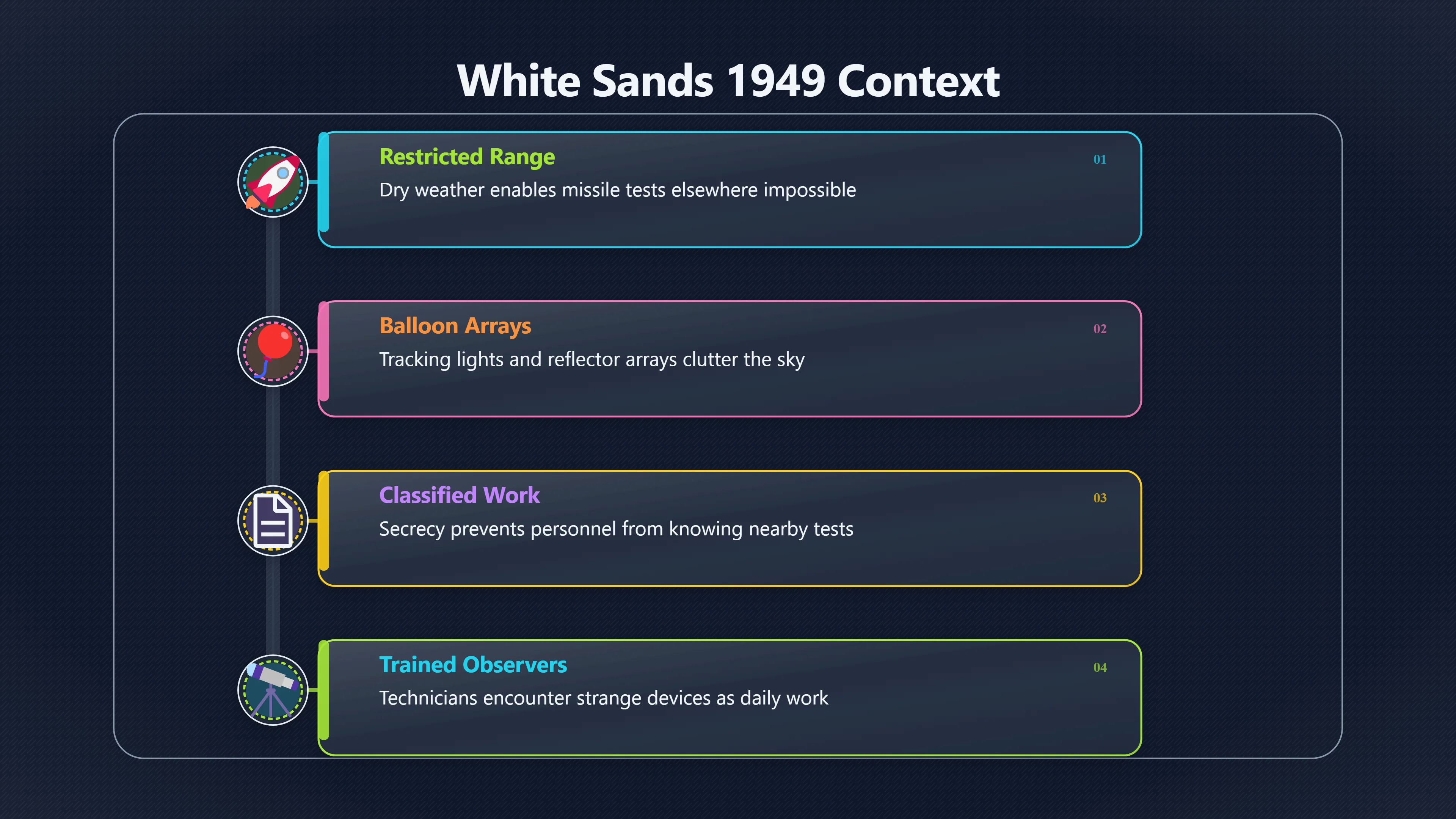
By 1949, White Sands Proving Ground had become a central laboratory of the emerging Cold War aerospace state. Captured German V-2 rockets were being launched there, new American missile systems were under development, and military researchers were using the region’s dry weather and huge restricted ranges to conduct experiments that could not easily be performed elsewhere.[thisdayinaviation.com]thisdayinaviation.comwhite sands proving groundsTag Archives: White Sands Proving Grounds3 May 1949: at 9:14 a.m., Mountain Daylight Saving Time (15:14 UTC), the Viking 1 rocket was lau… StratoCat This activity created a sky environment unlike that of most civilian regions in the United States. Personnel in the area regularly encountere[sacred-texts.com]sacred-texts.com27, 1956 — This wasn't the only UFO sighting made by White Sands scientists. On April 5, 1948, another team watched a UFO for several min… d:
- High-altitude balloons[facebook.com]facebook.comOn February 24, 1949 a high altitude test vehicle called…February 24, 1949 rocket to reach outer space is launched at White Sands, Ne…
- Pilot balloons used for wind measurements
- Experimental aircraft
- Rocket launches and falling debris
- Tracking lights and optical instruments
- Radar targets and reflector arrays
To an outside observer, almost any of these could appear strange. But the White Sands environment also meant that many observers were technically trained. Moore was not merely passing through the area; he was part of a specialised research culture built around atmospheric observation and balloon operations.[2ufologie.patrickgross.org]ufologie.patrickgross.orgMoore - who later became famous due to his involvement the Mogul balloon project in 1947 - with…Read more…
The timing is important as well. The late 1940s were years of rapid transition in American aerospace research. Military and civilian agencies were experimenting with technologies whose appearance often differed dramatically from familiar aircraft. Thin plastic balloons, reflective payloads, clustered balloon arrays, and radar targets could all produce unusual visual impressions under certain lighting conditions. Many programmes were also classified, meaning even informed military personnel might not know exactly what another team was testing nearby.[Wikipedia]WikipediaCharles Moore (geologistCharles Moore (geologist)Charles Moore (8 June 1815 – 8 December 1881) was a British geologist. Life. edit. Charles was the third chil…[Wikipedia]WikipediaSkyhook balloonSkyhook balloon
That combination of secrecy and experimentation helps explain why the White Sands region generated a disproportionately high number of early UFO reports. Even Air Force officer Edward J. Ruppelt later remarked that White Sands scientists and technicians reported several unexplained aerial observations during this era.[Internet Sacred Text Archive]sacred-texts.com27, 1956 — This wasn't the only UFO sighting made by White Sands scientists. On April 5, 1948, another team watched a UFO for several min…
Skyhook balloons and FFTV work
The most important technical background to the Moore sighting is Project Skyhook and the related high-altitude balloon research conducted by General Mills and Navy-supported programmes in the late 1940s.[Wikipedia]WikipediaCharles B. MooreCharles B. Moore[Wikipedia]WikipediaProject MogulProject Mogul
Skyhook balloons were radically different from ordinary weather balloons. Developed by General Mills engineers including figures connected to Moore’s research world, they used extremely thin polyethylene envelopes capable of reaching stratospheric altitudes above 100,000 feet. At launch, these balloons often appeared partially collapsed or oddly elongated because only a small portion of the envelope initially filled with lifting gas. As they ascended into thinner air, they expanded into much larger shapes.[Wikipedia]WikipediaCharles Moore (geologistCharles Moore (geologist)Charles Moore (8 June 1815 – 8 December 1881) was a British geologist. Life. edit. Charles was the third chil…
This matters because Moore’s 1949 observation occurred while his team was preparing for a high-altitude balloon operation. According to surviving summaries of the case, the crew was conducting pilot-balloon wind measurements in support of a forthcoming “FFTV Skyhook system” launch.[ufologie.patrickgross.org]ufologie.patrickgross.orgMoore - who later became famous due to his involvement the Mogul balloon project in 1947 - with…Read more…
The acronym FFTV is usually interpreted by researchers as referring to free-flight test vehicle operations associated with high-altitude balloon work. In practice, that meant the crew was already immersed in balloon tracking, ascent prediction, and atmospheric measurement when the sighting occurred.
Why Skyhook balloons looked unusual
Modern readers sometimes underestimate how unfamiliar these systems appeared in 1949. Skyhook balloons differed visually from standard rubber meteorological balloons in several important ways:
- Their plastic material reflected sunlight differently
- Their shapes changed dramatically during ascent
- Payload trains could create elongated silhouettes
- Cluster launches sometimes produced irregular geometry
- High-altitude illumination effects could make them appear self-luminous
Under certain conditions, observers reported silver, white, or yellowish oval objects with sharply defined outlines. These are descriptions that overlap with some early UFO reports from the same period.[Wikipedia]WikipediaCharles Moore (geologistCharles Moore (geologist)Charles Moore (8 June 1815 – 8 December 1881) was a British geologist. Life. edit. Charles was the third chil…
This overlap is one reason sceptical analysts have repeatedly revisited balloon explanations for the Arrey sighting. Moore himself later became strongly associated with balloon programmes including Project Mogul, the classified acoustic-detection effort later linked to the Roswell debris controversy.[Wikipedia]WikipediaCharles Moore (geologistCharles Moore (geologist)Charles Moore (8 June 1815 – 8 December 1881) was a British geologist. Life. edit. Charles was the third chil…
Yet the connection is not as simple as “balloon expert sees balloon”. Moore and his team were already tracking an actual pilot balloon during the observation. According to his report, he distinguished the unknown object from the meteorological balloon they had released and deliberately reacquired the real balloon through the theodolite.[ufologie.patrickgross.org]ufologie.patrickgross.orgMoore - who later became famous due to his involvement the Mogul balloon project in 1947 - with…Read more…
That distinction is one of the central reasons the case remained difficult to dismiss completely.
Why local testing both helps and complicates explanations
The White Sands setting simultaneously strengthens and weakens conventional explanations.[thisdayinaviation.com]thisdayinaviation.comwhite sands proving groundsTag Archives: White Sands Proving Grounds3 May 1949: at 9:14 a.m., Mountain Daylight Saving Time (15:14 UTC), the Viking 1 rocket was lau…
The strongest skeptical argument is straightforward: if there was any place in America where unusual airborne devices were likely to appear, it was southern New Mexico in 1949. Balloons, rocket hardware, reflective materials, classified payloads, and optical distortions produced by high-altitude sunlight were all common features of the local environment. A witness could encounter something genuinely unfamiliar without it being extraterrestrial or technologically impossible.[2thisdayinaviation.com]thisdayinaviation.comwhite sands proving groundsTag Archives: White Sands Proving Grounds3 May 1949: at 9:14 a.m., Mountain Daylight Saving Time (15:14 UTC), the Viking 1 rocket was lau…
At the same time, the setting complicates easy debunking because Moore was not a civilian unfamiliar with aerospace hardware. He worked professionally with balloons and atmospheric observations. The Navy forwarding memorandum reportedly highlighted this point, treating the observation as noteworthy precisely because it came from technically competent personnel conducting instrument-based tracking work.[ufologie.patrickgross.org]ufologie.patrickgross.orgMoore - who later became famous due to his involvement the Mogul balloon project in 1947 - with…Read more…
This creates a tension that has never been fully resolved:
- If the object was a balloon or test article, Moore was unusually qualified to recognise one.
- If the object was not recognised by Moore, then either the observation conditions were deceptive or the object differed from the systems familiar to his team.
Neither conclusion entirely settles the matter.
The problem of apparent motion
One of the most debated details is the object’s reported movement. Moore described rapid eastward travel followed by a change in elevation while azimuth remained relatively stable. Later commentators interpreted this as evidence against ordinary balloon drift.[ufologie.patrickgross.org]ufologie.patrickgross.orgMoore - who later became famous due to his involvement the Mogul balloon project in 1947 - with…Read more…
However, high-altitude observational geometry is notoriously deceptive. Without reliable range information, small changes in perspective can create misleading impressions of speed, climb rate, or directional change. Balloon researchers themselves were familiar with such problems, particularly when observing bright objects against a nearly featureless sky.
This is where the White Sands environment again becomes double-edged. The region produced both advanced observers and extremely difficult observational conditions.
Why the test-range context still matters to the case
The White Sands and Skyhook background remains central because it reframes the Moore sighting away from simplistic “flying saucer” narratives and toward a more historically grounded problem: how observers interpreted genuinely novel aerospace phenomena during the first years of the Cold War.
The case unfolded during a period when the United States was rapidly developing technologies that blurred the line between conventional aircraft, atmospheric science platforms, and classified military systems. Many objects seen over New Mexico in the late 1940s were real experimental devices rather than misidentified stars or hoaxes. Yet secrecy prevented straightforward identification, even among technically trained personnel.[Wikipedia]WikipediaCharles Moore (geologistCharles Moore (geologist)Charles Moore (8 June 1815 – 8 December 1881) was a British geologist. Life. edit. Charles was the third chil…[Wikipedia]WikipediaCharles Moore (geologistCharles Moore (geologist)Charles Moore (8 June 1815 – 8 December 1881) was a British geologist. Life. edit. Charles was the third chil…
For that reason, the Arrey incident is often treated less as proof of an extraordinary craft and more as a revealing example of how Cold War aerospace experimentation shaped the early UFO era. The White Sands environment supplied plausible conventional explanations, but it also supplied highly credible witnesses accustomed to observing the sky carefully. That unresolved balance is part of why the Charles B. Moore sighting still appears in serious discussions of early American UFO reports.

Amazon book picks
Further Reading
Books and field guides related to Was the Arrey UFO Part of Test Range Activity?. Use these as the next step if you want deeper reading beyond the article.
The Report on Unidentified Flying Objects
Contains the original military intelligence summary maps of the White Sands corridor and Balloon program research launches.
Ufos and Government
Reviews how Air Force agencies identified high-altitude Skyhook platforms and V-2 rockets as the prime candidates for regional saucer rep...
The UFO Book
Presents a complete historical profile showing how secret Cold War testing environments are fertile territory for misidentifications.
The Skeptics' Guide to the Universe
Examines why personal experience and high security clearance still leave an individual vulnerable to misidentifying their own project's c...
eBay marketplace picks
Marketplace Samples
Example marketplace items related to this page. Use the search link to explore similar finds on eBay.




Endnotes
1.
Source: Wikipedia
Title: Skyhook balloon
Link:https://en.wikipedia.org/wiki/Skyhook_balloon
2.
Source: Wikipedia
Title: Charles B. Moore
Link:https://en.wikipedia.org/wiki/Charles_B._Moore
3.
Source: ufologie.patrickgross.org
Link:https://ufologie.patrickgross.org/htm/arrey49.htm
Source snippet
Moore - who later became famous due to his involvement the Mogul balloon project in 1947 - with...Read more...
4.
Source: Wikipedia
Title: Project Mogul
Link:https://en.wikipedia.org/wiki/Project_Mogul
5.
Source: thisdayinaviation.com
Title: white sands proving grounds
Link:https://www.thisdayinaviation.com/tag/white-sands-proving-grounds/
Source snippet
Tag Archives: White Sands Proving Grounds3 May 1949: at 9:14 a.m., Mountain Daylight Saving Time (15:14 UTC), the Viking 1 rocket was lau...
Published: May 1949
6.
Source: Wikipedia
Title: Charles Moore (geologist)
Link:https://en.wikipedia.org/wiki/Charles_Moore_%28geologist%29
Source snippet
Charles Moore (geologist)Charles Moore (8 June 1815 – 8 December 1881) was a British geologist. Life. edit. Charles was the third chil...
Published: June 1815
7.
Source: ia801305.us.archive.org
Link:https://ia801305.us.archive.org/25/items/aeronauticsastro61unit/aeronauticsastro61unit.pdf
Source snippet
and astronautics... White Sands Proving Ground. VII. Page 12. Page 13. PREFACE for centuries flight was demonstrated in nature by birds...
8.
Source: sacred-texts.com
Link:https://sacred-texts.com/ufo/rufo/rufo08.htm
Source snippet
27, 1956 — This wasn't the only UFO sighting made by White Sands scientists. On April 5, 1948, another team watched a UFO for several min...
Published: April 5, 1948
9.
Source: jstor.org
Link:https://www.jstor.org/stable/26965566
Source snippet
Moore, the NYU Constant-. Level Balloon Project Engineer who was associated with. AFOAT-1's Project FITZWILLIAM in Operation SAND-. STONE...
10.
Source: pubs.usgs.gov
Link:https://pubs.usgs.gov/wdr/1999/nm-99-1/report.pdf
Additional References
11.
Source: perihelionsf.com
Link:https://www.perihelionsf.com/1508/article_2.htm
Source snippet
UFOs and Rockets... General Mills skyhook research balloons. One of the members of the crew, Charles B. Moore, watched the small 350-gram...
12.
Source: npshistory.com
Link:https://npshistory.com/publications/elca/chronicles/v7n2.pdf
13.
Source: stratocat.com.ar
Link:https://stratocat.com.ar/bases/69e.htm
Source snippet
White Sands Missile Range, New MexicoA multi-purpose test site whose main function is to provide support to missile development programs...
14.
Source: pureadmin.qub.ac.uk
Link:https://pureadmin.qub.ac.uk/ws/portalfiles/portal/369536273/Investigating_the_antimicrobial_efficacy_of_mesenchymal_stromal_cells_as_a_novel_potential_therapy_for_Mycobacterium_avium_pulmonary_infection.pdf
Source snippet
Where possible, we endeavour to provide supplementary materials to theses. This may include video, audio and other types of files.Read more...
15.
Source: celestis.com
Link:https://www.celestis.com/blog/a-brief-overview-of-the-new-mexico-space-trail/
16.
Source: researchgate.net
Link:https://www.researchgate.net/publication/362290477_Overview_of_Balloon_Flights_and_Their_Biomedical_Impact_on_Human_Spaceflight
Source snippet
General Mills Corporation. Winzen Research Institute). Skyhook flew... Ross and Charles Moore, reaching 81,000 ft. Strato-Lab IV...Read...
17.
Source: kirkmcd.princeton.edu
Link:https://kirkmcd.princeton.edu/JEMcDonald/mcdonald_hcsa_68.pdf
Source snippet
Moore, Jr., was with four enlisted Navy personnel making a pilot balloon observation preparatory to release of...Read more...
18.
Source: facebook.com
Title: It was an adapted V-2 (No. 9), fueled with alcohol
Link:https://www.facebook.com/TheWorldsofDavidDarling/posts/on-this-date-july-30-in-1946-a-rocket-reached-an-altitude-of-100-miles-167-km-fo/1221781669750719/
Source snippet
On this date, July 30, in 1946, a rocket reached an altitude...On this date, July 30, in 1946, a rocket reached an altitude of 100 miles...
19.
Source: facebook.com
Link:https://www.facebook.com/TheWorldsofDavidDarling/posts/project-mogul-was-a-secret-program-conducted-by-the-us-air-force-and-directed-by/960746719187550/
Source snippet
y Charles B. Moore in the late 1940s to develop balloon-borne...
20.
Source: facebook.com
Link:https://www.facebook.com/WeDigHeritage/posts/on-february-24-1949-a-high-altitude-test-vehicle-called-bumper-wac-launched-from/857456963164325/
Source snippet
On February 24, 1949 a high altitude test vehicle called...February 24, 1949 rocket to reach outer space is launched at White Sands, Ne...
Published: February 24, 1949
Topic Tree