What Did the BOAC Crew Really See?
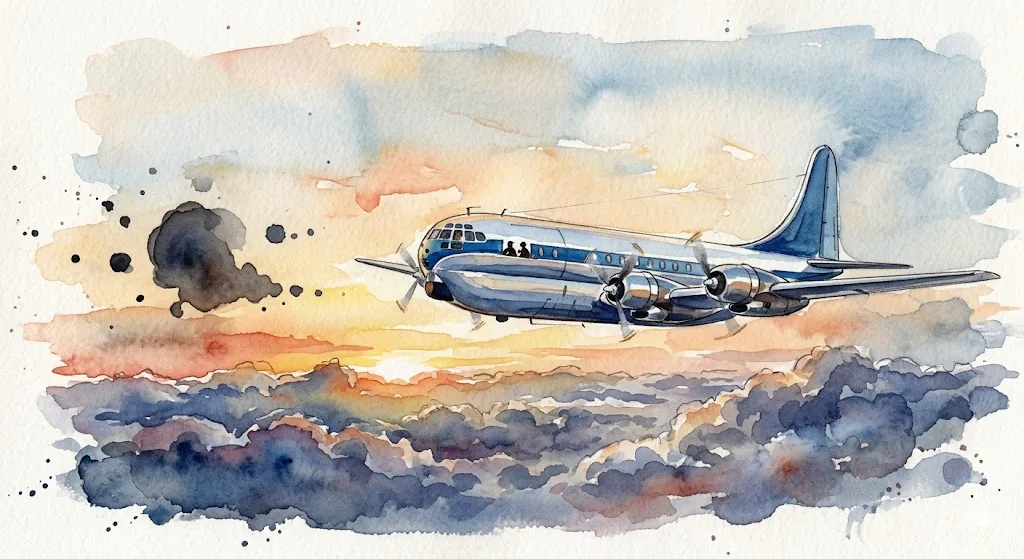
The BOAC Stratocruiser sighting of 29–30 June 1954 is one of the better-known mid-century airline UFO cases because it involved an experienced BOAC captain, multiple crew members, several passengers, a sustained observation near Labrador, and later analysis by the University of Colorado UFO Project. Captain James R.
Page outline Jump by section
Introduction
The case matters because it sits at the intersection of strong witness credibility and weak physical evidence. The witnesses were not casual observers; they were an airline crew at work in clear conditions, and Howard’s own voyage report was written soon after the event. Yet there was no confirmed radar track of the objects, no photograph, no recovered material, and no official identification. The strongest modern sceptical line is not that the crew invented the event, but that a rare atmospheric mirage, possibly involving distant cloud formations near sunset, may have produced an extraordinary but natural illusion.[files.ncas.org]files.ncas.orgCondon Report, Sec III, Chapter 5: Optical & Radar Analysis…[2files.ncas.org]files.ncas.orgCondon Report, Sec III, Chapter 5: Optical & Radar Analysis…
What happened on the BOAC flight?
BOAC Flight 510-196 left New York’s Idlewild Airport on 29 June 1954, bound for London, with a planned refuelling stop at Goose Bay because conditions did not favour a non-stop crossing. Later accounts identify the aircraft as Boeing 377-10-28 G-ALSC, RMA Centaurus, operated by British Overseas Airways Corporation. Martin Shough’s detailed 2009 study gives the departure as 17:03 local time, or 21:03 GMT, with 51 passengers aboard.[Academia]academia.eduOpen source on academia.edu.
The sighting began after the aircraft had crossed the St Lawrence area and was en route towards Goose Bay. In Howard’s later first-person account, he placed the start at about 9.05 p.m. Labrador time, roughly 20 minutes’ flying time north-east of Seven Islands. The aircraft was cruising at about 19,000 feet in clear upper air, with low cloud below and the sun setting to the left of the aircraft. Howard first described the object as a dark “blob” with smaller dark objects around it, then as something like an inverted pear, later seeming to change into other shapes.[Academia]academia.eduOpen source on academia.edu.
The most important near-contemporary document is Howard’s voyage report, completed during the onward leg from Goose Bay to London. In that report he placed the sighting at 01:05 GMT on 30 June, about 150 nautical miles south-west of Goose Bay. He wrote that the objects appeared on the port beam, at approximately the same altitude as the aircraft, and seemed to keep station with it. He also recorded that First Officer Lee Boyd, both engineers, both navigators, the radio officer, two stewards and the stewardess watched the objects, and that “usually six” smaller objects were visible with the large one.[Academia]academia.eduOpen source on academia.edu.
The sequence ended as an interceptor approached. Goose Bay was contacted, a fighter was sent to investigate, and Howard later reported that the smaller objects seemed to enter the larger one before the main object shrank and disappeared. The crew landed at Goose Bay at about 01:45 GMT and were met by a US Air Force intelligence officer. Howard’s voyage report says Fighter Control had the BOAC aircraft on radar but “nothing else” on the screen.[Academia]academia.eduOpen source on academia.edu.
Why the witnesses are taken seriously
The case is unusually strong as a witness case because the primary observers were trained aviation professionals, not a single startled ground witness. Howard was a former RAF Squadron Leader and an experienced BOAC captain. Shough’s review describes him as 33 years old, with about 7,500 flying hours and 256 Atlantic crossings at the time of the sighting; the same review says the standing of Howard and the other witnesses “has never been called in question”.[Academia]academia.eduOpen source on academia.edu.
Corroboration also came from within the aircraft. Howard did not report a fleeting light glimpsed through a window; he and other crew members watched an extended display. His voyage report names multiple categories of crew witnesses, and later accounts add that some passengers on the port side also saw the objects. That breadth of observation does not prove that the objects were extraordinary craft, but it does reduce the likelihood of a simple private mistake by one person.[nicap.org]nicap.orgBOA C Case: UFOS Follow British Airliner Over LabradorBOA C Case: UFOS Follow British Airliner Over Labrador
The witness descriptions were also fairly consistent in their core features: dark silhouettes, no lights, no flames, no vapour trails, a large changing form, six smaller attendant objects, and an apparent pacing of the Stratocruiser. Howard’s 1967 University of Colorado sighting form again described “one large object and six small”, all opaque and sharp-edged, with the small objects globular and the large one continually changing shape.[Academia]academia.eduOpen source on academia.edu.
The credibility issue cuts both ways. Good witnesses make the report worth studying, but professional expertise does not remove all perceptual traps. Airline pilots are trained to recognise aircraft, weather and navigational hazards, not necessarily rare optical effects viewed at sunset through atmospheric layers. The case’s enduring tension is that competent observers described something highly strange, while the physical record remains too thin to confirm that the strangeness belonged to an actual structured object.[files.ncas.org]files.ncas.orgCondon Report, Sec III, Chapter 5: Optical & Radar Analysis…
What evidence exists beyond testimony?
The documentary record is stronger than many UFO cases but weaker than a decisive investigation would require. The best anchors are Howard’s voyage report, his later first-person account, the University of Colorado sighting material, press coverage, and later technical analysis. The case was publicised quickly after the flight, and Howard was filmed for BBC and cinema newsreels, helping to make it a well-known British UFO story within days.[Academia]academia.eduOpen source on academia.edu.
There was, however, no confirmed radar evidence of the unknown objects. This point is crucial because the case is sometimes repeated as a radar-visual incident. The Condon Report’s optical and radar analysis explicitly categorised the Labrador case as “primarily visual” and stated that “no radar contact was made in this incident”. Howard’s own voyage report also says Fighter Control had the Stratocruiser on radar but did not have anything else on the screen.[files.ncas.org]files.ncas.orgCondon Report, Sec III, Chapter 5: Optical & Radar Analysis…
The fighter interception adds drama but not confirmation. Howard recalled being told that a fighter had the BOAC aircraft in radar contact and was closing head-on; this means the fighter had the airliner, not necessarily the objects. Howard also said he did not know whether the fighter saw anything, because the BOAC crew left Goose Bay before the fighter returned.[files.ncas.org]files.ncas.orgCondon Report, Sec III, Chapter 5: Optical & Radar Analysis…
The sketches are useful but limited. Howard drew the changing configuration in his logbook, and later reproductions show the large central form shifting shape while smaller objects appear around it. Sketches can preserve the witness’s impression, but they are not measurements; the apparent size, distance and altitude of featureless objects against a bright sky are especially vulnerable to error. Shough’s analysis used the drawings to estimate angular size, but treated those estimates as approximate rather than definitive.[Academia]academia.eduOpen source on academia.edu.

Official and technical interpretations
The University of Colorado UFO Project, usually known through the 1968 Condon Report, did not dismiss the BOAC sighting as a hoax or a trivial misidentification. Its analysis described the object as a dark, opaque, “jellyfish-like” form that changed shape and noted that the description was suggestive of an optical cause. The report said there was too little meteorological data to confirm or rule out the relevant optical propagation mechanisms, but it listed several facts favouring a mirage hypothesis: the objects stayed near the aircraft’s horizontal plane, the aircraft held a steady 19,000-foot altitude, and the image was seen near the setting sun against a bright sky.[files.ncas.org]files.ncas.orgCondon Report, Sec III, Chapter 5: Optical & Radar Analysis…
The Condon analysis proposed a superior mirage: a dark reflected image, perhaps of terrain below, seen against the bright sky through a thin temperature inversion just above cruising altitude. It argued that the apparent dwindling and disappearance could fit a mirage layer weakening or the viewing geometry changing. Yet the same discussion admitted a major difficulty: the mirage would need to remain directionally limited and stable over roughly 85 nautical miles, which the report called “quite unusual”. Its final classification was cautious: “some almost certainly natural phenomenon” so rare that it had apparently not been reported before or since.[files.ncas.org]files.ncas.orgCondon Report, Sec III, Chapter 5: Optical & Radar Analysis…
Later research refined the natural-explanation side of the debate. Shough’s 2009 study, associated with NARCAP and Caelestia, considered spaceships, birds, balloons and mirage explanations, and concluded that the most likely explanation was an unusual mirage, while stressing that the evidence was not conclusive.[caelestia.be]caelestia.beCAELESTI A The BOAC Labrador sightingCAELESTI A The BOAC Labrador sighting
That later mirage model shifted attention from reflected terrain to distant high clouds. Shough argued that a high-level duct near the aircraft’s altitude could, under special sunset conditions, preserve strong contrast from distant cloud tops and make them appear as dark, sharp-edged shapes near the horizon. The weather reconstruction matters here: June 1954 featured an unusual continental anticyclone, and Shough’s discussion cites high pressure over Labrador, warm conditions, and the possibility of stable atmospheric layers favourable to unusual refraction.[Academia]academia.eduOpen source on academia.edu.[Academia]academia.eduOpen source on academia.edu.
The broader meteorological background is not invented for the UFO case. Joshua Z. Holland’s 1954 Monthly Weather Review article was explicitly about the weather and circulation of June 1954 and the birth and growth of a continental anticyclone, giving independent support to the idea that the month had unusual large-scale atmospheric conditions.[American Meteorological Society Journals]journals.ametsoc.org1520 0493 1954 082 0163 twacoj 2 0 co 21520 0493 1954 082 0163 twacoj 2 0 co 2
Why simple explanations struggle
Some proposed explanations are weaker than they first appear. Birds can explain a dark, shape-changing mass, especially when silhouetted against a sunset; even Howard compared the large object’s changing shape to a swarm-like effect. Caelestia’s discussion notes that starling flocks and other bird swarms can form smooth, dark, changing shapes in the sky.[caelestia.be]caelestia.beCAELESTI A The BOAC Labrador sightingCAELESTI A The BOAC Labrador sighting
The difficulty is speed, altitude and continuity. The Stratocruiser was moving at roughly 230 knots, and Howard said the objects kept station for about 18 minutes, corresponding to around 80 miles. A normal bird flock would fall rapidly behind unless extreme winds or a sequence of replacement flocks created an illusion of continuity. Shough’s analysis argues that such a scenario would require implausibly large numbers of birds and repeated unnoticed transitions, and that late June is also a poor fit for a massive migration explanation in that region.[Academia]academia.eduOpen source on academia.edu.
Balloons face similar problems. A high-altitude balloon could be dark against a bright sky and might change apparent shape, but the reported formation of one large object with six smaller objects, the apparent pacing, and the disappearance as the fighter approached do not fit neatly. The known later Project Genetrix balloon material discussed in Shough’s appendix relates to launches after the BOAC case period, not a straightforward identification for 29–30 June 1954.[Academia]academia.eduOpen source on academia.edu.
Ships, distant landforms or conventional aircraft also struggle unless combined with mirage. Shough considered whether ships could be miraged from a great distance, but argued that the angular size of even a carrier at hundreds of miles would be too small without an implausible “telescopic” mirage effect. Conventional aircraft do not match the reported dark, non-luminous, shape-changing main object with six smaller attendants and no lights or trails.[Academia]academia.eduOpen source on academia.edu.
This is why the best sceptical explanation is not a simple “they saw birds” or “they saw another aircraft”. It is a compound atmospheric explanation: unusual viewing geometry, sunset contrast, stable high-level layers, possible distant cloud structures, and human interpretation of a rare optical display as nearby objects. That explanation is plausible enough to be taken seriously, but it remains inferential because the exact atmospheric profile and the exact distant target were not recorded at the time.[files.ncas.org]files.ncas.orgCondon Report, Sec III, Chapter 5: Optical & Radar Analysis…
What remains unresolved?
The case remains unresolved in the strict historical sense: no physical object was identified, no radar track confirmed the objects, and no single natural explanation has been proven. The most careful conclusion is that the witnesses almost certainly saw something real in the visual field, but the evidence does not establish that they saw structured craft flying in formation beside the aircraft.
The strongest pro-UFO points are the quality of the witnesses, the duration, the multiple observers, the apparent station-keeping, and the specific behaviour of the smaller objects relative to the larger one. Howard’s reports were detailed and consistent on the main elements, and his immediate voyage report is especially valuable because it was written before decades of retelling could reshape the story.[Academia]academia.eduOpen source on academia.edu.
The strongest sceptical points are the lack of confirmed radar contact, the near-horizon and near-sunset geometry, the shape-changing dark silhouette, and the fact that rare optical effects are known to produce surprising distortions. The Condon Report and later Shough/Caelestia work both found mirage-like explanations more promising than spacecraft, birds, balloons or conventional aircraft, while acknowledging gaps.[files.ncas.org]files.ncas.orgCondon Report, Sec III, Chapter 5: Optical & Radar Analysis…[2files.ncas.org]files.ncas.orgCondon Report, Sec III, Chapter 5: Optical & Radar Analysis…
The most common overstatement is to call the BOAC case “radar confirmed”. The available record does not support that. It is better described as a multiple-witness airline sighting with a fighter scramble and radar involvement around the airliner, but no confirmed radar return from the unknown objects themselves.[files.ncas.org]files.ncas.orgCondon Report, Sec III, Chapter 5: Optical & Radar Analysis…
Bottom line
The BOAC Stratocruiser sighting is a strong testimony case but not a strong physical-evidence case. It deserves attention because the witnesses were credible, the observation lasted long enough for discussion and sketching, and the early documentation preserves a coherent account. It also deserves caution because the case depends almost entirely on visual interpretation under unusual sunset and atmospheric conditions.
The most balanced reading is that the crew of RMA Centaurus probably saw an unusual real visual phenomenon over Labrador on 29–30 June 1954. Whether that phenomenon was a rare mirage of distant clouds, some other atmospheric effect, or an unknown aerial object cannot be settled from the surviving evidence. The case’s value today is less as proof of extraterrestrial craft and more as a revealing example of how difficult a well-witnessed aviation UFO report can be: credible observers, vivid detail, genuine official interest, and still no decisive answer.
Amazon book picks
Further Reading
Books and field guides related to What Did the BOAC Crew Really See?. Use these as the next step if you want deeper reading beyond the article.
Octopus
Contains documented flight records and witness analysis of Captain James R. Howard's 18-minute aerial light observation.
The UFO Book
Provides an objective encyclopedic history of the Goose Bay sightings, detailing the flight crew, air traffic control, and intercept repo...
In Plain Sight: an Investigation Into UFOs and Impossible Sci...
Reviews the historical record of the 1954 sighting, contextualizing how trained flight crew reports challenge conventional explanation bo...
Scientific Paranormal Investigation
Provides structural methodologies for assessing atmospheric mirages, temperature inversions, and visual tracking errors in high-latitude...
eBay marketplace picks
Marketplace Samples
Example marketplace items related to this page. Use the search link to explore similar finds on eBay.
Endnotes
1.
Source: academia.edu
Link:https://www.academia.edu/71626867/2_National_Aviation_Reporting_Center_on_Anomalous_Phenomena_www_narcap_org_Study_of_an_Unusual_Phenomenon_Observed_by_BOAC_Aircrew_over_Labrador_Newfoundland
2.
Source: files.ncas.org
Link:https://files.ncas.org/condon/text/s3chap05.htm
Source snippet
Condon Report, Sec III, Chapter 5: Optical & Radar Analysis...
3.
Source: nicap.org
Title: BOA C Case: UFOS Follow British Airliner Over Labrador
Link:https://www.nicap.org/reports/boac.htm
4.
Source: caelestia.be
Title: CAELESTI A The BOAC Labrador sighting
Link:https://www.caelestia.be/BOAC.html
5.
Source: caelestia.be
Title: CAELESTI A The BOAC Labrador sighting
Link:https://www.caelestia.be/BOAC4-1.html
6.
Source: nicap.org
Title: UFO Evidence 1964
Link:https://www.nicap.org/ufoe/UFO%20Evidence%201964.pdf
7.
Source: nicap.org
Link:https://www.nicap.org/ufoe/section_10.htm
8.
Source: nicap.org
Title: flying saucer conspiracy
Link:https://www.nicap.org/books/fsc/flying-saucer-conspiracy.pdf
9.
Source: nicap.org
Title: 1968 UFO Symposium
Link:https://nicap.org/books/1968Sym/1968_UFO_Symposium.pdf
10.
Source: academia.edu
Link:https://www.academia.edu/Documents/in/UFO_phenomena?after=83069034
11.
Source: caelestia.be
Link:https://www.caelestia.be/BOAC3.html
12.
Source: journals.ametsoc.org
Title: 1520 0493 1954 082 0163 twacoj 2 0 co 2
Link:https://journals.ametsoc.org/view/journals/mwre/82/6/1520-0493_1954_082_0163_twacoj_2_0_co_2.pdf
13.
Source: journals.ametsoc.org
Title: 1520 0493 1954 082 0163 twacoj 2 0 co 2.xml
Link:https://journals.ametsoc.org/abstract/journals/mwre/82/6/1520-0493_1954_082_0163_twacoj_2_0_co_2.xml
14.
Source: climate-lab-book.ac.uk
Link:https://www.climate-lab-book.ac.uk/category/weather/
15.
Source: scribd.com
Title: Condon Report | PDF | Unidentified Flying Object | Science Condon Report
Link:https://www.scribd.com/document/995965917/Condon-Report
16.
Source: Wikipedia
Title: Boeing 377 Stratocruiser
Link:https://en.wikipedia.org/wiki/Boeing_377_Stratocruiser
17.
Source: figshare.mq.edu.au
Link:https://figshare.mq.edu.au/ndownloader/files/34541186
18.
Source: jstor.org
Link:https://www.jstor.org/stable/520133
Additional References
19.
Source: youtube.com
Link:https://www.youtube.com/watch?v=S96RPhlknj0
Source snippet
1954: Cap. James Howard sketched a UFO he and his crew had observed from their BOAC Stratocruiser...
20.
Source: youtube.com
Link:https://www.youtube.com/watch?v=18Odviuj69I
Source snippet
1954-06-30: BOAC Captain James Howard Sketches Sighting...
21.
Source: youtube.com
Link:https://www.youtube.com/watch?v=8MYFA6G28jQ
Source snippet
BOAC Stratocruiser UFO 1954 sighting 1954-06-29: BOAC Capt James Howard Mirage or UFO Tom Owens UAP...
22.
Source: cia.gov
Link:https://www.cia.gov/readingroom/document/cia-rdp81r00560r000100010001-0
23.
Source: youtube.com
Link:https://www.youtube.com/watch?v=DpGgv1xuY6M
Source snippet
1954-06-29: BOAC Capt James Howard Mirage or UFO...
24.
Source: worldradiohistory.com
Link:https://www.worldradiohistory.com/UK/Melody-Maker/50s/Melody-Maker-1958-04-5-OCR.pdf
25.
Source: archive.org
Link:https://archive.org/download/aliensinskies00unit/aliensinskies00unit.pdf
26.
Source: medium.com
Link:https://medium.com/%40johnmooner-chief/boac-boeing-ufo-sighting-by-captain-james-howard-400ebeac5222
27.
Source: facebook.com
Link:https://www.facebook.com/BBCArchive/posts/onthisday-1954-british-airline-pilot-captain-james-howard-and-his-crew-reported-/486815347076731/
28.
Source: facebook.com
Link:https://www.facebook.com/groups/592060026020601/posts/922750122951588/
Topic Tree
Follow this branch
Related pages 106
- Godfrey Encounter
- Hamilton Airship
- Andreasson
- Villas Boas
- Apollo 11 Sightings
- +101 more in sidebar