The Hampton Roads Sighting Record
The Nash and Fortenberry sighting was a short but unusually detailed UFO report made by two Pan American World Airways pilots, William B. Nash and William H. Fortenberry, on the evening of 14 July 1952 near Newport News and Norfolk, Virginia. Its importance does not rest on photographs, radar confirmation, debris, or a landing trace; none exists.
Page outline Jump by section
What Nash and Fortenberry said they saw
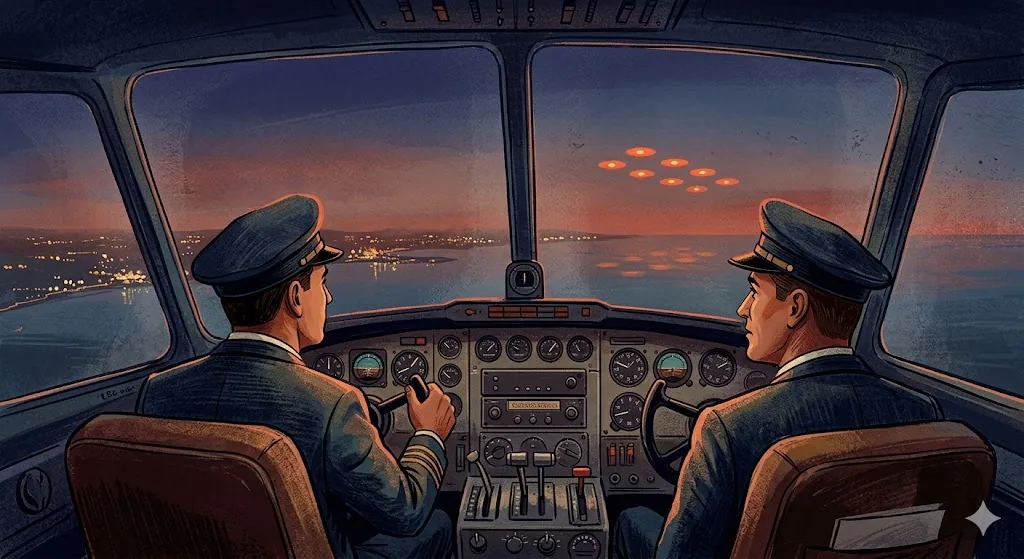
On 14 July 1952, a Pan American DC-4 was flying from New York to Miami with ten passengers and three crew members. Nash and Fortenberry were in the cockpit as the aircraft approached the Norfolk area at about 8,000 feet. Accounts based on the pilots’ report describe a red or orange-red glow appearing ahead and below the aircraft, which resolved into six disc-like lights moving in formation. Two more similar objects then appeared and joined the group before all eight receded and vanished.[Project Gutenberg]gutenberg.orgProject Gutenbergwww.gutenberg.orgProject Gutenbergwww.gutenberg.org
The most memorable part of the report was not simply “lights in the sky”, but the claimed manoeuvre. The pilots said the objects were in a narrow echelon formation, turned edge-on, reversed order, changed direction sharply, and then moved away westward. They estimated the objects as roughly 100 feet in diameter and 15 feet thick, with the sighting lasting about 12 to 15 seconds. Those estimates produced very high calculated speeds, but they depended on inferred distance and size rather than measured range.[Project Gutenberg]gutenberg.orgProject Gutenbergwww.gutenberg.orgProject Gutenbergwww.gutenberg.org
The Air Force summary preserved in the case paperwork states that the aircraft was approaching Norfolk on a north-east leg, that six unidentified objects were first seen approaching at or below the aircraft’s altitude, that the objects later changed direction and were joined by two more, and that the reported duration was only about 15 seconds. The same document records checks for known airborne objects with negative results and gives the conclusion as “Unknown” or “Unidentified”.[nicap.org]nicap.org520714norfolk docs2a520714norfolk docs2a
Why the witness quality matters, but does not settle the case
Nash and Fortenberry were not casual observers on the ground. They were professional airline pilots in an operational cockpit, and later accounts stress that Nash had logged more than 10,000 hours and that both men were accustomed to identifying aircraft, judging flight safety, and avoiding assumptions. This is one reason the case attracted serious attention from UFO researchers and from official investigators.[Project Gutenberg]gutenberg.orgProject Gutenbergwww.gutenberg.orgProject Gutenbergwww.gutenberg.org
That said, pilot credibility is not the same as physical measurement. The case depends heavily on estimates made during a startling event lasting seconds, at dusk or night, with unknown objects of unknown size and distance. Donald Menzel and Lyle Boyd, writing from a sceptical scientific perspective, made this point central to their analysis: if the distance estimate is uncertain, then the size and speed estimates become uncertain too. They argued that even skilled pilots cannot reliably determine the range of an unfamiliar light in darkness without a known reference object.[Project Gutenberg]gutenberg.orgProject Gutenbergwww.gutenberg.orgProject Gutenbergwww.gutenberg.org
This distinction is crucial. The strongest version of the case says two competent pilots saw a structured formation behave in a way they could not explain. The weaker claim is that the objects were definitively huge, solid machines travelling thousands of miles per hour. The first claim is well supported by the witness record; the second depends on assumptions about range, size, and solidity that the evidence cannot independently verify.[Project Gutenberg]gutenberg.orgProject Gutenbergwww.gutenberg.orgProject Gutenbergwww.gutenberg.org
What happened after the report
After the sighting, the pilots radioed Norfolk Civil Aeronautics Administration personnel with a report to be forwarded onward. They were later interviewed by Air Force officials in Miami. The official file records attempts to check possible aircraft explanations, including jets from nearby Langley Air Force Base, and notes that five jets were in the general vicinity but were not accepted as the explanation in the Air Force summary.[Project Gutenberg]gutenberg.orgProject Gutenbergwww.gutenberg.orgProject Gutenbergwww.gutenberg.org
The case entered the wider Project Blue Book environment at a difficult moment. Project Blue Book had begun in 1952 as the Air Force’s main UFO investigation, and the summer of 1952 brought a surge of reports. The National Archives notes that Blue Book records are declassified and that, across the whole programme from 1947 to 1969, 12,618 sightings were reported, of which 701 remained “Unidentified”. The Air Force’s later institutional position was that no investigated UFO showed evidence of a national-security threat, technological principles beyond known science, or extraterrestrial vehicles.[National Archives]cdn.nationalarchives.gov.ukbriefing guidebriefing guide
Nash and Fortenberry’s sighting also occurred just before the famous Washington, D.C. radar-visual incidents later in July 1952. A historical CIA account describes that month as a period of heavy national concern, with Washington radar reports on 19–20 and 27 July prompting fighter scrambles and headlines. That context matters because it helps explain why the Norfolk case became part of a wider “1952 flap” rather than remaining a local aviation oddity.[FAS Project on Government Secrecy]sgp.fas.orgSource details in endnotes.
Corroboration: useful, but uneven
The case is often described as corroborated by ground witnesses, but this claim needs careful wording. Some later researchers point to reports from the Norfolk area, including a naval officer associated with the USS Roanoke who reportedly saw eight objects moving in the direction of Point Comfort, and other local witnesses mentioned in Norfolk press coverage. Project 1947’s catalogue records this naval-officer account as a same-night report, while Thomas Tulien’s later review says some confirmatory reports survived through NICAP and newspaper sources rather than appearing in the official Blue Book file.[Project 1947]project1947.comSource details in endnotes.
This makes the corroboration interesting but not decisive. It is valuable because it suggests the pilots may not have been the only people in the region seeing unusual lights that evening. It is limited because the timing, geometry, and independence of those reports are not as well documented as the cockpit account, and some reports were apparently absent from the official Blue Book file. That leaves room for competing interpretations: either a broader local phenomenon occurred, or several separate observations were later linked because they sounded similar.[Academia]academia.eduSource details in endnotes.
A related but separate Hampton Roads sighting occurred two nights later, when a National Advisory Committee for Aeronautics scientist and another man reported amber lights near the same region. Edward Ruppelt, former head of Project Blue Book, treated that later report as part of the build-up to the Washington sightings and noted that a conventional aircraft explanation was considered but remained troublesome in his account. This later sighting should not be merged into the Nash-Fortenberry event, but it does show why investigators and writers saw the Norfolk region as active during that week.[Project Gutenberg]gutenberg.orgProject Gutenbergwww.gutenberg.orgProject Gutenbergwww.gutenberg.org
Official status: “Unknown” does not mean “alien”
The official classification is one of the reasons the case survived in UFO literature. The Air Force file did not simply dismiss the report as Venus, aircraft, a meteor, or a balloon; the surviving summary gives the conclusion as “Unknown” or “Unidentified”. For researchers sympathetic to the extraterrestrial hypothesis, that made the case a useful example of a trained-observer report that resisted easy explanation.[nicap.org]nicap.orgChallenge of UFOsChallenge of UFOs
However, Project Blue Book’s own later public summary draws a sharp line between “unidentified” and “extraterrestrial”. The National Archives copy of the Air Force fact sheet states that the programme found no evidence that unidentified cases represented technology beyond known scientific knowledge and no evidence that they were extraterrestrial vehicles. In other words, “Unknown” means the Air Force did not establish a conventional explanation to its satisfaction; it does not, by itself, identify what the objects were.[National Archives]cdn.nationalarchives.gov.ukbriefing guidebriefing guide
That distinction is especially important for this sighting because the report lacks independent physical data. There was no recovered material, no photograph, no cockpit instrument record, and no confirmed radar track tied to the objects. The official unknown status therefore preserves the puzzle rather than resolving it.
The main sceptical explanations
The most developed sceptical analysis came from Donald H. Menzel and Lyle G. Boyd in The World of Flying Saucers. They treated the Chesapeake Bay case as one of the famous reports that had not been fully explained, while arguing that it still did not support an extraterrestrial origin. Their core point was that the pilots’ interpretation relied on two vulnerable assumptions: that the objects’ distance, size, and speed estimates were roughly correct, and that the lights were solid objects rather than images or optical effects.[Project Gutenberg]gutenberg.orgProject Gutenbergwww.gutenberg.orgProject Gutenbergwww.gutenberg.org
Menzel and Boyd considered several possibilities. They judged simple cockpit reflections improbable because pilots are trained to recognise such effects and because Nash and Fortenberry reported seeing the objects through differently oriented cockpit windows. They then proposed that the source may have been outside and below the aircraft: a ground light, beacon, sign, searchlight, or similar source distorted and multiplied by atmospheric layers over the Chesapeake Bay region.[Project Gutenberg]gutenberg.orgProject Gutenbergwww.gutenberg.orgProject Gutenbergwww.gutenberg.org
Their weather argument relied on localised temperature or humidity discontinuities over water after a hot summer day. They argued that such layers could create refracted or reflected images that would seem to move, flip, brighten, change direction, or vanish as the aircraft’s viewing angle changed. This explanation does not identify the exact light source, which is a weakness, but it does address one of the largest physical problems in the literal-machine interpretation: a solid object making the reported turns at the inferred speeds should have produced extreme aerodynamic and inertial effects.[Project Gutenberg]gutenberg.orgProject Gutenbergwww.gutenberg.orgProject Gutenbergwww.gutenberg.org
Other sceptical suggestions have been less persuasive or less fully developed. The idea that the pilots saw ordinary jets struggles with the shape, colour, formation, and speed reported by the witnesses, and the Air Force paperwork indicates that known aircraft checks did not solve the case. A pure astronomical explanation also has difficulty accounting for the formation and abrupt relative motions described, although critics of the report would answer that those motions may be perceptual or optical rather than physical.[nicap.org]nicap.org520714norfolk docs2a520714norfolk docs2a
What makes the case strong
The case has several features that make it stronger than many famous UFO stories. The witnesses were trained aviation professionals. The report was made promptly rather than years later. The description includes time, aircraft position, altitude, direction, colour, formation, and sequence of motion. The Air Force investigated and did not file the case under a simple conventional label in the surviving summary.[nicap.org]nicap.orgChallenge of UFOsChallenge of UFOs
The case also has a clear internal narrative. The pilots did not report a vague glow for several minutes and then speculate; they described a rapid sequence of formation flight, edge-on turning, reversal, two additional objects joining, and disappearance. That level of detail is why the sighting became useful to both sides: UFO advocates could argue it suggested intelligent control, while sceptics could test whether the apparent structure might be an artefact of viewing geometry and light.[Project Gutenberg]gutenberg.orgProject Gutenbergwww.gutenberg.orgProject Gutenbergwww.gutenberg.org
What keeps it unresolved
The same features that make the sighting vivid also create the case’s main weakness. A 12-to-15-second night-time observation gives little opportunity for verification. The passengers apparently did not see the objects. The event produced no known photograph, no confirmed radar return, no instrument record, and no physical trace. The estimates of size, distance, altitude, and speed were made from visual judgement, not measurement.[Project Gutenberg]gutenberg.orgProject Gutenbergwww.gutenberg.orgProject Gutenbergwww.gutenberg.org
The possible ground-witness reports add texture but not a clean independent fix. Some appear in newspapers, private files, or later catalogues rather than as complete official case records. Tulien’s review specifically notes that some relevant reports do not appear in the Blue Book files, which is useful for provenance but also a warning: the evidential chain is not as tidy as later summaries sometimes imply.[Academia]academia.eduSource details in endnotes.
The result is a case that remains unresolved in a narrow sense, but not equally supportive of every explanation. It is fair to say the Air Force did not identify the sighting. It is not fair to say the case proves extraterrestrial craft. It is also not quite fair to say the sceptical optical explanation has solved every detail, because it does not identify the exact light source and relies on reconstructed atmospheric conditions rather than direct measurement at the aircraft’s line of sight.[National Archives]cdn.nationalarchives.gov.ukbriefing guidebriefing guide

Best reading of the evidence
The best evidence-based reading is that Nash and Fortenberry made a sincere and unusually detailed report of a striking aerial-light phenomenon near Norfolk on 14 July 1952. Their professional background gives the report more weight than an ordinary casual sighting, and the Air Force’s “Unknown” classification shows that investigators did not establish a conventional explanation from the information then available.[nicap.org]nicap.orgChallenge of UFOsChallenge of UFOs
The leap from “unidentified” to “solid, intelligently controlled extraterrestrial craft” is much less secure. The dramatic speed, size, and manoeuvre claims all depend on uncertain distance and solidity assumptions. Menzel and Boyd’s optical-ground-light hypothesis is not a complete identification, but it usefully explains why the most physically impossible parts of the report may reflect apparent motion rather than actual motion.[Project Gutenberg]gutenberg.orgProject Gutenbergwww.gutenberg.orgProject Gutenbergwww.gutenberg.org
That is why the Nash and Fortenberry sighting still matters. It is not a clean debunked case, nor is it a clean proof case. It is a strong example of the central problem in classic UFO evidence: credible people can report something genuinely puzzling, official investigators can fail to identify it, and yet the remaining evidence can still be too thin to support the most extraordinary interpretation.
Amazon book picks
Further Reading
Books and field guides related to What Really Happened Over Hampton Roads?. Use these as the next step if you want deeper reading beyond the article.
The Report on Unidentified Flying Objects
Contains direct first-hand notes on the investigation into Pan American pilots William Nash and William Fortenberry's immediate radio rep...
Octopus
Evaluates the historical weight of the 1952 Hampton Roads DC-4 report, reviewing the precision of the pilots' echelon formation logs.
The UFO Book
Features an objective overview of the 14 July 1952 Virginia encounter, mapping out the eight disc-like lights and their sharp directional...
Ufos and Government
Traces why the Air Force system maintained an 'Unknown' status for specific high-profile commercial flight records.
eBay marketplace picks
Marketplace Samples
Example marketplace items related to this page. Use the search link to explore similar finds on eBay.




Endnotes
1.
Source: nicap.org
Title: 520714norfolk docs2a
Link:https://www.nicap.org/docs/520714norfolk_docs2a.pdf
2.
Source: gutenberg.org
Title: Project Gutenbergwww.gutenberg.org
Link:https://www.gutenberg.org/ebooks/66639.txt.utf-8
3.
Source: archives.gov
Title: National Archives Project BLUE BOOK
Link:https://www.archives.gov/research/military/air-force/ufos
4.
Source: sgp.fas.org
Link:https://sgp.fas.org/library/ciaufo.html
5.
Source: gutenberg.org
Link:https://www.gutenberg.org/cache/epub/17346/pg17346-images.html
6.
Source: project1947.com
Link:https://www.project1947.com/47cats/usnavydraft1.htm
7.
Source: academia.edu
Link:https://www.academia.edu/83831064/Revisiting_One_of_the_Classics_The_Nash_Fortenberry_UFO_Sighting_14_July_1952
8.
Source: cia.gov
Link:https://www.cia.gov/readingroom/document/cia-rdp81r00560r000100010001-0
9.
Source: cia.gov
Title: CIA RDP81R00560R000100010001 0
Link:https://www.cia.gov/readingroom/docs/CIA-RDP81R00560R000100010001-0.pdf
10.
Source: archives.gov
Link:https://www.archives.gov/research/catalog/catalog-bulk-downloads/uap-bulk-download
11.
Source: archives.gov
Link:https://www.archives.gov/research/topics/uaps/rg-collections
12.
Source: project1947.com
Link:https://www.project1947.com/fig/1953a.htm
13.
Source: gutenberg.org
Link:https://www.gutenberg.org/files/66639/66639-h/66639-h.htm
14.
Source: nicap.org
Title: Challenge of UFOs
Link:https://www.nicap.org/books/coufo/coufo_complete.htm
15.
Source: Wikipedia
Title: Project Blue Book
Link:https://en.wikipedia.org/wiki/Project_Blue_Book
16.
Source: cdn.nationalarchives.gov.uk
Title: briefing guide 12 07 12
Link:https://cdn.nationalarchives.gov.uk/documents/briefing-guide-12-07-12.pdf
17.
Source: cdn.nationalarchives.gov.uk
Link:https://cdn.nationalarchives.gov.uk/documents/the-ufo-files-extract.pdf
18.
Source: nationalarchives.gov.uk
Link:https://www.nationalarchives.gov.uk/explore-the-collection/explore-by-time-period/postwar/ufo-reports/
Additional References
19.
Source: youtube.com
Link:https://www.youtube.com/watch?v=C0TNVNydVrw
Source snippet
UFO Encounters: A Complete Timeline & Comprehensive UFO Adjacent Rabbit Hole Guide...
20.
Source: youtube.com
Link:https://www.youtube.com/watch?v=eyCziOrLm-U
Source snippet
Fall Asleep to Project Blue Book UFO Files...
21.
Source: youtube.com
Title: Nash-Fortenberry UFO sighting
Link:https://www.youtube.com/watch?v=bVJpDLXyNs4
Source snippet
Unexplained flying objects witnessed by airline pilots: Scientific verification of credible UFOs...
22.
Source: facebook.com
Link:https://www.facebook.com/PAAMUSEUM/posts/though-we-dont-know-what-they-were-what-they-were-doing-or-where-they-came-from-/1244531289222587/
23.
Source: facebook.com
Link:https://www.facebook.com/PAAMUSEUM/posts/though-we-dont-know-what-they-were-what-they-were-doing-or-where-they-came-from-/1061919269473491/
24.
Source: facebook.com
Link:https://www.facebook.com/countrymusictunes/posts/it-was-a-quiet-night-flight-from-fort-worth-texas-to-nashville-tennessee-kacey-m/122165397398929568/
25.
Source: scribd.com
Link:https://www.scribd.com/doc/81391762/Donald-Keyhoe-Flying-Saucers-From-Outer-Space
26.
Source: facebook.com
Link:https://www.facebook.com/groups/793429382786885/posts/1550258523770630/
27.
Source: ufoevidence.org
Link:https://www.ufoevidence.org/cases/case92.htm
28.
Source: saturdaynightuforia.com
Link:https://www.saturdaynightuforia.com/html/articles/articlehtml/thepilotstale.html
Topic Tree
Follow this branch
Related pages 106
- Godfrey Encounter
- Hamilton Airship
- Andreasson
- Villas Boas
- Apollo 11 Sightings
- +101 more in sidebar