Fatima: The Evidence
The Fatima apparition of 1917 was a six-month sequence of reported Marian visions near Fatima, Portugal, centred on three shepherd children: Lucia dos Santos, Francisco Marto and Jacinta Marto.
Page outline Jump by section
Introduction
For a UFO or anomalous-events dossier, Fatima is best treated as a religious apparition case with mass-witness sky-phenomenon claims, not as a conventional “craft sighting”. Its value lies in the evidence tensions: child testimony versus adult crowds, early interrogations versus later memoirs, press accounts versus absent instrumental evidence, and official religious recognition versus naturalistic explanations.[Vatican]vatican.vaThe Message of FatimaThe Message of Fatima…
What allegedly happened at Fatima in 1917?
The reported events began on 13 May 1917 at Cova da Iria, where the three children said they saw a radiant “Lady” who asked them to return on the thirteenth day of each month for six months. The official Shrine of Fatima chronology records that Lucia was born in 1907, Francisco in 1908 and Jacinta in 1910, making them about ten, nine and seven during the apparitions. It also records that parish questioning began very soon afterwards, with Lucia first questioned by the parish priest on 27 May 1917.[Santuário de Fátima]fatima.ptSantuário de Fátima Shrine of Fatima | Chronology of the seersSantuário de Fátima Shrine of Fatima | Chronology of the seers
The basic sequence usually given is May, June, July, August, September and October 1917. July is especially important because later Catholic interpretation identifies it with the “Secret of Fatima”: a vision of hell, devotion to the Immaculate Heart of Mary, and a symbolic vision of a suffering Church. The Vatican’s 2000 publication of the Fatima material states that Lucia wrote the first two parts of the secret in her Third Memoir of 31 August 1941, with additions in the Fourth Memoir of 8 December 1941; the third part was written on 3 January 1944. That timing matters because some of the most famous details were formally recorded decades after the original events, even though the Church treats them within a continuous testimonial tradition.[Santuário de Fátima]fatima.ptSantuário de Fátima Shrine of Fatima | Chronology of the seersSantuário de Fátima Shrine of Fatima | Chronology of the seers
August produced one of the case’s clearest documentary anchors. The local administrator, Artur de Oliveira Santos, took the children to Vila Nova de Ourém on 13 August, preventing them from reaching Cova da Iria. The Shrine chronology quotes Santos’s own written explanation: he said he wanted to prevent the continuation of increasing “clerical speculation” around the children. After three days, the children were returned to their families; the reported fourth apparition was then placed on 19 August rather than the usual thirteenth.[Santuário de Fátima]fatima.ptSantuário de Fátima Shrine of Fatima | Chronology of the seersSantuário de Fátima Shrine of Fatima | Chronology of the seers
By September, the gatherings had grown. The Shrine account says the roads were “packed with people” on 13 September and presents the children’s message as moving from dramatic self-sacrifice towards a more focused religious call. This is a recurring pattern in Fatima sources: the children’s experiences were interpreted not merely as visions, but as a call to prayer, penance, conversion and devotion.[Santuário de Fátima]fatima.ptSantuário de Fátima Shrine of Fatima | Chronology of the seersSantuário de Fátima Shrine of Fatima | Chronology of the seers

Why 13 October became the centre of the case
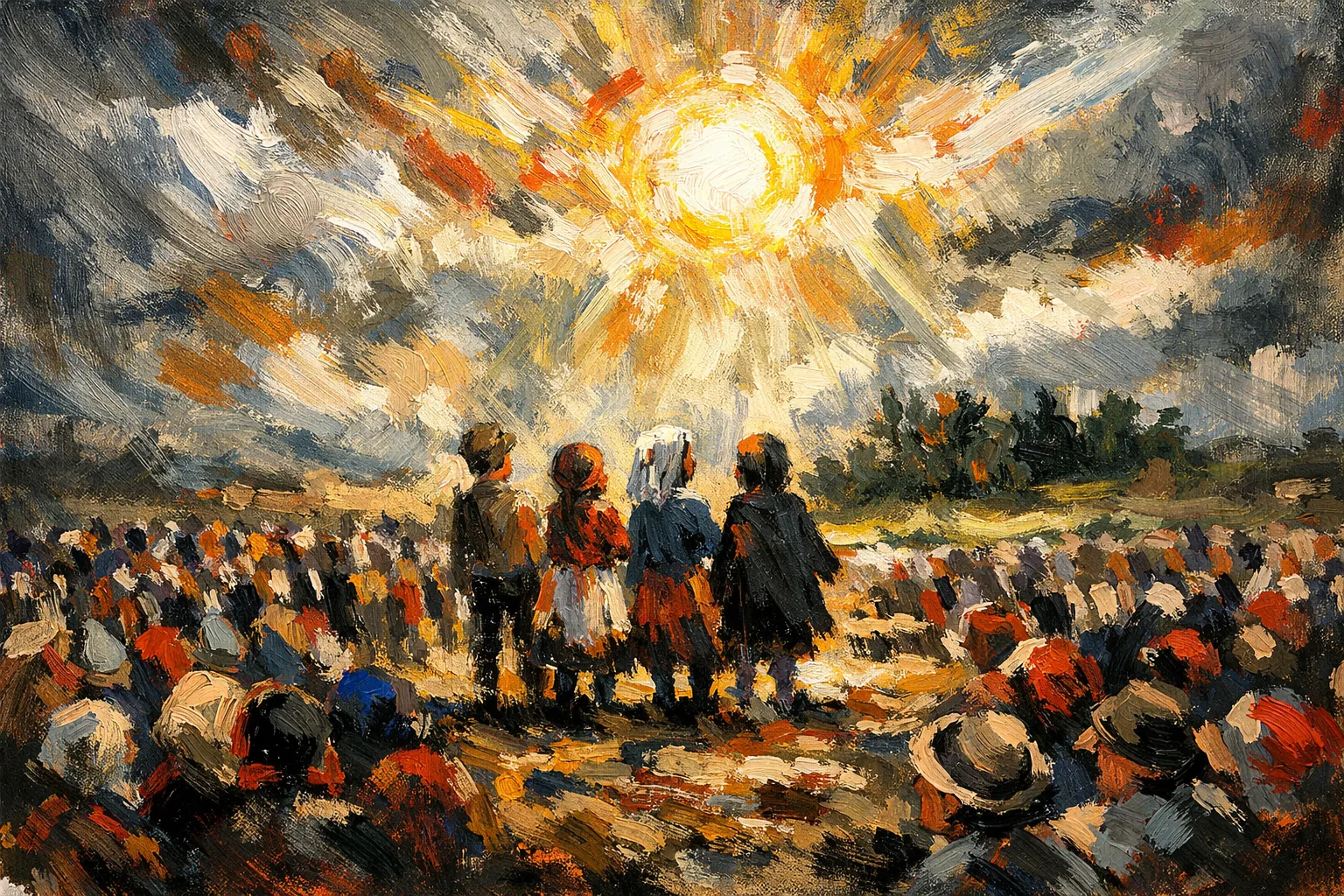
The case became internationally memorable because the children reportedly said that a public sign would occur at the final apparition. On 13 October 1917, a huge crowd gathered at Cova da Iria. The Shrine chronology cites the Lisbon newspaper O Seculo of 15 October 1917, whose reporter Avelino de Almeida described the crowd looking at the sky and the Sun appearing to “dance”, using the expression attributed to local peasants. The same Shrine chronology says the Lady identified herself to the children as the Lady of the Rosary at the final apparition.[Santuário de Fátima]fatima.ptSantuário de Fátima Shrine of Fatima | Chronology of the seersSantuário de Fátima Shrine of Fatima | Chronology of the seers
Crowd size is often given as about 70,000, although contemporary and later estimates vary. This uncertainty is important: the event was clearly large, but the exact number is not a controlled measurement. One Catholic source reproducing Almeida’s report notes that O Seculo was an anti-clerical Republican paper and that Almeida was sent to cover the anticipated event, which is why believers often treat his account as unusually valuable: it was not simply a devotional pamphlet written for an already convinced audience.[World Apostolate of Fatima USA]bluearmy.comSource details in endnotes.
Witness descriptions typically include rain, clouds clearing, an unusually visible or dulled solar disc, spinning or trembling motion, coloured light, and a frightening impression that the Sun was descending. Sceptical Inquirer summarises the reported variety: some witnesses said the Sun danced, some said it zigzagged towards Earth, some described colours, and others saw nothing unusual; the episode is usually said to have lasted about ten minutes. That mixture is one of the central evidential tensions. It gives the case breadth, because many people reported something, but it also creates problems for any single literal reconstruction.[Skeptical Inquirer]skepticalinquirer.orgSkeptical Inquirer Fatima Miracle Claims All Wet | Skeptical InquirerSkeptical Inquirer Fatima Miracle Claims All Wet | Skeptical Inquirer
The most defensible historical claim is therefore modest but significant: on 13 October 1917, a large crowd assembled because of the children’s prior claims, and many present reported unusual solar or sky phenomena. The stronger claim that the physical Sun itself moved is not supported by astronomical evidence and is usually framed by believers either as a local miracle or by sceptics as a perceptual and atmospheric event.[Skeptical Inquirer]skepticalinquirer.orgSkeptical Inquirer Fatima Miracle Claims All Wet | Skeptical InquirerSkeptical Inquirer Fatima Miracle Claims All Wet | Skeptical Inquirer
How good is the witness evidence?
The witness evidence is strongest where it is early, public and not fully controlled by later devotional retelling. The O Seculo report is important because it appeared immediately after the event and came from a secular, anti-clerical newspaper context. The Shrine’s own chronology also points to early interrogations by the parish priest and other questioners, preserving a historical record of the children’s claims rather than relying only on late recollection.[Santuário de Fátima]fatima.ptSantuário de Fátima Shrine of Fatima | Chronology of the seersSantuário de Fátima Shrine of Fatima | Chronology of the seers[2Santuário de Fátima]fatima.ptSantuário de Fátima Shrine of Fatima | Chronology of the seersSantuário de Fátima Shrine of Fatima | Chronology of the seers
The children’s credibility is more complicated. They were young, rural and subject to intense social pressure from multiple directions: family doubt, clerical questioning, public curiosity and political hostility. Lucia’s mother was reportedly sceptical, while civil authorities treated the affair as socially disruptive. The August detention cuts both ways: believers see it as evidence of the children’s firmness under pressure; sceptics can still argue that stubbornness under pressure does not prove a supernatural cause.[Santuário de Fátima]fatima.ptSantuário de Fátima Shrine of Fatima | Chronology of the seersSantuário de Fátima Shrine of Fatima | Chronology of the seers
A further complication is source layering. The events of 1917 were recorded in early interviews and newspaper accounts, but many details now associated with Fatima come from Lucia’s memoirs and later Church documents. The Vatican’s 2000 document is explicit that the published account of the first two parts of the secret follows Lucia’s 1941 Third Memoir, while the third part was written in 1944 and later interpreted by Church authorities. That does not make the material worthless, but it means a careful reader should distinguish between “reported in 1917”, “recorded in early investigations”, and “written down years later by Lucia”.[Vatican]vatican.vaThe Message of FatimaThe Message of Fatima…
The crowd testimony also has uneven evidential quality. A mass gathering helps against a simple private-fantasy explanation, but it does not automatically prove a shared external object. People were not recording the event with calibrated instruments; many had travelled in expectation of a sign; reports varied; and some people saw nothing. For anomalous-event analysis, Fatima is therefore better described as a mass-expectation and mass-testimony case than as a cleanly documented physical phenomenon.[Skeptical Inquirer]skepticalinquirer.orgSkeptical Inquirer Fatima Miracle Claims All Wet | Skeptical InquirerSkeptical Inquirer Fatima Miracle Claims All Wet | Skeptical Inquirer
What physical or documentary evidence exists?
The documentary evidence is substantial compared with many apparition cases, but the physical evidence is weak. The strongest documentation includes early parish questioning, press coverage, later diocesan investigation, Lucia’s memoirs, and Vatican publication of the third part of the secret and its interpretation. The Shrine chronology says Lucia answered the official interrogation of the diocesan canonical commission in 1924, and that the Bishop of Leiria declared the visions at Cova da Iria from 13 May to October 1917 “worthy of belief” on 13 October 1930.[Santuário de Fátima]fatima.ptSantuário de Fátima Shrine of Fatima | Chronology of the seersSantuário de Fátima Shrine of Fatima | Chronology of the seers
The most-cited physical claim is that wet clothes and muddy ground dried rapidly after the solar event. That claim appears in many traditional retellings, but it is hard to test after the fact. Sceptical writers argue that the weather record, amount of rainfall and drying conditions are not sufficiently established to treat the drying as a measurable miracle. Benjamin Radford’s sceptical treatment stresses that photographs and reports do not provide the kind of controlled evidence needed to confirm extraordinary drying by unknown energy.[Wikipedia]WikipediaMiracle of the SunMiracle of the Sun
Photographic evidence is also limited. There are photographs of the crowd, but not authenticated photographs of the Sun performing the alleged movements. This is a major weakness for the more literal versions of the claim. In a case where reporters and photographers were reportedly present, the lack of a clear photographic record of the solar phenomenon leaves the event dependent on testimony rather than independent physical capture.[Wikipedia]WikipediaMiracle of the SunMiracle of the Sun
The official Catholic finding is not the same thing as a scientific finding. The 1930 judgement “worthy of belief” authorised devotion and accepted the apparition within Catholic theological categories; it did not prove a solar anomaly under modern scientific standards. Portugal’s tourism authority summarises the institutional arc accurately: the phenomenon was initially viewed with suspicion by the Church, cherished by many people, and not acknowledged by the Bishop of Leiria until 1930.[Visit Portugal]visitportugal.comVisit Portugal Fátima, altar do mundo | www.visitportugal.comVisit Portugal Fátima, altar do mundo | www.visitportugal.com
Catholic interpretation versus sceptical explanations
The Catholic interpretation treats Fatima as a Marian apparition whose message is prayer, repentance, conversion and devotion. The Vatican’s 2000 document states that the message of Fatima centres on conversion and penance, and it interprets the third part of the secret symbolically, especially in relation to twentieth-century persecution of the Church and the suffering of the Pope. It also cautions that Fatima should not be reduced to curiosity about the future; what remains, in that official reading, is the call to prayer and conversion.[Vatican]vatican.vaThe Message of FatimaThe Message of Fatima…
For believers, the October crowd event matters because it appears to fulfil a prior public prediction. The argument is not only “many people saw something”, but “many people came because a sign had been promised, and then many reported a striking sign”. The hostile political context and the involvement of a secular newspaper reporter are often used to strengthen that argument.[Santuário de Fátima]fatima.ptSantuário de Fátima Shrine of Fatima | Chronology of the seersSantuário de Fátima Shrine of Fatima | Chronology of the seers[2Santuário de Fátima]fatima.ptSantuário de Fátima Shrine of Fatima | Chronology of the seersSantuário de Fátima Shrine of Fatima | Chronology of the seers
Sceptical explanations focus on three main points. First, the Sun itself could not have physically danced without being observed far beyond Fatima and without catastrophic astronomical consequences. Second, witness reports varied significantly, including reports of people seeing nothing. Third, looking near the Sun after rain or through changing cloud can produce unusual visual effects, especially when a crowd is primed to expect a miracle.[Skeptical Inquirer]skepticalinquirer.orgSkeptical Inquirer Fatima Miracle Claims All Wet | Skeptical InquirerSkeptical Inquirer Fatima Miracle Claims All Wet | Skeptical Inquirer
Radford’s explanation is psychological and optical: people looking up near the Sun, hoping and expecting a sign, could experience apparent motion as eye muscles tired; differing reports are treated as evidence for perception rather than a single external event. Other sceptical summaries add possible meteorological factors such as thin cloud, changing brightness, moisture or dust in the atmosphere, and retinal after-effects from solar viewing. These explanations do not require witnesses to be lying; they argue that sincere testimony can still misinterpret a natural or perceptual phenomenon.[Live Science]livescience.comLive Science The Lady of Fátima & the Miracle of the Sun | Live ScienceLive Science The Lady of Fátima & the Miracle of the Sun | Live Science
Neither side fully eliminates the other’s strongest point. Sceptics must explain why a public prediction drew a large crowd and produced a memorable cluster of reports. Believers must explain why the evidence is inconsistent, localised, not instrumentally recorded, and not supported by clear astronomical observation elsewhere. That is why Fatima remains compelling as a case study even for readers who do not accept its supernatural interpretation.[Skeptical Inquirer]skepticalinquirer.orgSkeptical Inquirer Fatima Miracle Claims All Wet | Skeptical InquirerSkeptical Inquirer Fatima Miracle Claims All Wet | Skeptical Inquirer

What remains unresolved?
The unresolved core is not whether a large religious event happened at Fatima; that is well supported. The unresolved question is what best explains the reported solar phenomena on 13 October 1917. The evidence supports a real public gathering and many sincere reports, but it does not settle whether the experience was miraculous, atmospheric, optical, psychological, or some combination of those factors.[Santuário de Fátima]fatima.ptSantuário de Fátima Shrine of Fatima | Chronology of the seersSantuário de Fátima Shrine of Fatima | Chronology of the seers[Skeptical Inquirer]skepticalinquirer.orgSkeptical Inquirer Fatima Miracle Claims All Wet | Skeptical InquirerSkeptical Inquirer Fatima Miracle Claims All Wet | Skeptical Inquirer
Several specific questions remain difficult to answer with confidence:
- How many people actually saw the same thing? The crowd was large, but the testimony was not uniform. Some saw dramatic motion, some colours, some lesser effects, and some nothing unusual.[Skeptical Inquirer]skepticalinquirer.orgSkeptical Inquirer Fatima Miracle Claims All Wet | Skeptical InquirerSkeptical Inquirer Fatima Miracle Claims All Wet | Skeptical Inquirer
- How much did expectation shape perception? The crowd gathered because a miracle had been predicted. That strengthens the fulfilment claim for believers, but also strengthens the suggestion-based explanation for sceptics.[Live Science]livescience.comLive Science The Lady of Fátima & the Miracle of the Sun | Live ScienceLive Science The Lady of Fátima & the Miracle of the Sun | Live Science
- Which details are early and which are later? The children’s 1917 claims, early interrogations, 1917 press reports, Lucia’s later memoirs and Vatican interpretations are all important, but they are not the same kind of evidence.[Santuário de Fátima]fatima.ptSantuário de Fátima Shrine of Fatima | Chronology of the seersSantuário de Fátima Shrine of Fatima | Chronology of the seers
- What would count as decisive physical proof? A verified photograph, independent astronomical report, or precise meteorological record would greatly change the assessment, but the surviving record is mainly testimonial and documentary.[Wikipedia]WikipediaMiracle of the SunMiracle of the Sun
For the wider Fatima dossier, the case naturally connects to linked branches on the “Miracle of the Sun”, the Three Secrets of Fatima, Lucia’s memoirs, the 1930 diocesan approval, and later papal interpretations. Those branches should be separated because each rests on different evidence: immediate public observation, private visionary testimony, later written recollection, Church judgement and twentieth-century retrospective interpretation.[Vatican]vatican.vaThe Message of FatimaThe Message of Fatima…
Bottom line for case assessment
Fatima is one of the strongest modern apparition cases in terms of public impact, documentation and institutional aftermath, but it is not a clean physical-evidence case. The timeline is unusually well defined: reported apparitions from 13 May to 13 October 1917, official questioning within weeks, civil detention in August, a mass public event in October, diocesan investigation in the 1920s, and formal Catholic approval in 1930.[Santuário de Fátima]fatima.ptSantuário de Fátima Shrine of Fatima | Chronology of the seersSantuário de Fátima Shrine of Fatima | Chronology of the seers[3Santuário de Fátima]fatima.ptSantuário de Fátima Shrine of Fatima | Chronology of the seersSantuário de Fátima Shrine of Fatima | Chronology of the seers[3Santuário de Fátima]fatima.ptSantuário de Fátima Shrine of Fatima | Chronology of the seersSantuário de Fátima Shrine of Fatima | Chronology of the seers
The best evidence for the case is cumulative: the children’s persistence, early interrogations, the hostile civil context, the October crowd, and press reporting from a secular newspaper. The best evidence against a literal solar miracle is also cumulative: no global astronomical event, inconsistent witness reports, no clear photographic proof of the phenomenon itself, and plausible optical or psychological mechanisms. A fair assessment should therefore avoid both extremes: it is too well documented to dismiss as a simple invented legend, but too testimonial and interpretive to establish a physical miracle by ordinary evidential standards.
Amazon book picks
Further Reading
Books and field guides related to What Really Happened at Fatima?. Use these as the next step if you want deeper reading beyond the article.
St. Gertrude the Great
Details the full 1917 chronology, the shepherd children's accounts, and the mass testimony surrounding the 'Miracle of the Sun'.
Passport to Magonia: from Folklore to Flying Saucers
Analyzes Fatima not just as a religious event, but as a mass-witness phenomenon with significant similarities to UFO close encounters.
Scientific Paranormal Investigation
Teaches methodology for evaluating cases that sit between dramatic crowd testimony and natural atmospheric explanations.
Ufos and Government
Documents how mass aerial observations, even religious-coded ones, are often indexed within wider paranormal sighting wave records.
eBay marketplace picks
Marketplace Samples
Example marketplace items related to this page. Use the search link to explore similar finds on eBay.
Endnotes
1.
Source: fatima.pt
Title: Santuário de Fátima Shrine of Fatima | Chronology of the seers
Link:https://www.fatima.pt/en/pages/chronology-of-the-three-seers
2.
Source: vatican.va
Title: The Message of Fatima
Link:https://www.vatican.va/roman_curia/congregations/cfaith/documents/rc_con_cfaith_doc_20000626_message-fatima_en.html
Source snippet
The Message of Fatima...
3.
Source: bluearmy.com
Link:https://www.bluearmy.com/astounding-things-how-the-midday-sun-danced-at-fatima/
4.
Source: Wikipedia
Title: Miracle of the Sun
Link:https://en.wikipedia.org/wiki/Miracle_of_the_Sun
5.
Source: skepticalinquirer.org
Title: Skeptical Inquirer Fatima Miracle Claims All Wet | Skeptical Inquirer
Link:https://skepticalinquirer.org/2019/05/fatima-miracle-claims-all-wet/
6.
Source: livescience.com
Title: Live Science The Lady of Fátima & the Miracle of the Sun | Live Science
Link:https://www.livescience.com/29290-fatima-miracle.html
7.
Source: visitportugal.com
Title: Visit Portugal Fátima, altar do mundo | www.visitportugal.com
Link:https://www.visitportugal.com/en/content/fatima-a-journey-to-the-altar-of-the-world
Additional References
8.
Source: youtube.com
Link:https://www.youtube.com/watch?v=JzMgZYrhoAk
Source snippet
4 The Miracle of the Sun In Fatima (October 13, 1917)...
Published: October 13, 1917
9.
Source: americamagazine.org
Link:https://www.americamagazine.org/faith/2017/05/10/story-fatima-apparitions-miracles-and-journey-sainthood/
10.
Source: youtube.com
Title: The Miracle of the Sun In Fatima (
Link:https://www.youtube.com/watch?v=L4IbOzuNlmE
Source snippet
5 Fatima: The Miracle of the Sun Was a Warning...
Published: October 13, 1917
11.
Source: youtube.com
Title: The Miracle That Shook the World
Link:https://www.youtube.com/watch?v=bPFuNMr8vjU
Source snippet
3 Witness the Amazing Story of Our Lady of Fatima in 1917...
12.
Source: youtube.com
Link:https://www.youtube.com/watch?v=ri9-W06uAf8
Source snippet
2 The Miracle That Shook the World...
13.
Source: youtube.com
Title: Fatima: The Miracle of the Sun Was a Warning
Link:https://www.youtube.com/watch?v=SCQZz3BRwKc
Topic Tree
Follow this branch
Related pages 106
- Godfrey Encounter
- Hamilton Airship
- Andreasson
- Villas Boas
- Apollo 11 Sightings
- +101 more in sidebar