Within Apollo 11 Sightings
Was Apollo 11's UFO Really Spacecraft Debris?
The famous Apollo 11 UFO story rests on a real unidentified object, but the crew's own reasoning points toward mission hardware.
On this page
- What the astronauts saw during translunar coast
- Why size and distance could not be judged
- The debris candidates the crew considered
Page outline Jump by section
Introduction
The best-documented “Apollo 11 UFO” incident was not a dramatic encounter near the Moon, but a cautious discussion among the astronauts about a bright object seen during the translunar coast between Earth and the Moon. Neil Armstrong, Buzz Aldrin and Michael Collins all acknowledged that they could not identify the object with certainty at the time. Yet the same debriefing that fuelled later UFO speculation also strongly points toward a far more ordinary explanation: debris or hardware associated with the Apollo spacecraft itself.[U.S. Department of War]war.govnasa uap d4 apollo 11 technical crew debriefing 1969Department of WarNASA-UAP-D4, Apollo 11 Technical Crew Debriefing, 196911 Mar 1977 — Of course, we were seeing all sorts of little object…
 What makes the episode historically interesting is not evidence of extraterrestrial craft, but how experienced astronauts handled uncertainty in deep space. The crew carefully discussed what they could and could not determine, recognised the limits of visual perception in space, and repeatedly returned to possible mission-related debris as the most plausible explanation. Later retellings often preserved the word “unidentified” while dropping the astronauts’ own sceptical reasoning.
What the astronauts saw during translunar coast
The sighting occurred after Apollo 11 had separated from the Saturn V rocket’s S-IVB third stage and begun its coast toward the Moon. During this phase, the spacecraft had already jettisoned panels and other hardware as part of the normal mission sequence.[LPI]lpi.usra.eduApollo 11 Mission OverviewThe Apollo 11 basalts formed 3.6 to 3.9 billion years ago and are unusually rich in the element titanium. Br…
In the post-flight technical debriefing on 31 July 1969, Aldrin described seeing “one brighter object” among the many small particles and objects visible outside the spacecraft during routine operations and waste dumps. The object appeared unusual enough that the astronauts examined it through the onboard monocular telescope.[U.S. Department of War]war.govnasa uap d4 apollo 11 technical crew debriefing 1969Department of WarNASA-UAP-D4, Apollo 11 Technical Crew Debriefing, 196911 Mar 1977 — Of course, we were seeing all sorts of little object…
The crew’s descriptions were cautious and visual rather than sensational:
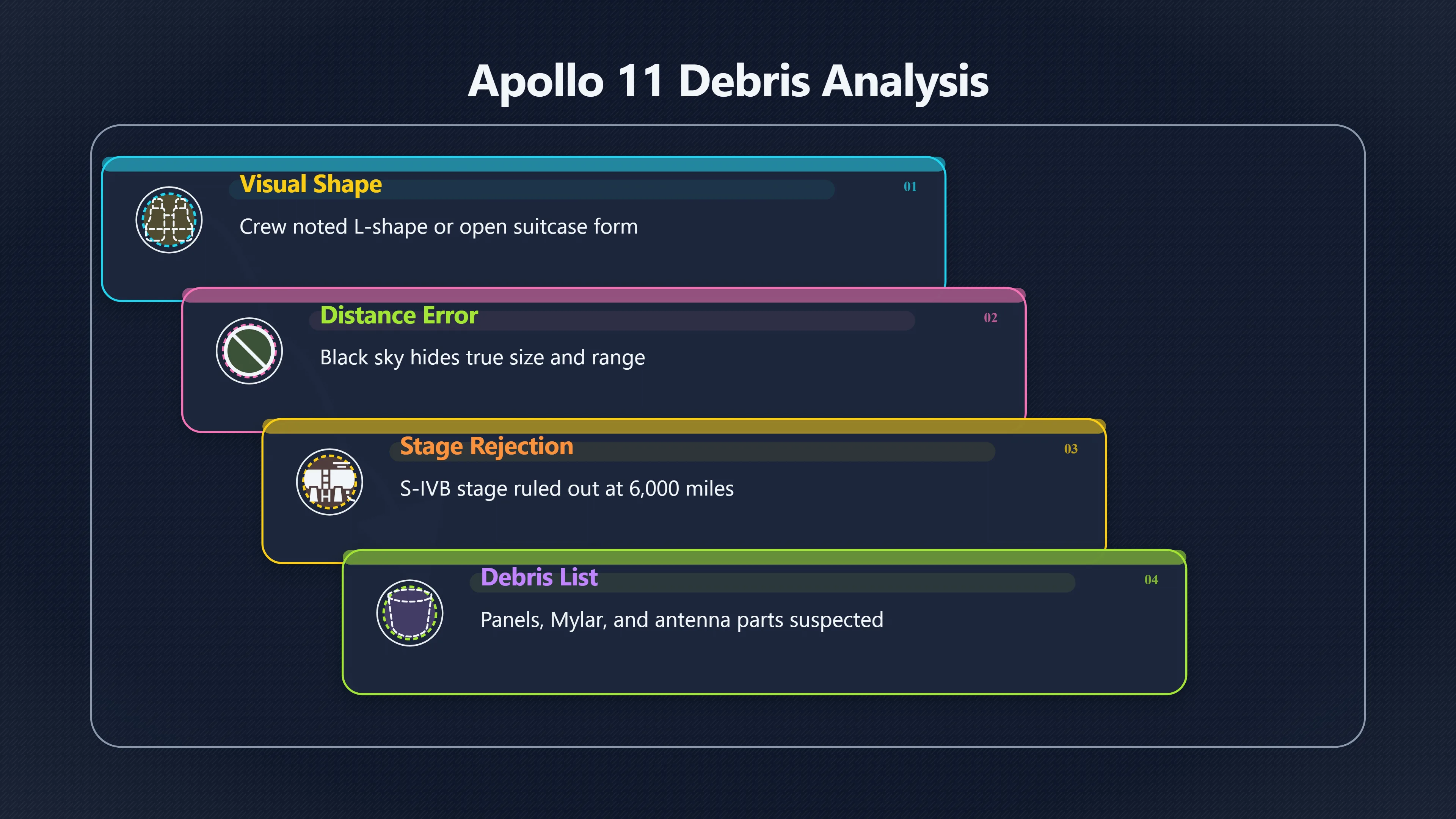
- Aldrin said the object seemed to have “a bit of an L-shape”.
- Armstrong compared it to “an open suitcase”.
- Other descriptions mentioned shapes resembling a hollow cylinder or connected rings.[U.S. Department of War]war.govnasa uap d4 apollo 11 technical crew debriefing 1969Department of WarNASA-UAP-D4, Apollo 11 Technical Crew Debriefing, 196911 Mar 1977 — Of course, we were seeing all sorts of little object…
The object did not appear to manoeuvre intelligently, change course abruptly, or interact with the spacecraft. Instead, the astronauts mainly discussed its appearance and possible origin. Collins later stated that he suspected it came from their own spacecraft or associated hardware.[U.S. Department of War]war.govnasa uap d4 apollo 11 technical crew debriefing 1969Department of WarNASA-UAP-D4, Apollo 11 Technical Crew Debriefing, 196911 Mar 1977 — Of course, we were seeing all sorts of little object…
That point is crucial because later UFO retellings often omit that the astronauts themselves leaned toward a debris explanation.
Why size and distance could not be judged
One reason the story became exaggerated is that the object sounded “close” to the astronauts. But Armstrong explicitly explained why this impression could not be trusted in space. He noted that without knowing the object’s size, there was no way to estimate its distance; equally, without knowing its distance, there was no way to estimate its size.[U.S. Department of War]war.govnasa uap d4 apollo 11 technical crew debriefing 1969Department of WarNASA-UAP-D4, Apollo 11 Technical Crew Debriefing, 196911 Mar 1977 — Of course, we were seeing all sorts of little object…
This was not a minor technical caveat. It was the central observational problem.
In ordinary Earth environments, humans estimate distance using atmospheric haze, perspective, shadows and familiar reference objects. Deep space removes nearly all of those cues. Against a black background, a tiny nearby fragment can appear similar to a large distant object. Sunlight reflecting from metallic or Mylar surfaces can also make small debris appear unusually bright.
The spacecraft was additionally in passive thermal control during part of the coast phase, a slow rotational manoeuvre often called a “barbecue roll”. Because the spacecraft slowly rotated, the crew saw the object repeatedly from changing viewing angles. That changing perspective may have contributed to the shifting descriptions of its shape.[U.S. Department of War]war.govnasa uap d4 apollo 11 technical crew debriefing 1969Department of WarNASA-UAP-D4, Apollo 11 Technical Crew Debriefing, 196911 Mar 1977 — Of course, we were seeing all sorts of little object…
The debriefing therefore presents an unusually disciplined example of eyewitness uncertainty. Rather than claiming certainty, the astronauts repeatedly stressed the limits of what they could infer.
Why the S-IVB stage was considered — and rejected
The crew’s first suspicion was that the object might be the discarded S-IVB third stage of the Saturn V rocket. That possibility made immediate sense because the stage had only recently separated from Apollo 11.[U.S. Department of War]war.govnasa uap d4 apollo 11 technical crew debriefing 1969Department of WarNASA-UAP-D4, Apollo 11 Technical Crew Debriefing, 196911 Mar 1977 — Of course, we were seeing all sorts of little object…
Mission Control informed the astronauts that the S-IVB was approximately 6,000 miles away. After hearing that estimate, the crew concluded that the observed object was probably not the rocket stage itself.[U.S. Department of War]war.govnasa uap d4 apollo 11 technical crew debriefing 1969Department of WarNASA-UAP-D4, Apollo 11 Technical Crew Debriefing, 196911 Mar 1977 — Of course, we were seeing all sorts of little object…
This exchange later became distorted in UFO literature. Some accounts present the “6,000 miles away” statement as proof the object must have been something extraordinary. In reality, the astronauts simply moved on to other spacecraft-related possibilities after eliminating one specific candidate.
Rejecting the S-IVB did not mean rejecting debris.
The debris candidates the crew considered
The most important detail in the original debriefing is that the astronauts immediately considered ordinary mission hardware as the likely source of the object. Their discussion stayed entirely within the context of known spacecraft operations.[U.S. Department of War]war.govnasa uap d4 apollo 11 technical crew debriefing 1969Department of WarNASA-UAP-D4, Apollo 11 Technical Crew Debriefing, 196911 Mar 1977 — Of course, we were seeing all sorts of little object…
Possible explanations discussed by the crew included:
- A separated panel from the spacecraft-lunar module adapter.
- Loose Mylar insulation material.
- Hardware associated with the high-gain antenna.
- Other small discarded mission components.
- Reflective debris illuminated by sunlight.[U.S. Department of War]war.govnasa uap d4 apollo 11 technical crew debriefing 1969Department of WarNASA-UAP-D4, Apollo 11 Technical Crew Debriefing, 196911 Mar 1977 — Of course, we were seeing all sorts of little object…
This explanation fits the broader Apollo operational environment. Apollo missions routinely released hardware, covers, panels and waste products into nearby space. Astronauts on multiple missions reported seeing floating objects or illuminated debris after separation events. Space historian and NASA engineer James Oberg has repeatedly argued that many astronaut “UFO” stories arose from exactly this kind of booster- or spacecraft-associated debris.[Wikipedia]WikipediaJames ObergJames Oberg
The Apollo 11 sighting also lacked several features usually associated with extraordinary aerospace claims:
- No radar confirmation.
- No anomalous acceleration.
- No interaction with the spacecraft.
- No photographic evidence clearly showing a structured craft.
- No crew claim that the object was alien or intelligently controlled.
Instead, the astronauts described an unresolved visual observation whose most probable source was nearby mission material.
How later retellings changed the story
The modern “Apollo 11 UFO” narrative largely developed after isolated quotations from the debriefing began circulating without their surrounding context. The phrase “unidentified object” survived, while the astronauts’ repeated emphasis on uncertainty and spacecraft debris often disappeared.[Wikipedia]WikipediaUFO sightings in outer spaceUFO sightings in outer space
Buzz Aldrin later complained that some interviewers took his comments out of context. In later public discussions, he clarified that the crew saw something they could not immediately identify, but that debris from the spacecraft remained the most likely explanation.[Wikipedia]WikipediaApollo 16Apollo 16It was the second of Apollo's "J missions", with an extended stay on the lunar surface, a focus on science, and the use of th…
The case therefore occupies an unusual middle ground in UFO history:
- The sighting was real.
- The witnesses were highly credible.
- The object was temporarily unidentified.
- But the available evidence strongly favours a mundane explanation.
That combination explains why the incident continues to attract attention. It is not a hoax, and it is not an invented story. Yet neither is it strong evidence for extraterrestrial visitation.

What the incident actually demonstrates
The Apollo 11 bright-object sighting is most valuable as a lesson in perception, uncertainty and evidence handling during spaceflight.
The astronauts behaved less like sensational witnesses and more like cautious investigators. They tested hypotheses, ruled out one candidate after consulting Mission Control, acknowledged the limits of visual judgement in space, and finally leaned toward spacecraft debris without claiming certainty.[U.S. Department of War]war.govnasa uap d4 apollo 11 technical crew debriefing 1969Department of WarNASA-UAP-D4, Apollo 11 Technical Crew Debriefing, 196911 Mar 1977 — Of course, we were seeing all sorts of little object…
That careful reasoning is often lost in simplified retellings. The enduring fascination of the story comes partly from the setting — three astronauts travelling to the Moon during humanity’s most famous space mission — but the underlying evidence remains relatively modest.
The most defensible conclusion is also the least dramatic: Apollo 11’s crew probably observed illuminated debris associated with their own mission hardware, seen under viewing conditions that made accurate distance and size estimation nearly impossible.
Amazon book picks
Further Reading
Books and field guides related to Was Apollo 11's UFO Really Spacecraft Debris?. Use these as the next step if you want deeper reading beyond the article.
Carrying the Fire
Collins offers first-hand details of tracking jettisoned panels and the Saturn V rocket's S-IVB third stage during flight.
First Man: The Life of Neil Armstrong
Documents how Armstrong handled technical observations, optical illusions, and unexpected hardware particles during the translunar coast.
A Man on the Moon
Details the precise timeline of the Apollo 11 mission, including the crew's observations through the onboard monocular telescope.
Apollo EECOM
Provides technical context on space capsule waste dumps, insulation shedding, and how spacecraft debris tracks alongside the cabin.
Endnotes
1.
Source: war.gov
Title: nasa uap d4 apollo 11 technical crew debriefing 1969
Link:https://www.war.gov/medialink/ufo/release_1/nasa-uap-d4-apollo-11-technical-crew-debriefing-1969.pdf
Source snippet
Department of WarNASA-UAP-D4, Apollo 11 Technical Crew Debriefing, 196911 Mar 1977 — Of course, we were seeing all sorts of little object...
2.
Source: nasa.gov
Title: alsj and afj
Link:https://www.nasa.gov/history/alsj-and-afj/
Source snippet
The Apollo Lunar Surface Journal and Apollo Flight Journal19 Dec 2025 — The Apollo Lunar Surface Journal and Apollo Flight Journal are im...
3.
Source: lpi.usra.edu
Link:https://www.lpi.usra.edu/lunar/missions/apollo/apollo_11/
Source snippet
Apollo 11 Mission OverviewThe Apollo 11 basalts formed 3.6 to 3.9 billion years ago and are unusually rich in the element titanium. Br...
4.
Source: Wikipedia
Title: James Oberg
Link:https://en.wikipedia.org/wiki/James_Oberg
5.
Source: Wikipedia
Title: UFO sightings in outer space
Link:https://en.wikipedia.org/wiki/UFO_sightings_in_outer_space
6.
Source: Wikipedia
Title: Apollo 16
Link:https://en.wikipedia.org/wiki/Apollo_16
Source snippet
Apollo 16It was the second of Apollo's "J missions", with an extended stay on the lunar surface, a focus on science, and the use of th...
Additional References
7.
Source: instagram.com
Link:https://www.instagram.com/p/DMVGYFZOr2p/
Source snippet
Fifty six years ago, humans walked on the Moon.ARMSTRONG: Like an open suitcase. COLLINS: No... We looked at it through the monocular an...
8.
Source: instagram.com
Link:https://www.instagram.com/p/DYFUV1lE1y4/?img_index=2
Source snippet
morePhotos published by the Pentagon appear to show unidentified anomalous phenomena from the Apollo moon missions, denoting possible UAP...
9.
Source: rmg.co.uk
Link:https://www.rmg.co.uk/stories/space-astronomy/strange-things-humans-have-left-on-moon
10.
Source: facebook.com
Title: a 1969 debrief of buzz aldrin stating he saw a sizable object close to the lunar
Link:https://www.facebook.com/theguardian/posts/a-1969-debrief-of-buzz-aldrin-stating-he-saw-a-sizable-object-close-to-the-lunar/1400585945432988/
Source snippet
A 1969 debrief of Buzz Aldrin stating he saw a 'sizable'...Buzz Aldrin watched something unidentified travel alongside Apollo 11 on the...
11.
Source: instagram.com
Title: The Moonwalk You Didn’t Notice During the historic Apollo 11
Link:https://www.instagram.com/reel/DWDdZTgkXdF/
Source snippet
S-IVB was 6,000 miles... L-shape to it.' They are scientists, they are going to ask questions... Armstrong replied: 'Like an open suitcase...
12.
Source: instagram.com
Title: A newly resurfaced technical debrief from the historic
Link:https://www.instagram.com/p/DYFUV1lE1y4/
Source snippet
alien spacecraft.... It had a sizeable dimension to it, so we put the monocular on it. English Transcript. OCR. Apollo 11 UFO claims res...
13.
Source: frontier.watch
Title: nasa uap d4 apollo 11 technical crew debriefing 1969
Link:https://frontier.watch/ufo/release-1/doc/nasa-uap-d4-apollo-11-technical-crew-debriefing-1969
Source snippet
L-shape, open suitcase, hollow cylinder, or two... Ground control reported the S-IVB stage was 6,000 miles away, leaving the object's id...
14.
Source: aol.com
Link:https://www.aol.com/articles/declassified-apollo-mission-ufo-files-201738000.html
Source snippet
onspiracy theories that the historic Moon landings were faked in a studio...
15.
Source: x.com
Link:https://x.com/upuknews1/status/2052741690231066834
Source snippet
rs claiming the astronauts may have witnessed unidentified...Read more...
16.
Source: instagram.com
Link:https://www.instagram.com/reel/DX4gwk5PSan/?hl=en-gb
Source snippet
ing to ask questions... Armstrong replied: 'Like an open suitcase...
Topic Tree