Within Bonilla 1883
What Do the 1883 Bonilla Photographs Show?
Analyzes the Bonilla photographs, their limitations, and what the images can reveal about the observed objects.
On this page
- Photographic technology and conditions
- Image analysis and preservation
- Interpretive limits and inferences
Page outline Jump by section
Introduction
The most direct physical record we have of the 1883 solar transits observed by Jos A. y Bonilla are the surviving photographs he took at the Astronomical Observatory of Zacatecas, Mexico, on 1213August1883. These wetplate images, published in the French astronomy journal LAstronomie in 1886, show dozens to hundreds of small dark shapes silhouetted against the bright solar disc. As historical artefacts they are significant: they corroborate that Bonilla did not merely describe an anomaly but photographed something crossing the Sun, and they stand among the earliest astronomical images used in later discussions about unidentified flying objects and unusual solar transits. Yet the photographs technical limitations, inconsistent preservation, and the ambiguity of what they record also illustrate the interpretive limits of nineteenthcentury solar photography.[Wikipedia]WikipediaBonilla observationBonilla observation

Photographic Technology and Conditions
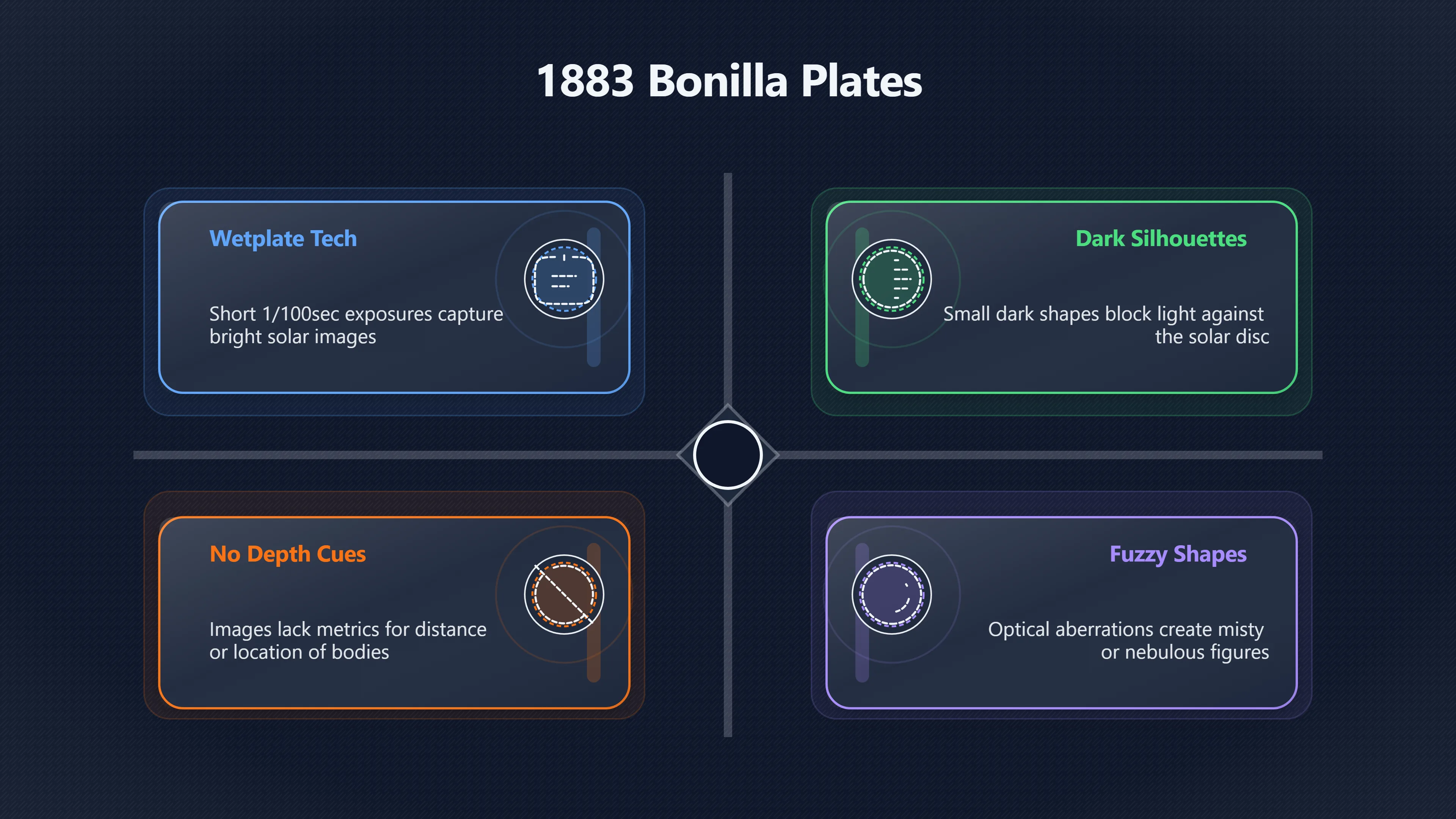
Photographic astronomy in 1883 relied on the wet collodion process, which required applying a lightsensitive coating to a glass plate immediately before exposing it in the telescope and developing it soon after. Bonilla exposed his plates at very short timescalesoften cited as about 1/100secondto capture the very bright solar image and the fleeting silhouettes crossing its disc.[Wikipedia on IPFS]en.wikipedia-on-ipfs.orgWikipedia on IPFSBonilla observationWikipedia on IPFSBonilla observation
These technical details shape both what the images can show and what they cannot resolve:
- Contrast limitations: Wetplate negatives have limited dynamic range. Against the bright solar background, only strong silhouettes would record reliably, meaning the dark blobs on the plates could represent small highcontrast features of many different origins.
- Temporal resolution: With exposures around 1/100sec, any object transiting the solar disc would appear as a brief streak or spot; motion blur or shape distortion are inherent given the optics and tracking of the era.
- Lack of independent metadata: Unlike modern digital astrophotography, Bonillas plates lacked precise time stamps, calibration frames, or attendant metadata; only his written counts and rough timings accompany them. These omissions constrain later efforts to interpret the scales, speeds, or distances of the silhouetted objects.
Photographs were reproduced in LAstronomie months or years later, making the surviving published images the primary descendants of the originals rather than intact negatives with documented provenance.[Isaac Koi Archive]isaackoi.com18830812 bonilla photosIsaac Koi Archive1883.0812 Bonilla photos…
What the Images Show and Dont Show
The surviving images unmistakably record small dark marks against the solar discBonilla himself counted hundreds of objects in his observations, and many plates show multiple specks or shapes.[Wikipedia]WikipediaBonilla observationBonilla observation Yet the photographic record by itself is ambiguous in several respects:
- Silhouetted shapes only: The plates do not capture illuminated features of the objects themselves; they are visible only because they block or absorb solar light. This means texture, surface detail, colour, and threedimensional form are absent from the evidence.
- No depth or distance cues: A silhouette on the Suns disc does not indicate whether the object is in Earths atmosphere, near Earth, or far beyond. Parallax could, in theory, constrain distance if simultaneous observations existed from two widely separated observatories, but none were recorded during the 1883 event. This absence means the plates alone cannot determine the scale or location of the transiting bodies.[Discover Magazine]discovermagazine.comDiscover MagazineDid a fragmenting comet nearly hit the Earth in 1883? Color me very skeptical | Discover MagazineOctober 17, 2011…
- Ambiguous shapes: Many of the silhouetted figures appear fuzzy or nebulous, which can result from optical aberrations, atmospheric seeing, or artefacts of the photographic process. Bonilla himself described some objects as misty, but the wetplate images do little to sharpen that characterization.[Wikipedia]WikipediaBonilla observationBonilla observation
Because of these limitations, the plates can be read as evidence that something crossed the solar disc as seen from Zacatecas at those times, but they are not definitive physical proof of the nature, origin, or scale of the objects.

Interpretive Limits and Inferences
The primary challenge when assessing the Bonilla photographs lies in what canand cannotbe inferred from the images themselves.
Historical Interpretations from the Plates
- Contemporary reaction: When LAstronomie published Bonillas article in 1886, its editors expressed uncertainty about what the images showed. They suggested that the dark shapes could be mundane atmospheric bodiesbirds, insects, high dustor other neartelescope artefacts rather than true astronomical bodies.[Isaac Koi Archive]isaackoi.com18830812 bonilla photosIsaac Koi Archive1883.0812 Bonilla photos…
- Later scientific hypotheses: Modern researchers analysed Bonillas counts and descriptions (but not the original plates themselves) and proposed that the photographed bodies might represent fragments of a highly fragmented comet passing very close to Earth. Using Bonillas counts, timing estimates, and assumptions about distances, these researchers calculated hypothetical dimensions and masses for such fragments.[arXiv]arxiv.orgInterpretation of the observations made in 1883 in Zacatecas (Mexico): A fragmented Comet that nearly hits the EarthOctober 12, 2011…
Skeptical Assessments
The photographic evidence alone has been a focal point for sceptical critique:
- Absence of corroboration: No other observatorysuch as those in Puebla or Mexico Cityreported seeing similar transits on the same dates. This suggests that if the phenomena were distant solar system bodies, they might have been visible more widely; the fact that only Bonillas images exist argues for interpretations tied to local optical or atmospheric effects.[Discover Magazine]discovermagazine.comDiscover MagazineDid a fragmenting comet nearly hit the Earth in 1883? Color me very skeptical | Discover MagazineOctober 17, 2011…
- Comet hypothesis weaknesses: While the comet fragment hypothesis uses Bonillas observations to infer distances and sizes, critics emphasise that the images themselves do not demonstrate the presence of cometary tails, coma structure, or other characteristics typically evident in actual comet photography. The plates show dark silhouettes only, not the bright nebulosity associated with comets under visible light conditions.[Discover Magazine]discovermagazine.comDiscover MagazineDid a fragmenting comet nearly hit the Earth in 1883? Color me very skeptical | Discover MagazineOctober 17, 2011…
Photographic Evidence as Corroboration, Not Resolution
Perhaps the strongest conclusion about the 1883 photographs is that they corroborate Bonillas visual reports: someone with astronomical training observed something crossing the Sun and documented it visually and photographically. However, the plates on their own do not independently resolve what those objects were. They strengthen the historical record that an unusual observation occurred but do not, without supplementary data, allow confident scientific identification of the phenomenon.[Wikipedia]WikipediaBonilla observationBonilla observation
Conclusion
The Bonilla photographs remain a fascinating early example of solar transit imaging, notable for recording many small silhouettes against the solar disc. Their value today lies less in what they conclusively reveal about the observed phenomena and more in how they document the event itself and the evolving interpretation of such data across decades. They vividly foreground the limits of nineteenthcentury solar photography: clear shapes against a bright disc, but no metrics for depth, scale, or physical nature. In the absence of contemporaneous corroborating observations or preserved original plates with detailed metadata, the Bonilla photographs are best understood as crucial but inherently ambiguous physical evidence of the 1883 solar transits.[Wikipedia]WikipediaBonilla observationBonilla observation
Amazon book picks
Further Reading
Books and field guides related to What Do the 1883 Bonilla Photographs Show?. Use these as the next step if you want deeper reading beyond the article.
The UFO Book
Provides details on the 1883 photographic evidence, addressing the limitations of early plate technology versus modern analysis.
The Skeptics' Guide to the Universe
Explains why the limitations of nineteenth-century photographic tech set hard limits on what can be interpreted.
Scientific Paranormal Investigation
Teaches investigative tools for evaluating vintage photographic plates against known imaging artifacts.
Sister States, Enemy States
Discusses the history of photographic hoaxes and technical errors when evaluating early solar images.
eBay marketplace picks
Marketplace Samples
Example marketplace items related to this page. Use the search link to explore similar finds on eBay.
Endnotes
1.
Source: Wikipedia
Title: Bonilla observation
Link:https://en.wikipedia.org/wiki/Bonilla_observation
2.
Source: en.wikipedia-on-ipfs.org
Title: Wikipedia on IPFSBonilla observation
Link:https://en.wikipedia-on-ipfs.org/wiki/Bonilla_observation
3.
Source: arxiv.org
Link:https://arxiv.org/abs/1110.2798
Source snippet
Interpretation of the observations made in 1883 in Zacatecas (Mexico): A fragmented Comet that nearly hits the EarthOctober 12, 2011...
Published: October 12, 2011
4.
Source: isaackoi.com
Title: 18830812 bonilla photos
Link:https://www.isaackoi.com/ufo-history/ufo/18830812-bonilla-photos.html
Source snippet
Isaac Koi Archive1883.0812 Bonilla photos...
5.
Source: discovermagazine.com
Link:https://www.discovermagazine.com/did-a-fragmenting-comet-nearly-hit-the-earth-in-1883-color-me-very-skeptical-23066
Source snippet
Discover MagazineDid a fragmenting comet nearly hit the Earth in 1883? Color me very skeptical | Discover MagazineOctober 17, 2011...
Published: October 17, 2011
6.
Source: discovermagazine.com
Title: did a fragmenting comet nearly hit the earth in 1883 color me very skeptical
Link:https://www.discovermagazine.com/the-sciences/did-a-fragmenting-comet-nearly-hit-the-earth-in-1883-color-me-very-skeptical
Source snippet
Color me very skeptical | Discover MagazineDID A FRAGMENTING COMET NEARLY HIT THE EARTH IN 1883? COLOR ME VERY SKEPTICAL Explore the skep...
Additional References
7.
Source: scienceblogs.de
Link:https://scienceblogs.de/astrodicticum-simplex/2011/10/18/die-geschichte-vom-grossen-kometen-der-1883-fast-die-menscheit-ausgeloscht-haben-soll/
Source snippet
Die Geschichte vom groen Kometen der 1883 fast die Menscheit ausgelscht haben soll Astrodicticum SimplexOctober 18, 2011 DIE GESCHI...
Published: October 18, 2011
8.
Source: theklew.com
Title: Astronomer Photographs Objects Crossing in Front of The Moon the klew
Link:https://theklew.com/ufosihaveknown/pre-1920/jose-bonillas-photo-of-objects-crossing-in-front-of-the-moon/
Source snippet
August 12, 1883 ASTRONOMER PHOTOGRAPHS OBJECTS CROSSING IN FRONT OF THE MOON Aug 12 1883 August 12, 1883 > On 12 August 1883, photograp...
Published: August 12, 1883
9.
Source: youtube.com
Link:http://www.youtube.com/watch?v=noZk9lCAhEo
Source snippet
Pentagon Just Released UFO Files. So Did 12 Civilizations Before Them Pentagon Just Released UFO Files. So Did 12 Civilizations Before Th...
10.
Source: wikihandbk.com
Title: :Bonilla observation /
Link:https://wikihandbk.com/wiki/%D0%90%D0%BD%D0%B3%D0%BB%D0%B8%D0%B9%D1%81%D0%BA%D0%B0%D1%8F_%D0%92%D0%B8%D0%BA%D0%B8%D0%BF%D0%B5%D0%B4%D0%B8%D1%8F%3ABonilla_observation
Source snippet
BONILLA OBSERVATION:Jose Bonilla UFO observation 12 August 1883.jp...
Published: August 1883
11.
Source: thinkaboutitdocs.com
Title: 1883 zacatecas observatory mexico sighting
Link:https://www.thinkaboutitdocs.com/1883-zacatecas-observatory-mexico-sighting/
Source snippet
1883: Zacatecas Observatory, Mexico SightingApril 8, 2013 April 9, 2026 Think AboutIts 1883: ZACATECAS OBSERVATORY, MEXICO SIGHTING Orb...
Published: April 8, 2013
12.
Source: ibtimes.com
Title: giant comet almost hit earth 1883 324469
Link:https://www.ibtimes.com/giant-comet-almost-hit-earth-1883-324469
Source snippet
Giant Comet Almost Hit Earth in 1883 | IBTimesGIANT COMET ALMOST HIT EARTH IN 1883 RESEARCHERS EXAMINING HUNDRED YEAR OLD DATA FIND TROUB...
13.
Source: astropt.org
Title: 1 fotografia de OVNI era um cometa?
Link:https://www.astropt.org/2011/10/22/1%C2%AA-fotografia-de-ovni-era-um-cometa/
Source snippet
* By Carlos Oliveira in Cometas, OVNIs A 12 de Agosto de 1883, o astrnomo Mexicano Jos Bonilla estava a observar o Sol a partir do Obse...
14.
Source: archivo.eluniversal.com.mx
Title: eluniversal.com.mx El Universal
Link:https://archivo.eluniversal.com.mx/articulos/66724.html
Source snippet
Universal - - En 1883 mexicano capt cometa que casi choca con la TierraOctober 18, 2011 EN 1883 MEXICANO CAPT COMETA QUE CASI CHOCA C...
Published: October 18, 2011
15.
Source: handwiki.org
Title: Astronomy:Bonilla observation
Link:https://handwiki.org/wiki/Astronomy%3ABonilla_observation
Source snippet
February 6, 2024 ASTRONOMY:BONILLA OBSERVATION From HandWiki [Input] Short description: 1883 astronomical event One of the phot...
Published: February 6, 2024
16.
Source: quantaboo.com
Title: O FENMENO INEXPLICVEL PER
Link:https://quantaboo.com/misterio-no-seculo-xix-os-objetos-negros-que-cruzaram-o-sol-em-1883-953032
Source snippet
Mistrio no Sculo XIX: Os Objetos Negros que Cruzaram o Sol em 1883 - QuantaBoo - O seu portal interdimensional de notcias!February 13...
Topic Tree