Within Bonilla 1883
How Credible Was José A. Bonilla as a Witness?
Explores José A.
On this page
- Early career and observatory role
- Observation methods and instruments
- Historical evaluations of credibility
Page outline Jump by section
Introduction
José A. y Bonilla occupies an unusual place in the history of astronomical anomalies because the entire 1883 incident rests primarily on the testimony and photographs of a single trained observer. That fact cuts both ways. Supporters of the case point out that Bonilla was not an amateur sensationalist but a professionally trained astronomer, engineer and astrophotographer who directed the Zacatecas Observatory in Mexico. Skeptics counter that no major observatory independently confirmed the transits he described, and that solitary observations are inherently difficult to verify. The credibility question therefore matters as much as the photographs themselves. Was Bonilla a careful scientific observer reporting a genuine but misunderstood event, or did he misinterpret ordinary objects passing close to his telescope? The surviving historical record suggests a more nuanced answer than either outright dismissal or UFO mythology.[2arXiv]arxiv.orgInterpretation of the observations made in 1883…by HJD Manterola · 2011 · Cited by 4 — In 1883, on the 12th and 13th of August, M…

Why Bonilla Was Taken Seriously in His Own Time
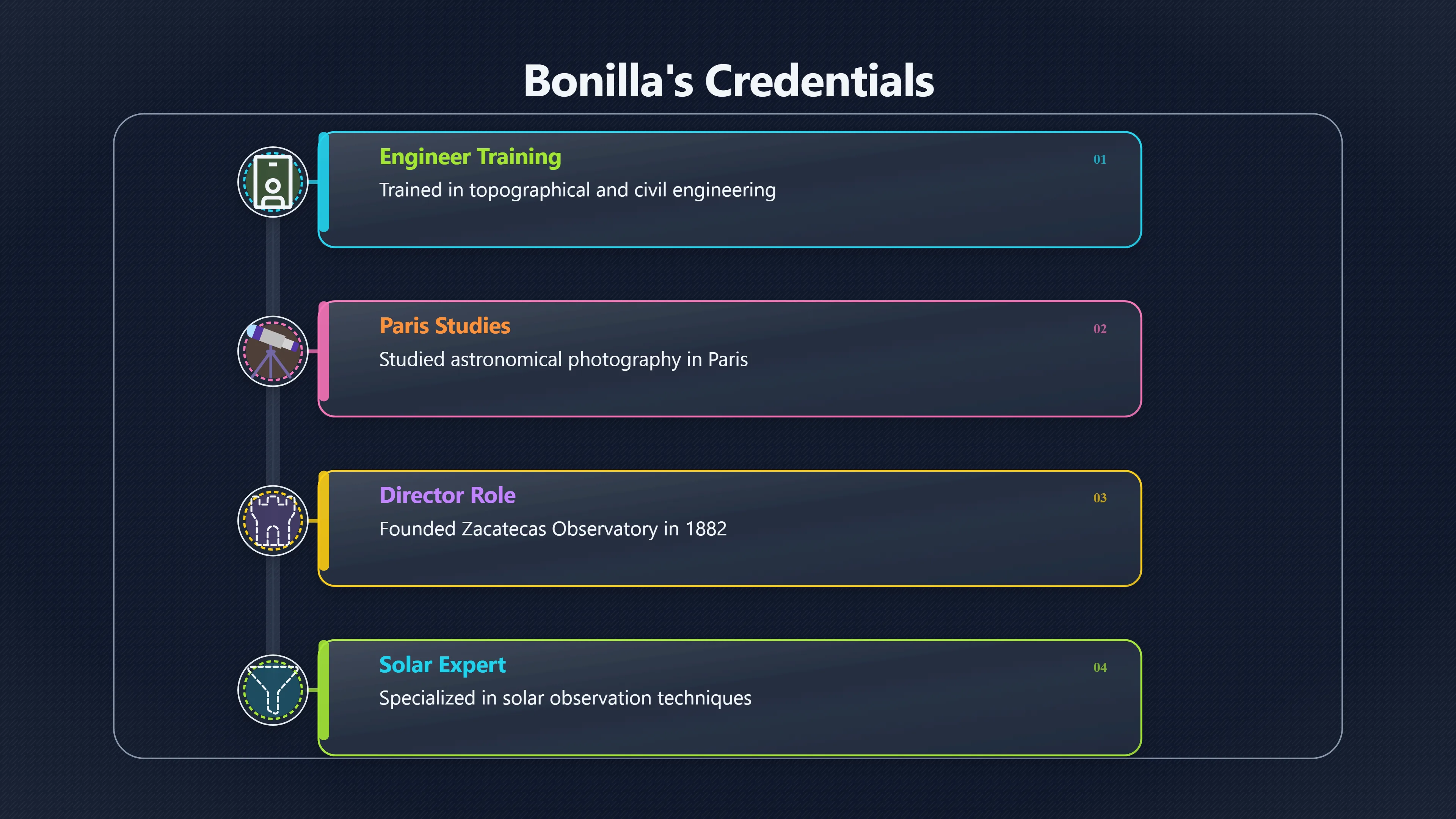
José Árbol y Bonilla was not an obscure hobbyist suddenly thrust into notoriety. By the early 1880s he had already built a substantial technical reputation within Mexican scientific circles. Historical accounts describe him as trained in topographical engineering and civil engineering, with additional studies in astronomical photography in Paris. He became the founding director of the Zacatecas Astronomical Observatory shortly after its opening in 1882, making him one of the leading scientific figures associated with provincial astronomy in nineteenth-century Mexico.[2academia.edu]academia.eduA fragmented Comet that nearly hits the Earth12 Oct 2011 — In 1883, on the 12th and 13th of August, Mexican astronomer Jose A. y Bonilla…
His background matters because the credibility debate often turns on whether he possessed enough observational experience to distinguish astronomical phenomena from nearby terrestrial interference. Bonilla had formal exposure to solar observation techniques, photographic processes and telescope operation at a time when astrophotography remained technically demanding. The wet-plate collodion method he used required preparation skill, timing discipline and familiarity with exposure behaviour. These are not the traits usually associated with a careless observer.[Universe Today]universetoday.comwas the first photographed ufo a cometUniverse TodayWas the "First Photographed UFO" a Comet?14 Oct 2011 — On August 12th, 1883, Mexican astronomer José Bonilla was preparing…
The Zacatecas Observatory itself also lends some institutional weight to the event. The observatory was founded during a period when Mexico was expanding scientific infrastructure beyond Mexico City. Bonilla’s observatory participated in broader astronomical work connected to solar studies and international observational efforts. Researchers revisiting the case have noted that Bonilla’s observatory opened during preparations for observations of the transit of Venus, one of the era’s major astronomical campaigns.[academia.edu]academia.eduA fragmented Comet that nearly hits the Earth12 Oct 2011 — In 1883, on the 12th and 13th of August, Mexican astronomer Jose A. y Bonilla…
None of this proves that Bonilla correctly interpreted what he saw. It does, however, make simplistic portrayals of him as gullible or untrained historically inaccurate.
What Bonilla Actually Reported
One reason the case remains debated is that Bonilla’s own account was comparatively restrained. In the report later published in L’Astronomie in 1886, he described dark objects crossing the Sun’s disc, often surrounded by a mist-like appearance and leaving faint trailing effects. Importantly, he did not claim extraterrestrial craft, intelligent control or any sensational explanation.[Phys.org]phys.orgMexican astronomers suggest Bonilla sighting might have…October 19, 2011 — 19 Oct 2011 — In 1886 in the L'Astronomie magazine, he repo…[2arXiv]arxiv.orgInterpretation of the observations made in 1883…by HJD Manterola · 2011 · Cited by 4 — In 1883, on the 12th and 13th of August, M…
This restraint tends to support his credibility as a witness. Bonilla documented what he observed rather than attaching speculative conclusions to it. Later UFO culture retroactively transformed the photographs into alleged evidence of alien vehicles, but that interpretation emerged decades after the original event. Bonilla himself appears to have treated the phenomenon as an unresolved astronomical puzzle.[Universe Today]universetoday.comwas the first photographed ufo a cometUniverse TodayWas the "First Photographed UFO" a Comet?14 Oct 2011 — On August 12th, 1883, Mexican astronomer José Bonilla was preparing…
His report also included operational details that historians generally regard as characteristic of genuine observation logs:
- specific observation dates and times;
- estimates of the number of objects observed;
- references to changing visibility conditions;
- photographic attempts using wet plates;
- descriptions of object appearance against and outside the solar disc.
These details are consistent with scientific note-taking rather than invented spectacle. At the same time, they do not eliminate the possibility of misidentification.
The Central Credibility Problem: No Independent Confirmation
The strongest argument against treating Bonilla’s observations as evidence of an extraordinary astronomical event is the absence of corroboration from other observatories. If hundreds of large objects crossed the Sun in a way visible from Earth, why did other astronomers not report them?
This issue was recognised almost immediately. Camille Flammarion, the editor of L’Astronomie and one of Europe’s best-known astronomical popularisers, published Bonilla’s account but reportedly leaned towards ordinary explanations such as birds, insects or dust near the telescope.[2academia.edu]academia.eduA fragmented Comet that nearly hits the Earth12 Oct 2011 — In 1883, on the 12th and 13th of August, Mexican astronomer Jose A. y Bonilla…
The lack of independent observations has remained the central weakness of the case ever since. Critics argue that nearby objects crossing the telescope’s field of view are far more plausible than a massive astronomical phenomenon visible only from Zacatecas.
Modern defenders of Bonilla’s reliability respond with a geometrical argument. The 2011 UNAM reanalysis proposed that if fragmented comet material passed extremely close to Earth, the objects might only have transited the Sun from a narrow observational corridor aligned with Zacatecas. Under that interpretation, observatories outside the relevant line of sight would not necessarily have seen the transits at all.[Phys.org]phys.orgMexican astronomers suggest Bonilla sighting might have…October 19, 2011 — 19 Oct 2011 — In 1886 in the L'Astronomie magazine, he repo…[2arXiv]arxiv.orgInterpretation of the observations made in 1883…by HJD Manterola · 2011 · Cited by 4 — In 1883, on the 12th and 13th of August, M…
That explanation keeps the event physically possible, but it depends heavily on assumptions about distance, trajectory and timing derived from Bonilla’s own estimates. In other words, the argument partly relies on trusting the original witness in order to defend the witness.
Did Bonilla Misidentify Birds or Insects?
The credibility debate is not really about whether Bonilla fabricated the photographs. Most historians and commentators accept that he genuinely photographed something crossing the Sun. The key question is whether he correctly interpreted the scale and distance of those objects.
Why the mundane explanation remains persuasive
Several features of the photographs and descriptions fit nearby biological objects surprisingly well:
- irregular outlines;
- varying shapes between exposures;
- blurred edges resembling wings or insect motion;
- inconsistent apparent size;
- short transit durations.
Flammarion’s original suspicion that birds, insects or airborne debris crossed near the telescope therefore remains influential.[Wikipedia]WikipediaBonilla observationBonilla observation
Solar observation is particularly vulnerable to this kind of misinterpretation because the observer focuses on a bright projected disc while small nearby objects can appear as sharply contrasted silhouettes. Insects passing close to a telescope lens can create dramatic apparent transits disproportionate to their actual size.
The fact that Bonilla worked during daylight solar observation also increases the probability of airborne interference. Unlike deep-space astronomy conducted under dark skies, solar work naturally occurs in environments containing birds, insects and atmospheric particles.
Why the mundane explanation is not entirely satisfying
Supporters of Bonilla’s credibility point to several awkward details for the insect-or-bird interpretation.
First, Bonilla reportedly observed hundreds of objects over extended periods on two separate days. Second, he described some objects as surrounded by a luminous or misty envelope. Third, the photographed objects reportedly moved in coherent directions rather than random flight paths.[spacesafetymagazine.com]spacesafetymagazine.comHe saw several distant objects that were close together…Read more…[2arXiv]arxiv.orgInterpretation of the observations made in 1883…by HJD Manterola · 2011 · Cited by 4 — In 1883, on the 12th and 13th of August, M…
None of these points definitively rule out terrestrial explanations, but they complicate simplistic dismissals. Large migrating bird flocks could produce repeated transits, yet the reported appearance does not neatly match ordinary bird silhouettes. Likewise, insects near the lens can create unusual optical effects, but the sheer number of recorded passages encouraged later researchers to consider astronomical alternatives.
This tension explains why the case has persisted for more than a century: the observations are difficult to explain cleanly either as a trivial error or as an extraordinary celestial event.
How Modern Historians Tend to Assess Bonilla
Modern historical treatments usually separate Bonilla’s personal credibility from the later claims built around his photographs.
There is little evidence that Bonilla intentionally fabricated data. The surviving record instead portrays him as a technically educated astronomer attempting to document an unusual phenomenon as carefully as nineteenth-century methods allowed. His willingness to publish uncertainty rather than certainty generally strengthens assessments of his honesty.[Phys.org]phys.orgMexican astronomers suggest Bonilla sighting might have…October 19, 2011 — 19 Oct 2011 — In 1886 in the L'Astronomie magazine, he repo…[2arXiv]arxiv.orgInterpretation of the observations made in 1883…by HJD Manterola · 2011 · Cited by 4 — In 1883, on the 12th and 13th of August, M…
At the same time, historians of astronomy recognise that trained observers can still make sincere interpretive errors. Nineteenth-century astronomy contains many examples of reputable scientists misidentifying atmospheric effects, optical artefacts or transient visual phenomena. The credibility of the observer does not automatically validate the interpretation.
This distinction is essential when evaluating the Bonilla case:
- Bonilla as a witness: generally regarded as credible, technically competent and sincere.
- Bonilla’s interpretation of what he observed: unresolved and open to substantial doubt.
- Later UFO claims attached to the case: largely unsupported by the historical evidence.
That middle position is where most evidence-based discussion now sits.
The Photographs and the Limits of Nineteenth-Century Evidence
The photographs themselves add another layer to the credibility question because they simultaneously support and weaken Bonilla’s case.
On one hand, the images demonstrate that Bonilla did not merely claim to see objects; he attempted to document them instrumentally. For a nineteenth-century astronomer, this was a serious scientific act. The photographs make the case harder to dismiss outright as fantasy or invention.[Universe Today]universetoday.comwas the first photographed ufo a cometUniverse TodayWas the "First Photographed UFO" a Comet?14 Oct 2011 — On August 12th, 1883, Mexican astronomer José Bonilla was preparing…
On the other hand, the surviving images are technologically limited. Wet-plate solar photography in the 1880s lacked the precision needed to determine distance, composition or motion reliably from silhouette shapes alone. The reproductions published in L’Astronomie are coarse and ambiguous by modern standards.
Because the original negatives are not available for modern forensic examination, researchers cannot perform the kinds of image analysis that would now be standard in astronomical investigations. That missing chain of evidence permanently limits certainty.
The photographs therefore function more as corroboration that Bonilla observed repeated transits than as proof of what those transits physically were.
Why the Witness Debate Still Matters
The Bonilla case survives in modern discussion not because the evidence clearly proves anything extraordinary, but because it sits at an unusual intersection of competent observation and unresolved interpretation.
If Bonilla had been an untrained observer, the case would probably have faded into obscurity long ago. If multiple observatories had independently confirmed the phenomenon, it might now be considered a major astronomical event. Instead, historians are left with a scientifically trained witness, authentic nineteenth-century photographs and a phenomenon that remains difficult to classify with certainty.
That combination explains why the case continues to appear in discussions of early astronomical anomalies and historical UFO folklore. Bonilla’s credibility as an observer is strong enough to prevent easy dismissal, yet the evidential gaps are large enough to prevent firm conclusions.[Universe Today]universetoday.comwas the first photographed ufo a cometUniverse TodayWas the "First Photographed UFO" a Comet?14 Oct 2011 — On August 12th, 1883, Mexican astronomer José Bonilla was preparing…
Amazon book picks
Further Reading
Books and field guides related to How Credible Was José A. Bonilla as a Witness?. Use these as the next step if you want deeper reading beyond the article.
The UFO Book
Summarizes the case history and evaluates Bonilla's professional standing vs. the objective limitations of his solitary observation.
The Skeptics' Guide to the Universe
Explains why individual expertise does not protect a witness from misinterpreting unique observational conditions.
Scientific Paranormal Investigation
Teaches how to assess witness credentials objectively when faced with anecdotal or ambiguous data.
Sister States, Enemy States
Discusses the sociological tendency to over-rely on professional titles when verifying sighting claims.
eBay marketplace picks
Marketplace Samples
Example marketplace items related to this page. Use the search link to explore similar finds on eBay.
Endnotes
1.
Source: Wikipedia
Title: Bonilla observation
Link:https://en.wikipedia.org/wiki/Bonilla_observation
2.
Source: arxiv.org
Link:https://arxiv.org/abs/1110.2798
Source snippet
Interpretation of the observations made in 1883...by HJD Manterola · 2011 · Cited by 4 — In 1883, on the 12th and 13th of August, M...
3.
Source: Wikipedia
Title: José Bonilla (astronomer)
Link:https://en.wikipedia.org/wiki/Jos%C3%A9Bonilla%28astronomer%29
4.
Source: academia.edu
Link:https://www.academia.edu/59150350/Interpretation_of_the_observations_made_in_1883_in_Zacatecas_Mexico_A_fragmented_Comet_that_nearly_hits_the_Earth
Source snippet
A fragmented Comet that nearly hits the Earth12 Oct 2011 — In 1883, on the 12th and 13th of August, Mexican astronomer Jose A. y Bonilla...
5.
Source: Wikipedia
Title: Observación de Bonilla
Link:https://es.wikipedia.org/wiki/Observaci%C3%B3n_de_Bonilla
6.
Source: phys.org
Link:https://phys.org/news/2011-10-mexican-astronomers-bonilla-sighting-comet.html
Source snippet
Mexican astronomers suggest Bonilla sighting might have...October 19, 2011 — 19 Oct 2011 — In 1886 in the L'Astronomie magazine, he repo...
Published: October 19, 2011
7.
Source: spacesafetymagazine.com
Link:https://www.spacesafetymagazine.com/space-hazards/asteroid-hitting-earth/reanalysis-observations-recorded-1883-zacatecas-mexico-suggest-fragments-billion-ton-comet-close-earth/
Source snippet
He saw several distant objects that were close together...Read more...
8.
Source: universetoday.com
Title: was the first photographed ufo a comet
Link:https://www.universetoday.com/articles/was-the-first-photographed-ufo-a-comet
Source snippet
Universe TodayWas the "First Photographed UFO" a Comet?14 Oct 2011 — On August 12th, 1883, Mexican astronomer José Bonilla was preparing...
Additional References
9.
Source: medium.com
Link:https://medium.com/%40ignacio.emerio/the-bonilla-observation-a-puzzling-event-in-the-history-of-astronomy-e0d0b1655bb0
Source snippet
The Bonilla Observation: A Puzzling Event in the History of...In August 1883, a curious celestial event was recorded by Mexican astronom...
Published: August 1883
10.
Source: facebook.com
Title: this image of an 1883 observation by mexican astronomer josé bonilla was initial
Link:https://www.facebook.com/stsci/posts/this-image-of-an-1883-observation-by-mexican-astronomer-jos%C3%A9-bonilla-was-initial/691465613015725/
Source snippet
This image of an 1883 observation by Mexican astronomer...This image of an 1883 observation by Mexican astronomer José Bonilla was initi...
11.
Source: facebook.com
Title: in 1883 mexican astronomer josé bonilla was observing the sun from the observato
Link:https://www.facebook.com/thewittyhistorian/posts/in-1883-mexican-astronomer-jos%C3%A9-bonilla-was-observing-the-sun-from-the-observato/778198478587975/
Source snippet
In 1883, Mexican astronomer José Bonilla was observing...On August 12, 1883, the astronomer José Bonilla reported that he saw more than...
Published: August 12, 1883
12.
Source: researchgate.net
Link:https://www.researchgate.net/publication/51945342_Interpretation_of_the_observations_made_in_1883_in_Zacatecas_Mexico_Afragmented_Comet_that_nearly_hits_the_Earth
Source snippet
y Bonilla observed several objects passing in front of the solar disk. In 1886 in the...Read more...
13.
Source: reddit.com
Title: til in 1883 astronomer josé bonilla reported that
Link:https://www.reddit.com/r/todayilearned/comments/c8twye/til_in_1883_astronomer_jos%C3%A9_bonilla_reported_that/
Source snippet
TIL in 1883, astronomer José Bonilla reported that he saw...TIL in 1883, astronomer José Bonilla reported that he saw more than 300 dark...
14.
Source: reddit.com
Link:https://www.reddit.com/r/science/comments/lf37y/billion_tonne_comet_may_have_missed_earth_by_a/
Source snippet
Tonne Comet May Have Missed Earth By A Few Hundred Kilometres in 1883 - A re-analysis of historical observations suggest E...
15.
Source: youtube.com
Title: 5 Times The World Almost Ended!
Link:https://www.youtube.com/watch?v=IF3ZuFSrZT4
Source snippet
Top 10 Mysterious UFO Sightings - Fact or Fiction | Educational Videos by Mocomi Kids...
16.
Source: youtube.com
Title: UFO Photos | Tales from the Dark Side
Link:https://www.youtube.com/watch?v=-l7hkt5AMu0
Source snippet
Top 10 Times the World should have ENDED!! List of crazy world events...
17.
Source: youtube.com
Title: Top 10 Times the World should have ENDED!! List of crazy world events!
Link:https://www.youtube.com/watch?v=k6JP-ghEn88
Source snippet
5 Times The World Almost Ended...
18.
Source: youtube.com
Title: OVNIs y astronomía: casos reales que cambiarán tu visión del cielo
Link:https://www.youtube.com/watch?v=ZqNcVNL3n2A
Source snippet
UFO Photos | Tales from the Dark Side...
Topic Tree