What Really Happened Over Kaikoura?
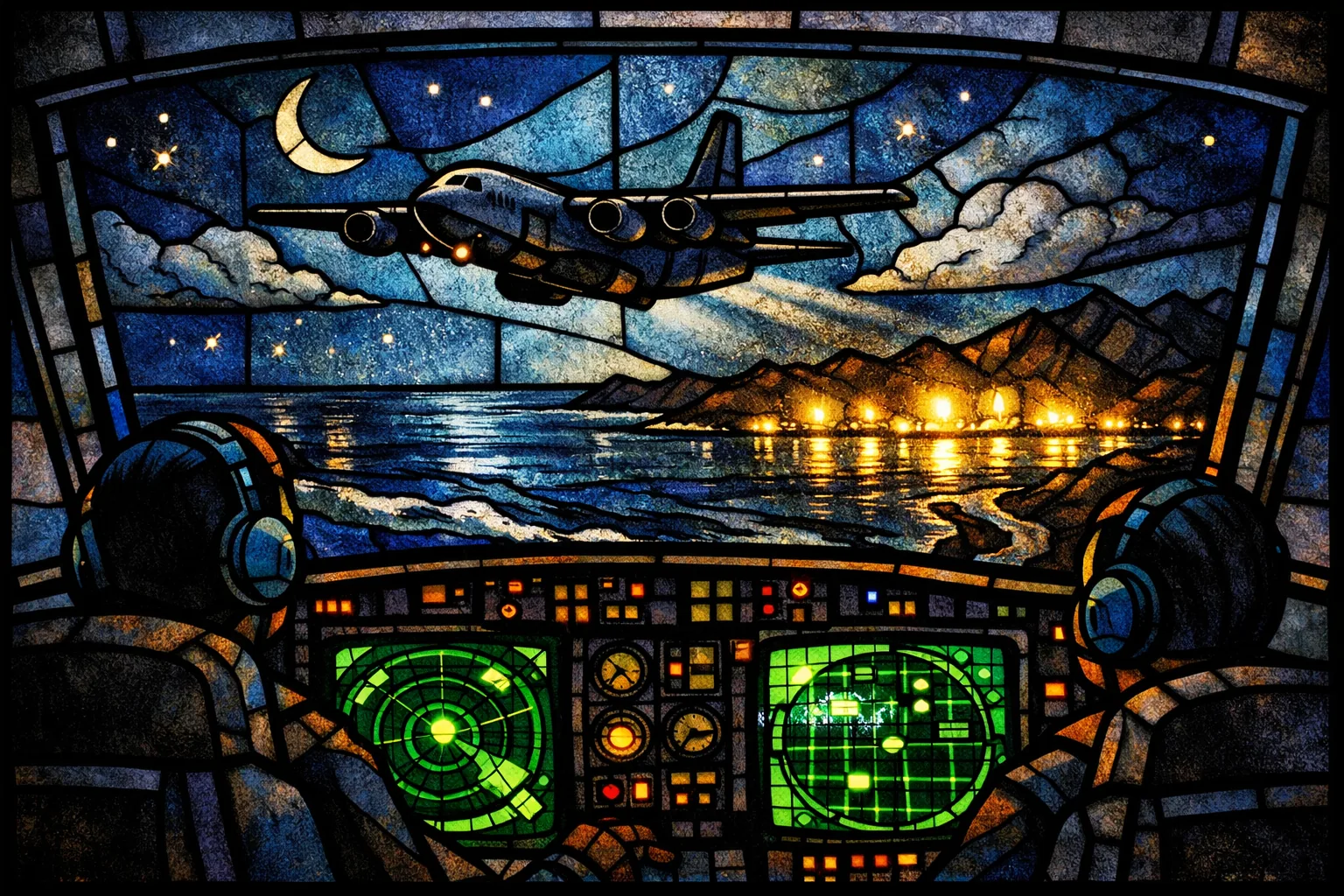
The Wellington/Kaikoura incident of 1978 — more commonly remembered as the Kaikōura lights — remains one of New Zealand’s best-known UFO cases because it joined together several unusually strong ingredients: experienced aircrew, air-traffic-control radar reports, aircraft radar indications, tape-recorded cockpit commentary, official investigation files,...
Page outline Jump by section
Introduction
The case is not “proved alien contact”. It is better understood as a difficult radar-visual incident in which several observations were probably mixed together: bright celestial objects, unusual atmospheric refraction, ship and squid-fleet lights, possible radar anomalies, and some still-contested witness impressions. The official New Zealand Air Force conclusion favoured natural but unusual atmospheric and observational causes, while UFO investigators such as Bruce Maccabee argued that at least parts of the event resisted conventional explanation. [Internet Archive]archive.orgInternet Archive Full text of "Declassified New Zealand UFO documentsInternet Archive Full text of "Declassified New Zealand UFO documents
Why this case still stands out
Many UFO reports rest on a single witness memory. The Wellington/Kaikoura case is different because it unfolded during commercial flights and was documented in several overlapping ways. The declassified New Zealand Defence Force files identify the people aboard the 30–31 December flight: Captain William Startup, First Officer Robert Guard, cameraman David Crockett, sound recordist Ngaire Crockett, and reporter Quentin Fogarty, with air traffic control involvement from Geoffrey Causer and radar technician Bryan Chalmers. [Internet Archive]archive.orgInternet Archive Full text of "Declassified New Zealand UFO documentsInternet Archive Full text of "Declassified New Zealand UFO documents
That combination matters. A pilot seeing a light can be mistaken; radar can produce spurious returns; film can distort point sources; a journalist’s narration can dramatise uncertainty. But when visual reports, radio exchanges, radar comments, and film all occur during the same flight, the case becomes more useful as a study in how evidence overlaps — and how it can still fail to settle the central question.
The case also became internationally visible because the film crew was not merely reporting after the fact. They were in the aircraft to cover earlier sightings and then filmed lights during the flight. DigitalNZ’s public collection summary records that a television news crew boarded a plane on 30 December 1978 after earlier reports, and captured lights in the early hours of 31 December. [DigitalNZ]digitalnz.orgDigital NZUFOs over NZ by Zokoroa - DigitalNZ…
The chronology that matters
The first important cluster occurred on 21 December 1978, when Safe Air pilots flying between Blenheim and Christchurch reported strange lights near the Kaikoura area. Later accounts and public summaries describe those earlier reports as the reason the television crew arranged to join another Safe Air flight at the end of the month. [Wikipedia]WikipediaKaikōura lightsKaikōura lights
The most famous flight began late on 30 December 1978. According to the event listing in the declassified file, the aircraft took off around 11:54 pm and headed south. By about 12:10 am on 31 December, the plane had passed Cape Campbell; the television crew were in the loading bay preparing a report about the previous UFO sightings when the pilots first saw lights in the direction of Kaikoura. The aircraft was above 10,000 feet and travelling at roughly 170 knots. [Internet Archive]archive.orgInternet Archive Full text of "Declassified New Zealand UFO documentsInternet Archive Full text of "Declassified New Zealand UFO documents
At about 12:12 am, the aircraft contacted Wellington radar and asked whether there were targets in the direction of the Kaikoura peninsula. Wellington replied that targets had been appearing and disappearing at about the aircraft’s one o’clock position and around 13 miles away. The file also says the controller had noticed unusual targets east of the Clarence River and Kaikoura Coast for as long as half an hour before the aircraft reported anything. [Internet Archive]archive.orgInternet Archive Full text of "Declassified New Zealand UFO documentsInternet Archive Full text of "Declassified New Zealand UFO documents
The event sequence then becomes messier. Wellington radar reported intermittent targets ahead, to the side, and behind the aircraft. Some had no visual confirmation; others coincided loosely with lights seen by the crew. At about 12:22 am, Fogarty recorded that those aboard had seen “probably 6 or 7 or even more bright lights over Kaikoura”, and that some had been picked up by Wellington radar. At about 12:24 am, Wellington reported a target at 12 o’clock and 3 miles; the aircraft replied that it had picked it up and that it had a flashing light. Crockett obtained short film sequences showing bright oval blue-white images and several lights in a row flashing on and off. [Internet Archive]archive.orgInternet Archive Full text of "Declassified New Zealand UFO documentsInternet Archive Full text of "Declassified New Zealand UFO documents
What the witnesses add — and what they cannot prove
The strongest witness value in the case comes from the experience of the aircrew and the immediacy of the records. Startup and Guard were not casual observers on the ground; they were operating an aircraft at night and communicating with air traffic control. The television crew were present by chance in the sense that they did not know the specific events would occur, but they were there because earlier sightings had already made the route newsworthy. [Internet Archive]archive.orgInternet Archive Full text of "Declassified New Zealand UFO documentsInternet Archive Full text of "Declassified New Zealand UFO documents
That makes the case more credible than a simple “light in the sky” anecdote. Yet credibility is not the same as identification. Pilots can accurately report what a light appeared to do relative to the aircraft while still misjudging distance, size, altitude, or whether a radar return was physically connected to the light. The official file repeatedly distinguishes between visual impressions and confirmed coincidence of radar and visual range. In one later episode, for example, the crew saw a bright orb-like light on roughly the same bearing as an aircraft radar return, but the report notes that the crew could not confirm that the range of the light and the radar return were the same. [Internet Archive]archive.orgInternet Archive Full text of "Declassified New Zealand UFO documentsInternet Archive Full text of "Declassified New Zealand UFO documents
This is the central evidential tension: the witnesses were serious and the records are unusually rich, but much of the apparent corroboration depends on whether separate observations — a light, a radar blip, a bearing, a film image — were actually the same object.
The film: powerful evidence with serious optical problems
The 16 mm footage is the case’s most famous artefact. It gave the incident a public life that radar transcripts alone never would have had. The film showed luminous forms, and later analysis treated it as potentially measurable evidence rather than mere spectacle.
Bruce Maccabee, an optical physicist, analysed the film and published a short paper in Applied Optics in 1979 on the photometric properties of a bright object seen off the New Zealand coast. The PubMed record identifies the article as “Photometric properties of an unidentified bright object seen off the coast of New Zealand”, published in Applied Optics on 1 August 1979. [PubMed]pubmed.ncbi.nlm.nih.govSource details in endnotes.
Maccabee’s analysis, reproduced in the declassified file, estimated high brightness and a characteristic source size that, depending on distance assumptions, could be on the order of tens of metres. He argued that the brightness, size, and duration imposed severe requirements on conventional explanations such as plasma or ball lightning, and that an intensive non-government investigation had ruled out explanations including Venus, meteors, squid boats, ground lights, atmospheric effects, aircraft, balloons, birds, insects, and hoax. [Internet Archive]archive.orgInternet Archive Full text of "Declassified New Zealand UFO documentsInternet Archive Full text of "Declassified New Zealand UFO documents
Government-linked technical analysis pushed in a different direction. A DSIR-linked image analysis in the files concluded that the brightness of selected TV1 film frames was consistent with Venus, that the images were severely out of focus, and that deblurring produced images of a size consistent with Venus. The same section noted that the original film image was strongly out of focus, a crucial point because an out-of-focus bright point can appear as a large luminous disc. [Internet Archive]archive.orgInternet Archive Full text of "Declassified New Zealand UFO documentsInternet Archive Full text of "Declassified New Zealand UFO documents
The film therefore cuts both ways. It prevents the case from being dismissed as a memory-only story, but it also introduces camera artefacts, focus problems, reflections, window effects, and focal-length assumptions. The stronger the claim made from the film — for example, estimating the object’s size — the more it depends on contested assumptions about distance, focus, and whether the camera was recording an aerial object at all.
Radar: the most persuasive and most troublesome part
Radar is often treated as the decisive feature of the Kaikoura case, but the declassified file shows a more complicated picture. Wellington radar reported intermittent targets near the aircraft’s track, including targets at 13 miles, 10 miles, 3 miles, and other positions. Some appeared for only one sweep of the scope, and some had no visual confirmation. [Internet Archive]archive.orgInternet Archive Full text of "Declassified New Zealand UFO documentsInternet Archive Full text of "Declassified New Zealand UFO documents
That detail matters because a single-sweep radar return is weaker evidence than a sustained track. Radar can detect real objects, but it can also produce anomalous returns under certain atmospheric conditions, especially when temperature inversions or ducting bend radar energy in unusual ways. The Air Force report explicitly placed the sightings in a period when atmospheric conditions over New Zealand were considered conducive to unusual effects on radar and light waves. [Internet Archive]archive.orgInternet Archive Full text of "Declassified New Zealand UFO documentsInternet Archive Full text of "Declassified New Zealand UFO documents
The official report also treated several specific radar events as likely spurious. In one section, it says the crew saw four to five lights near the coast and Wellington radar reported contacts 13 miles ahead, but the report judged the lights difficult to explain and considered the radar returns most probably spurious. In another event, Wellington radar reported a large target behind the aircraft that appeared to track the Argosy, but the crew saw nothing when they turned to look. [Internet Archive]archive.orgInternet Archive Full text of "Declassified New Zealand UFO documentsInternet Archive Full text of "Declassified New Zealand UFO documents
The strongest pro-UFO reading is that radar and witnesses repeatedly pointed to the same sky sector during a short period. The strongest sceptical reading is that the apparent matches are loose: bearings lined up at times, but ranges and identities often did not, and several radar returns lacked visual confirmation.
Official explanations: Venus, refraction, ships, and squid-fleet lights
The New Zealand Air Force’s public conclusion was that the reported radar and visual sightings were the result of natural but unusual atmospheric phenomena. The investigation drew on the Department of Scientific and Industrial Research, the Civil Aviation Division of the Ministry of Transport, and the Meteorological Service. It specifically cited atmospheric conditions, the brightness of Venus, and the presence of light-producing vessels as relevant factors. [Internet Archive]archive.orgInternet Archive Full text of "Declassified New Zealand UFO documentsInternet Archive Full text of "Declassified New Zealand UFO documents
Venus played a major role in the official account. The report argued that one crew observation was highly probably an unusual view of Venus, made to appear large, bright, and orange by atmospheric conditions. It acknowledged a timing difficulty — the observation occurred before the ordinary rise time of Venus — but said DSIR scientists advised that super-refraction could make the planet visible before its actual rising. [Internet Archive]archive.orgInternet Archive Full text of "Declassified New Zealand UFO documentsInternet Archive Full text of "Declassified New Zealand UFO documents
The squid-fleet explanation addressed both light and radar possibilities. The report noted that around 50 Japanese squid boats had sailed from Wellington to an area east of Banks Peninsula during 19–28 December 1978, and that their track was close to a radar track plotted by Wellington radar. It did not claim conclusive proof that these vessels caused every radar trace, but it argued there was no shortage of shipping in the area and that the squid fleet’s intense lights, combined with meteorological conditions, could have produced reflected or refracted images. Each boat was described as putting out about 200 kilowatts of light. [Internet Archive]archive.orgInternet Archive Full text of "Declassified New Zealand UFO documentsInternet Archive Full text of "Declassified New Zealand UFO documents
This official explanation is plausible in broad terms, especially for bright lights near the horizon or sea surface. Its weakness is that it can become a basket explanation: Venus for some moments, squid boats for others, cars or trains for others, and anomalous radar for the rest. That may be realistic in a complex night-time incident, but it also leaves room for critics to say the explanation is assembled after the fact rather than tied cleanly to every observation.
The sceptical case after the official report
Later sceptical analysis sharpened the squid-boat argument. Former DSIR scientist William Ireland published a retrospective discussion in New Zealand Skeptic in 2000, arguing that an old mystery looked less mysterious and that many frames resembled squid-boat lights. The available journal result summarises the thrust of the argument: images similar to squid boat lights appear in frames that are in reasonable focus. [NZ Skeptics]skeptics.nzSource details in endnotes.
The sceptical case is strongest when it focuses on ordinary sources that can look extraordinary under poor distance cues: distant fishing vessels with powerful lamps, reflections from sea or cloud, atmospheric bending of light, out-of-focus camera images, and radar returns from ships or atmospheric effects. These mechanisms do not require witnesses to lie or be foolish. They require only that night-time perception, radar interpretation, and camera optics interacted badly.
But scepticism also has to avoid overclaiming. The official files themselves sometimes use cautious language: “might have been”, “could have been”, “most probable”, “no conclusive proof”. The better sceptical conclusion is not that every detail has been nailed down beyond doubt, but that enough ordinary mechanisms exist to make an extraordinary explanation unnecessary.
The pro-UFO case and its limits
The pro-UFO argument rests on four main points. First, the witnesses included pilots and a television crew rather than a single anonymous observer. Second, radar operators reported unusual targets before and during parts of the visual sightings. Third, film exists. Fourth, some reported behaviour — lights seeming to appear, disappear, track, or move in unusual ways — sounded unlike ordinary aircraft or celestial objects. [Internet Archive]archive.orgInternet Archive Full text of "Declassified New Zealand UFO documentsInternet Archive Full text of "Declassified New Zealand UFO documents
Maccabee’s analysis remains the most developed technical pro-UFO argument. It tried to extract physical properties from the film and concluded that a conventional source would face demanding brightness, size, and duration requirements. [Internet Archive]archive.orgInternet Archive Full text of "Declassified New Zealand UFO documentsInternet Archive Full text of "Declassified New Zealand UFO documents
The limits are equally important. Physical estimates from film depend heavily on range assumptions. Radar bearing does not automatically prove that the visual light and radar target were the same object. A light that seems close may be far away. A bright planet near the horizon can appear distorted. A fishing fleet can be more conspicuous than a casual observer expects. And a radar return that appears to “track” an aircraft may still be anomalous or unrelated.
The pro-UFO case therefore establishes that the incident deserved investigation; it does not establish an extraterrestrial craft. The best unresolved question is narrower: whether every major observation from the 30–31 December flight can be cleanly assigned to known sources, or whether a residual unknown remains after the likely misidentifications are removed.
How the declassified files changed the public picture
The release of New Zealand’s UFO files in 2010 gave the case renewed attention. ABC News reported that the New Zealand military released hundreds of previously classified reports dating from 1954 to 2009, including one of the most comprehensive files on two sightings of strange lights off Kaikoura in 1978, one filmed by a television crew aboard a plane. The Defence Force said it had acted largely as a collection point and had not substantiated the reports. [ABC News]abc.net.auABC News NZ military releases UFO filesABC News NZ military releases UFO files
That point is often missed. The existence of a military file is not the same as military confirmation of an extraordinary object. Governments collect reports for air-safety, public-interest, and intelligence reasons, even when they do not endorse the content. In this case, the files are valuable because they preserve interviews, technical analysis, radar discussion, and official uncertainty — not because they secretly prove the UFO claim.
The 2010 release also showed how the case sits between two public habits: believers often emphasise “radar, pilots, and film”, while debunkers often emphasise “Venus and squid boats”. The files support parts of both framings. They show genuine official concern and detailed investigation, but they also show repeated attempts to match observations to ordinary sources.
What is most likely today?
A fair reading is that the Wellington/Kaikoura incident was probably not one single event. It was a cluster of sightings and instrument readings occurring during a period of heightened attention, with several possible sources being interpreted together.
The most likely explanation is mixed:
- Some visual lights were probably Venus or other astronomical sources distorted by atmospheric refraction, especially where the official file notes matching bearings and unusual brightness.
- Some lights near the coast or sea horizon may have been ships, fishing fleets, squid-boat lamps, cars, or trains, sometimes reflected or refracted by weather conditions.
- Some radar returns were probably anomalous, transient, or unrelated to the lights being watched.
- Some film images were likely affected by focus, lens, window, and exposure issues, making ordinary lights appear larger or stranger than they were.
- Some witness impressions remain difficult to reconstruct because distance, altitude, and range were not independently pinned down.
That conclusion is less dramatic than “alien spacecraft” and less tidy than “fully solved”. It fits the documents better. The case’s importance lies in showing how a UFO incident can be genuinely interesting, sincerely reported, and richly documented while still falling short of extraordinary proof.
Why the case still matters in UFO history
The Kaikoura case remains useful because it is a high-quality cautionary example. It warns sceptics not to dismiss every witness account as fantasy: trained pilots, radar controllers, and camera operators really did record and report unusual events. It also warns enthusiasts not to treat overlapping evidence as automatic confirmation: radar, film, and testimony can all be real records while still being ambiguous.
For a wider UFO dossier, the case belongs beside other radar-visual incidents where the key question is not whether witnesses saw something, but whether the available evidence fixes what they saw. In the Wellington/Kaikoura incident, the answer remains partly unresolved, but the balance of evidence favours a complex mix of conventional sources, optical effects, and radar anomalies over a single extraordinary craft.
Amazon book picks
Further Reading
No matched book cards were available for What Really Happened Over Kaikoura?, so this fallback keeps a direct Amazon reading path visible.
Topical books
UFO investigation books
Browse books, explainers and reference titles related to this topic.
Search AmazonRelated search
scientific UFO research books
Browse books, explainers and reference titles related to this topic.
Search AmazonRelated search
UAP investigation books
Browse books, explainers and reference titles related to this topic.
Search AmazoneBay marketplace picks
Marketplace Samples
Example marketplace items related to this page. Use the search link to explore similar finds on eBay.






Endnotes
-
Source: archive.org
Title: Internet Archive Full text of “Declassified New Zealand UFO documents”
Link: https://archive.org/stream/NewZealandUFO/AIR-1080-6-897-Volume-1-1978-1981_djvu.txt -
Source: digitalnz.org
Title: Digital NZ
Link: https://digitalnz.org/stories/5b03db151257577580bb9571Source snippet
UFOs over NZ by Zokoroa - DigitalNZ...
-
Source: Wikipedia
Title: Kaikōura lights
Link: https://en.wikipedia.org/wiki/Kaik%C5%8Dura_lights -
Source: skeptics.nz
Link: https://skeptics.nz/wp-content/uploads/NZSkeptic-57.pdf -
Source: archive.org
Link: https://archive.org/stream/NewZealandUFO/AIR-1630-2-Volume-2-1990-2009_djvu.txt -
Source: Wikipedia
Title: List of reported UFO sightings
Link: https://en.wikipedia.org/wiki/List_of_reported_UFO_sightings -
Source: abc.net.au
Title: ABC News NZ military releases UFO files
Link: https://www.abc.net.au/news/2010-12-23/nz-military-releases-ufo-files/2383152 -
Source: pubmed.ncbi.nlm.nih.gov
Link: https://pubmed.ncbi.nlm.nih.gov/20212696/
Additional References
-
Source: academia.edu
Link: https://www.academia.edu/71337593/UFOs_and_the_extraterrestrial_contact_movement_a_bibliography -
Source: facebook.com
Link: https://www.facebook.com/NetflixFansDiaries/posts/a-giant-ufo-seen-by-400-students-and-teachers-in-new-zealand/496547632517013/ -
Source: facebook.com
Link: https://www.facebook.com/PFNewZealand/posts/a-mysterious-blinking-light-passing-over-kaitorete-spit-doesnt-belong-to-a-ufo-b/1362922292534464/ -
Source: facebook.com
Link: https://www.facebook.com/AirForceMuseumofNewZealand/posts/while-were-on-the-subject-of-ufosaccording-to-information-that-our-research-offi/10153802736066279/ -
Source: facebook.com
Link: https://www.facebook.com/rnznewzealand/posts/declassified-government-documents-show-officials-were-struggling-to-debunk-tv1-f/10158728324658731/ -
Source: facebook.com
Link: https://www.facebook.com/RoswellUFOmuseum/posts/ever-heard-of-the-kaikoura-lights-the-new-zealand-ufo-sightings-of-december-31-1/2736766463029377/ -
Source: researchgate.net
Link: https://www.researchgate.net/publication/377871814_Exploring_Unidentified_Aerospace_Phenomena_through_Instrumented_Field_Studies_Historical_Insights_Current_Challenges_and_Future_Directions -
Source: enigmalabs.io
Link: https://enigmalabs.io/library/f53c2a78-5a8c-4bc2-8362-ed289a89e2a0 -
Source: wsj.com
Link: https://www.wsj.com/video/new-zealand-releases-ufo-files/83A11581-5F93-4AD2-A2DD-E4F3E9D2E563 -
Source: sbs.com.au
Link: https://www.sbs.com.au/news/article/new-zealand-military-releases-ufo-files/hknryeche
Topic Tree
Follow this branch
Related pages 106
- Godfrey Encounter
- Hamilton Airship
- Andreasson
- Villas Boas
- Apollo 11 Sightings
- +101 more in sidebar